Synopsis: The "Necktie Murderer" is on the loose in
London. The recently unemployed Richard Blaney becomes the prime suspect when his
ex-wife turns up as one of the victims. Barbara, his current girlfriend, is convinced
of his innocence and helps him hide from the police. In the meantime, Chief Inspector
Oxford of the Scotland Yard must piece together the case from a paucity of clues
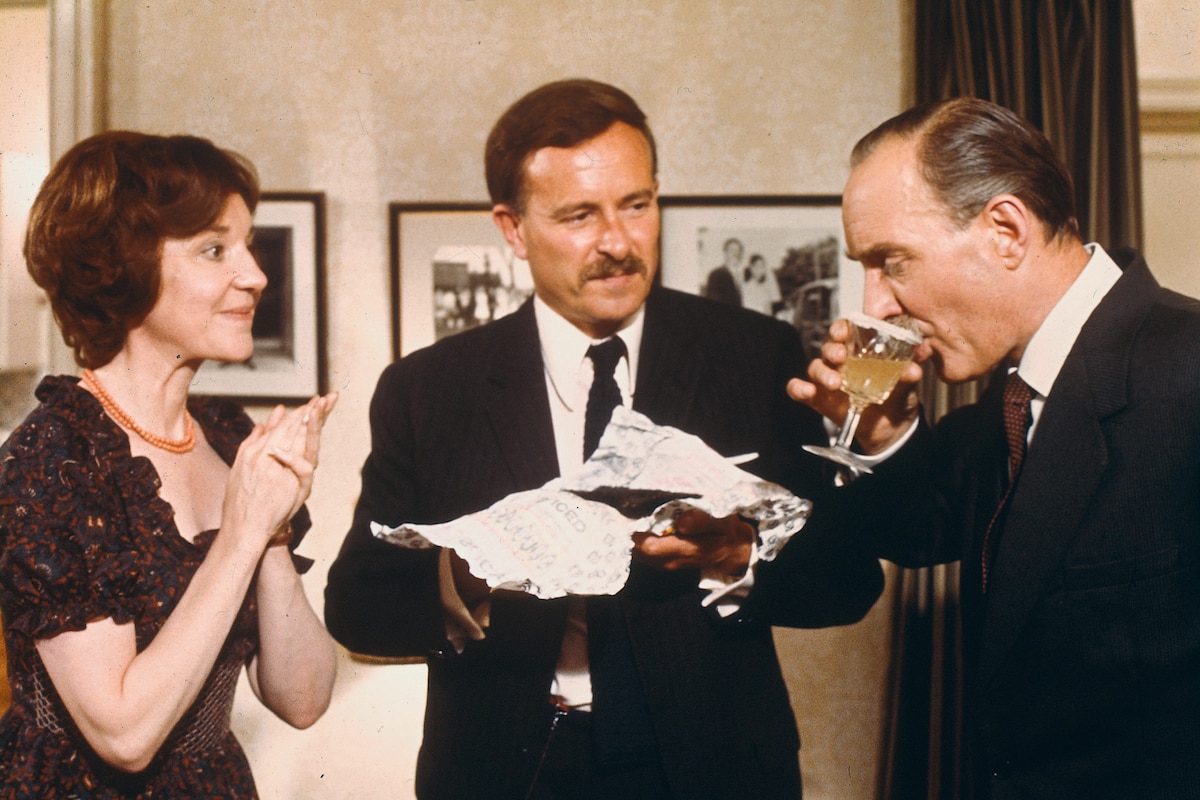
and endure his wife's inedible "gourmet" meals at home. When Richard by
chance learns the true identity of the killer, he must fight to clear his name.
After the mixed-to-poor critical and box office response to Marnie
(1964), Torn Curtain (1966) and Topaz (1969),
Frenzy (1972) was widely regarded as a return to form for Alfred
Hitchcock. The lower budget, particularly compared to Topaz,
allowed Hitchcock relative freedom from studio interference. Another undoubted factor
contributing to the success of this film was the recently established MPAA ratings
system, which enabled the director to push the boundaries of sex and violence much
further than in older thrillers such as Psycho (1960). Beyond
the inherent box-office appeal of exploitation content, this new freedom enabled
Hitchcock to revitalize otherwise familiar thematic territory. The most explicit
and insidiously effective scene in this regard is the rape and murder of Brenda,
Richard's ex-wife. Equally memorable, however, is the scene in which the killer
invites an unsuspecting woman into his apartment while the camera retreats down
the stairs and out into the street, and the subsequent episode in which the killer
must rummage through sacks full of potatoes to retrieve a personal item held in
the rigid grip of the corpse.
Frenzy opens with an aerial shot of the Thames River and the
Tower Bridge, its touristic, picture-postcard look emphasized by the seal of the
City of London superimposed on the right side of the screen. Such tourism, however,
is far from innocent; a crowd of bystanders is soon attracted to a woman's nude
corpse washed up on the riverbank. Later in the film, one character even states:
"Well, we haven't had a good, juicy series of sex murders since Christie [i.e.,
John Christie] and they're so good for the tourist trade." Clearly, Hitchcock
is suggesting a parallel between the public's fascination with the lurid details
of a crime and the basic voyeurism of film spectatorship, a recurring theme in his
work articulated most clearly in Rear Window (1954). This time
the director adds a further element of grisly humor by comparing the twisted appetites
of the killer with food and eating: in addition to the aforementioned scene with
the corpse hidden amongst potatoes, we see the killer work in a produce market and,
after a killing, he picks his teeth as if finishing a satisfying meal.
The lead role of Richard Blaney, as performed by Jon Finch (b. 1941), is unusual
to the extent which the character is made deliberately unsympathetic, especially
compared to the unctuous killer. Finch's first film roles were the Hammer horror
vehicles The Vampire Lovers (1970) and The Horror of
Frankenstein (1970). Roman Polanski subsequently chose him for the lead
role of his controversial adaptation of Macbeth (1971). Polanski's
film and Frenzy proved to be the two most significant film roles
of his career. During the late Seventies and early Eighties he appeared in a few
BBC Shakespeare productions; his most recent film appearance was in Ridley Scott's
epic on the Crusades, Kingdom of Heaven (2005). According to
Hitchcock biographer Patrick McGilligan, Finch angered the director during the production
of Frenzy by publicly criticizing the anachronistic dialogue
and nearly got himself fired from the film. However, Hitchcock's London in this
film is not the swinging, pot-smoking city of Blow-Up (1966);
it is in a certain sense a London of the imagination, as the postcard-type image
opening the film indicates. One example of this is a 1971 interview in the Evening
Standard, in which the director complained that most contemporary pubs
were too "psychedelic," whereas he was seeking a traditional-looking pub
with dark wooden interiors.
Michael Caine was originally considered for the juicy role of Bob Rusk, and one
can easily imagine how his affable screen persona might have fit within Hitchcock's
vision. Barry Foster (1931-2002) nonetheless makes his own mark as the outwardly
friendly psychopath. An established stage actor--like much of the film's cast--he
appeared in
many films throughout the 1960s, but it was likely his performance in the little-seen
British thriller Twisted Nerve (1968) that attracted Hitchcock's
attention. In later years, he appeared in the Merchant-Ivory films Heat
and Dust (1983) and Maurice (1987).
Anna Massey (b. 1937) is probably best known today for her role in Michael Powell's
Peeping Tom (1960). She also appeared in Otto Preminger's brilliant, underrated
drama Bunny Lake Is Missing (1965) and a variety of "heritage" films and
TV miniseries, among them two A. S. Byatt adaptations: Angels and Insects (1995) and Possession (2002). Massey's most recent feature film is the disturbing psychological thriller The Machinist (2004) starring Christian Bale.
Vivien Merchant (1929-1982), who gleefully steals scenes as Mrs. Oxford, did not
appear in many films, but they included such noteworthy productions as Alfie
(1966) and Accident (1967). For many years she was married to
the great playwright Harold Pinter and appeared in his plays. She won the Tony for
Best Actress for her work in The Homecoming (1967) and reprised
the role in Peter Hall's 1973 film version.
The screenwriter Anthony Shaffer (1926-2001) is most commonly associated with the phenomenally popular stage play Sleuth, adapted by Joseph L. Mankiewicz in
1972, and the truly original occult thriller The Wicker Man (1973).
Unfortunately, Shaffer's obvious talents were not always fully utilized, as films
such as The Sting II (1983) and a spate of Agatha Christie adaptations--among
them Death on the Nile (1978), Evil Under the Sun
(1982) and Appointment with Death (1988)--would seem to indicate.
His work with Hitchcock was unusually rapid and harmonious, suggesting the ease
with which he joined in on Hitchcock's macabre game.
Producer and Director: Alfred Hitchcock
Script: Anthony Shaffer, based on the novel Goodbye
Piccadilly, Farewell Leicester Square by Arthur La Bern
Photography: Gil Taylor
Editor: John Jympson
Music: Ron Goodwin
Production Design: Syd Cain
Principal cast: Jon Finch (Richard Blaney); Barry Foster (Bob
Rusk); Barbara Leigh-Hunt (Brenda Blaney); Anna Massey (Barbara Milligan); Alec
McCowen (Chief Inspector Oxford); Vivien Merchant (Mrs. Oxford); Elsie Randolph
(Gladys); Billie Whitelaw (Hetty Porter); Clive Swift (Johnny Porter); George Tovey
(Mr. Salt).
C-120m. Letterboxed.
by James Steffen
Frenzy
by James Steffen | September 23, 2005
SIGN UP FOR OUR NEWSLETTERS

CONNECT WITH TCM