Synopsis:
During the 1922-1923 civil war in Ireland, the Boyle family is struggling to make
ends meet. The father, "Captain" Jack Boyle, is referred to as the "Paycock"
because of his tendency to strut uselessly about. Unemployed, he spends much of
his time in the pub with his friend Joxer Daly. Juno, Boyle's wife and the real
head of the household, attempts to keep her husband in line and food on the table.
Their son Johnny, wounded during a stint with the Irish Republican Army, is moody
and withdrawn, haunted by a recent act of betrayal. When Charles Bentham--a handsome
young solicitor and possible suitor for the daughter Mary--announces that the family
has come into a substantial inheritance, they believe that their fortunes have turned.
However, Bentham's sudden disappearance shatters their illusions and pushes the
family to the brink of disintegration.
Sean O'Casey's 1924 play Juno and the Paycock is a classic of
modern Irish theater. As a tragedy--or more properly speaking, a tragicomedy--it
was distinctive in that it used political events of the very recent and painful
past in Ireland as its background. In 1922, a treaty between the United Kingdom
and Ireland gained official recognition for the Free State of Ireland, though the
United Kingdom retained control over Northern Ireland. Between June 1922 and April
1923, a civil war broke out between those who supported the treaty and those who
demanded more thoroughgoing independence. The term "Irregulars" in O'Casey's
play refers to the anti-treaty faction of the Irish Republican Army. In that respect,
the Boyle family can be seen as a metaphor for a wounded Irish society.
Sara Allgood, the actress who originated the role of Juno, here recreates it on
the screen, lending her character a sense of humor and a resilience that makes her
tower over the male characters, who are all depicted as inadequate in various ways.
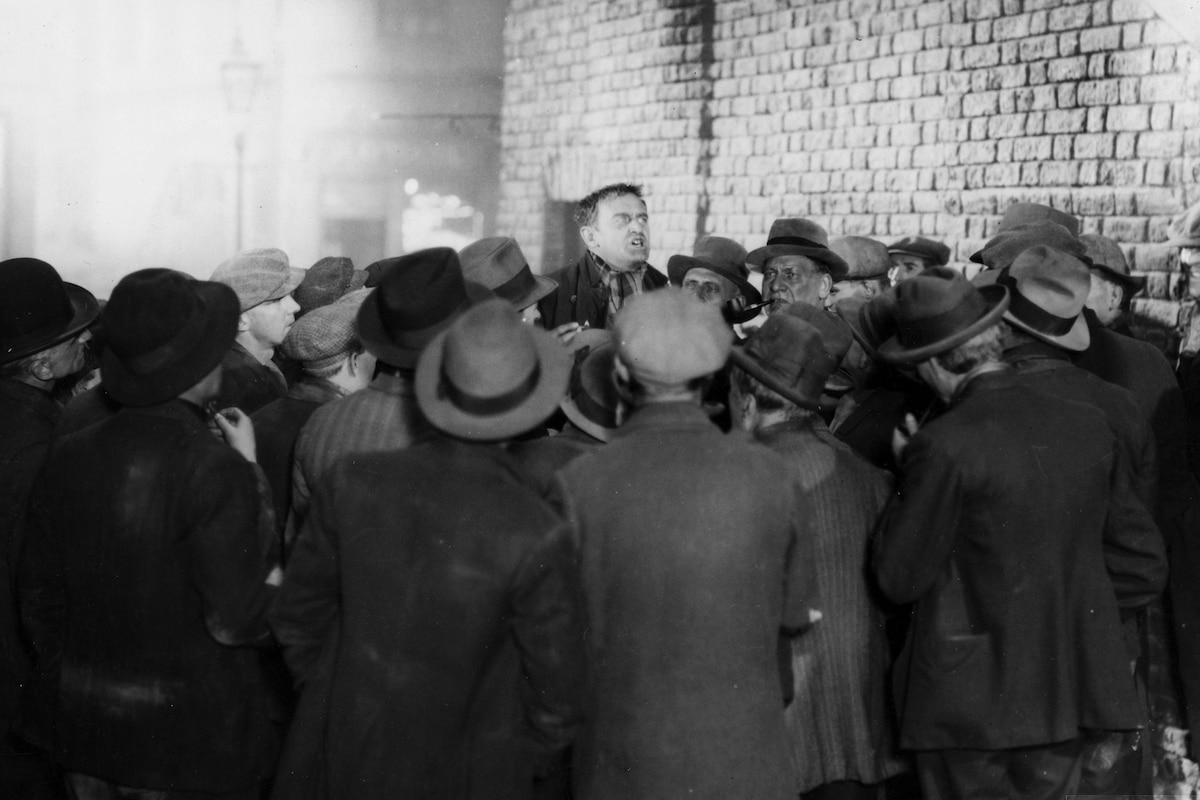
The inimitable Barry Fitzgerald, who originated the role of Captain Boyle, appears
as "the Orator" in a new prologue that O'Casey wrote specifically for
the film to help clarify the political background of the play. Juno and
the Paycock is also noteworthy for its colorful use of language, from
Joxer Daly's repeated use of the epithet "darlin'" to Captain Boyle's
own comic malapropisms--among them, his reference to Joxer as a "prognosticator"
and his famous declaration, "The whole world's in a terrible state of chassis!"
Sean O'Casey (1880-1964) spent much of his life troubled by ill health, especially
by poor eyesight. His first three major plays--The Shadow of a Gunman
(1923), Juno and the Paycock (1924) and The Plough and
the Stars (1926)--are set in the Dublin tenements in which he was raised.
The first two were tremendous artistic and financial successes for Dublin's Abbey
Theatre, but The Plough and the Stars, which many regard as his
masterpiece, sparked a riot because of its salty language and O'Casey's unsentimental--though basically sympathetic--treatment of working class Irish people and their response
to the Easter Rising of 1916. In an act of self imposed exile, O'Casey moved to
London in 1926 and remained in England for the rest of this life. Besides his plays,
he is renowned for a series of autobiographies written in an extravagant, experimental
prose style. While O'Casey viewed the cinema as essentially inferior to the theater,
according to Hitchcock biographer Patrick McGilligan the playwright had also outlined
a project entitled "The Green Gates"--about a day in the life of Hyde
Park. That film project unfortunately never materialized, so O'Casey developed it
into a stage play instead.
Alfred Hitchcock genuinely admired O'Casey's play and saw it multiple times on the
London stage. The film is largely faithful to the play's dialogue and most of it
remains confined to the main room of the Boyles' tenement, as in the play. However,
Hitchcock does open the film out with street scenes and purely cinematic elements
such as the recurring image of a window looking out onto the street, accompanied
by the sound of machine-gun fire off screen. Extending the experiments of Blackmail (1929) even further, the director uses fairly sophisticated sound effects for an early British sound film, including a gramophone recording of the song "If
You're Irish, Come into the Parlor" that was simulated by a singer and orchestra
off stage.
But the most elaborate use of sound is unquestionably Hitchcock's staging of the
end of Act II, the scene where Captain Boyle, Juno, Joxer and Maisie Madigan listen
to the gramophone then attend the funeral for Mrs. Tancred's son on the street below.
While they are absent, the "Mobilizer" enters the apartment and orders
Johnny to attend a "meeting." Hitchcock described the setup as follows:
"In one corner was a crowd of people talking in low voices; in another, half
a dozen people marking time; in a third, a stage-hand was beating a sofa with two
canes to make machine-gun fire. The fourth corner was filled by a propman singing
the tune through a megaphone." Improvements in sound technology--among them
more sensitive microphones and the ability to mix different tracks--have long since
made such effects relatively easy to accomplish today. However, Hitchcock's execution
of the scene demonstrates his eagerness to experiment with the possibilities of
sound film as much as his desire to be faithful to the written stage directions
in O'Casey's play.
Later in his career Hitchcock would occasionally dismiss the film, most famously
in Francois Truffaut's book-length series of interviews. However, Juno
and the Paycock was actually fairly well received during its initial run
in England. For instance, James Agate of the Tatler characterized
it as "very nearly a masterpiece." When the film was released in the U.S.,
the reviewer for the New York Times warmly praised the lead actors
but complained about the sound recording quality and the play's odd mixture of comedy
and tragedy. While Juno and the Paycock ultimately doesn't transcend
its origins as a filmed play and thus is usually thought of lesser interest for
Hitchcock fans than, say, Blackmail, it is of considerable historical
value as a rare film adaptation of a classic modern play, and as a record of the
great Sara Allgood's signature role as an actress.
Producer: John Maxwell
Director: Alfred Hitchcock
Screenplay: Alma Reville, adapted from the play by Sean O'Casey
Photography: J. J. Cox
Editing: Emile de Ruelle
Art Direction: J. Marchant
Principal Cast: Sara Allgood (Juno Boyle), Edward Chapman (Capt. Jack "Paycock"
Boyle), Sidney Morgan (Joxer Daly), John Longden (Charles Bentham), Kathleen O'Regan (Mary Boyle), John Laurie (Johnny Boyle), Donald Calthrop (Needle Nugent), Maire O'Neil (Maisie Madigan), Dave Morris (Jerry Devine), Fred Schwartz (Kelly), Dennis Wyndham (Mobilizer), Barry Fitzgerald (Orator).
BW-85m.
by James Steffen
Juno and the Paycock
by James Steffen | September 23, 2005
SIGN UP FOR OUR NEWSLETTERS

CONNECT WITH TCM