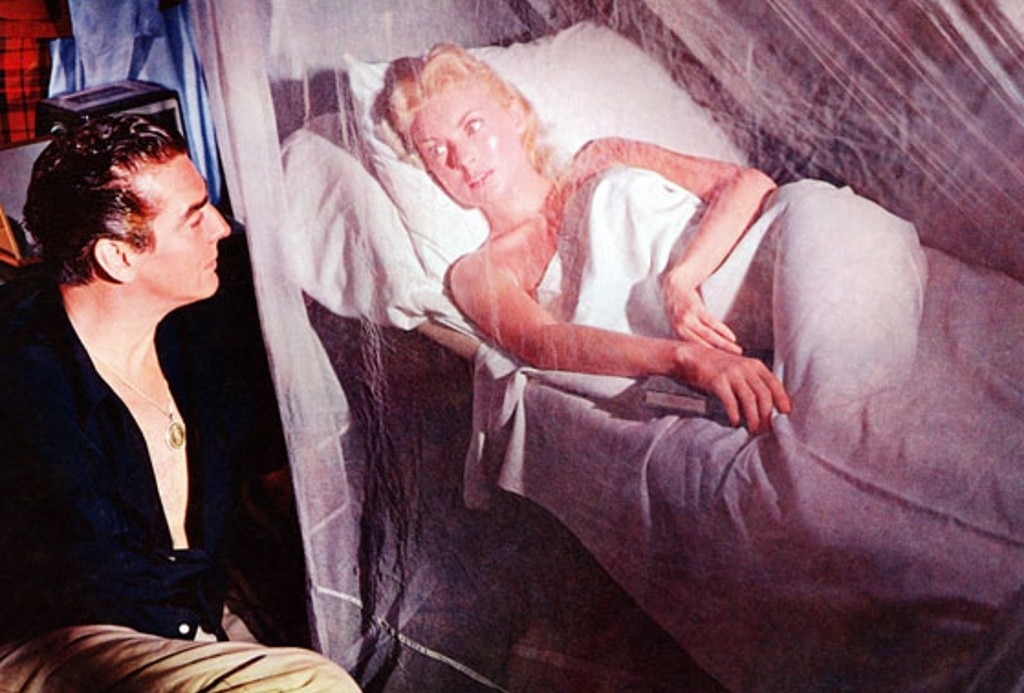
History as a backdrop to the action is an old standby in Hollywood and storytelling in general. In 1956, in the middle of the Mau Mau uprising in Kenya, producers Irving Allen and Albert "Cubby" Broccoli, the latter later famous as the producer of the James Bond franchise, put together Safari, a rousing adventure thriller set in Kenya during the very same uprising. Filmed on location (except for a few studio interiors), and starring Victor Mature and Janet Leigh, Safari is beautifully photographed and more exciting than expected, but modern day viewers should be warned: the film contains a couple of now hard to watch scenes of animal killings, including the shooting of a bull elephant.
The movie begins with hunter Ken Duffield (Victor Mature) going off on yet another safari and leaving his son behind with his housekeeper and loyal ranch hands, including Jeroge (Earl Cameron). After his first day on safari he gets an urgent radio message that Mau Mau terrorists are in the vicinity of his home and rushes back. The housekeeper and boy take up arms against the onslaught of rebels but Jeroge, it turns out, is a Mau Mau general and kills them both. Duffield is broken and the British remove his hunting license so he can't be hired on safaris but the real reason is they don't want him going after Jeroge. Best to let the British army take care of that. Meanwhile, a wealthy British politician, Sir Vincent Brampton (Roland Culver), shows up with his showgirl fiancée, Linda (Janet Leigh), intent on using Duffield to take him on safari. Duffield tells him he can't and Brampton pulls some strings to get his license back. The safari begins but only as a pretense for Duffield to secretly hunt down Jeroge.
Safari was directed by Terence Young who would later go on to direct three early James Bond classics, including the very first Bond movie, Dr. No (1962). Watching Safari, it's easy to see why producer Broccoli would stick with Young once he got the rights to do the Bond movies. Victor Mature and Janet Leigh, brave, macho man and sleek, sexy blond, make for an early prototype of the Bond/Bond girl model. Young also excels at action and the early attack sequence is a great example. As the Mau Mau rebels close in, Young brings the camera inside the house, showing the rebels advancing through window vantage points and brief glimpses in the dark. The housekeeper and young son do their best shooting as many as they can until Jeroge is revealed, in the same frame as the young son, shooting another ranch hand which goes unnoticed by the boy as the shot is but one of many among the gunfire. When Jeroge finally approaches and kills the boy, Young wisely takes the camera off the boy and into Jeroge's face as we watch the shocking scene unfold. It's a heavy opening for an action movie but Young shoots it with just enough distance to make sure it doesn't weigh down the rest of the movie, something showing the boy die surely would have done.
The leads do a fine job as well. Victor Mature got a lot of heat for not being the world's greatest actor but, in reality, he knew his range and did a fine job in roles like this, playing both stoic heroism and embittered rage quite well. He even does a good job expressing grief, not through crying, but looking as if the world punched him the gut and left him breathless.
Janet Leigh looks as beautiful as ever and brings energy and wit to the role of gold digging showgirl. Leigh played sarcasm and cynicism well and the same world weary attitude she displays in Touch of Evil (1958),Psycho (1960), and The Manchurian Candidate (1962) is seen here, too, bringing a sharper edge to the showgirl character that another, lesser, actress might not have brought to the role. She's forced to struggle through only one silly scene when her character manages to go down a crocodile infested river in a tiny yellow raft (for no other reason than to have Victor Mature race to the rescue) but otherwise is a stronger female character than this kind of movie was used to seeing.
Earl Cameron plays Jeroge and was one of the first black actors in Britain to get respectable, non-stereotypical roles. He even teamed up with Young and Broccoli again on Thunderball (1965). As of 2014, he was still active in television and the movies.
Safari is gorgeous to look at, filmed in Technicolor Cinemascope and on location. The Kenyan landscapes are beautiful to behold and give the movie a more modern feeling since the action is clearly not happening on a set. The exciting climax, filmed at the foot of a Kenyan mountain range, and filled with attacking rebels, dug-in combatants, and a last second ride to the rescue, Calvary style, gave Terence Young good training for his later work with James Bond and ended up being one of his best action efforts and one of the best adventures of 1956.
by Greg Ferrara
Safari
by Greg Ferrara | September 22, 2014
SIGN UP FOR OUR NEWSLETTERS

CONNECT WITH TCM