Is art worth fighting for? Dying for? These are questions posed in The Train (1964), a thrilling WWII action picture, both to the characters in the story and to us, the audience. When the art in question is a treasure trove of French impressionist art ("the heritage of France"), at risk of being hauled out of the country by Nazis to an uncertain fate, the questions become all the more difficult to answer.
How refreshing it is for a movie filled with eye-popping, visceral, kinetic action to also center around such a thoughtful dilemma. The Train is not only gripping but timeless, because the issues at its core are timeless.
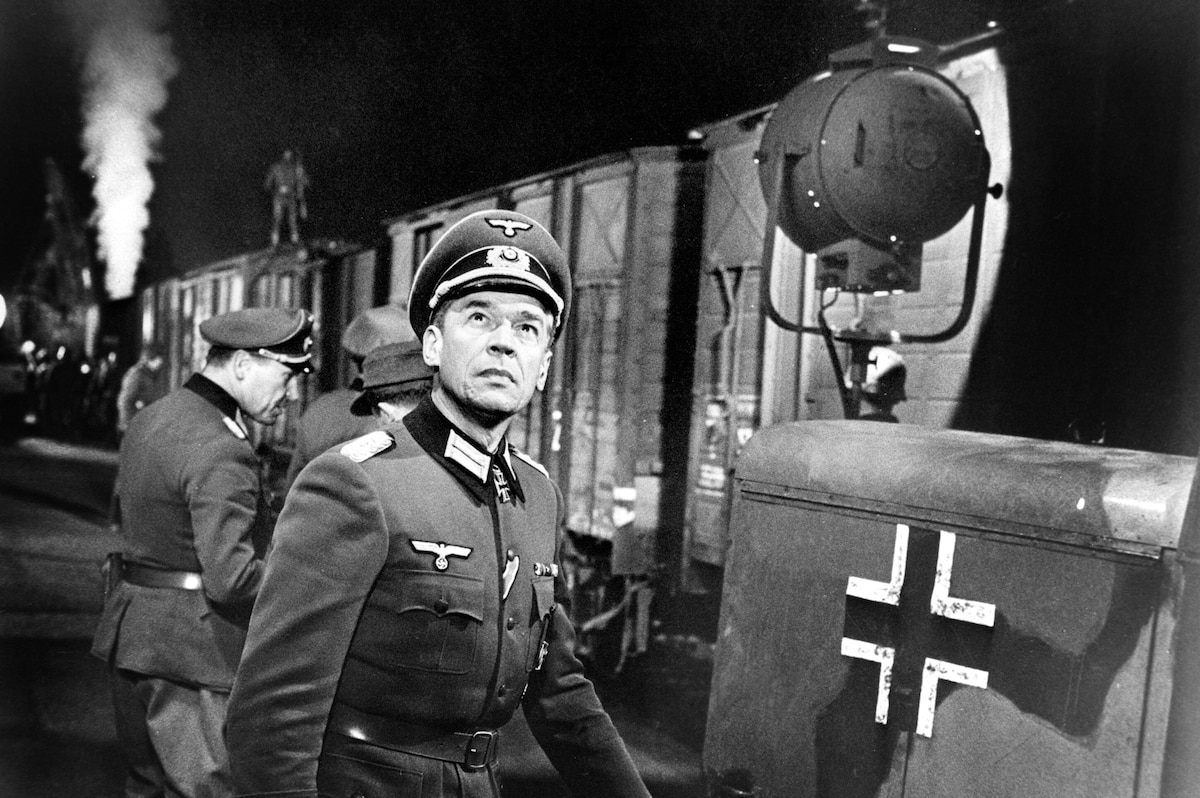
It's also timeless in the way director John Frankenheimer, working from an Oscar-nominated script by Franklin Coen and Frank Davis (along with three uncredited writers), crafts an efficient, no-nonsense style that grabs audience attention right off the bat. Nazi Colonel Von Waldheim (Paul Scofield) quietly enters a building to look admiringly at scores of great impressionist paintings hanging on the walls. "Degenerate art," he tells a French curator. "I should detest it." But it's clear he doesn't, even as he then oversees the crating up of all this art in preparation for shipment to Germany. These are the last days of the German occupation of France. The Allies are closing in fast, and Waldheim wants to spirit the art away to Germany on a special train. The curator, however, informs the local French resistance of the scheme, and the French train-yard chief, Labiche (Burt Lancaster), is asked to prevent the train from leaving, or to at least to delay it long enough until the Allies to arrive in a few days' time.
And so begins a cat and mouse game between Waldheim and Labiche, who at first is dead-set against risking any lives for the art. Eventually, however, Labiche becomes as determined to keep the train in France as Waldheim is obsessed with getting it out. Labiche and his men concoct clever, elaborate schemes to delay and reroute the train under the constant noses of brutal Nazis. Scofield is positively brilliant as Waldheim, whose love for the art makes him at best a complex Nazi, and Lancaster, at age 50, delivers one of his most physical performances -- running, jumping, climbing trains, scrambling over walls, and sliding down steep hills. And for the last section of the film he does all that with a limp, caused by a real mishap he had while golfing on a day off. Frankenheimer later called Burt Lancaster "the strongest man physically I've ever known. He was one of the best stuntmen who ever lived. I don't think anybody's ever moved as well on the screen."
Frankenheimer shoots many of Lancaster's stunts in long, complex takes, often having his star end the shot in close-up, as if to impress us (successfully) that it was in fact Lancaster doing his own stunt work. The long takes also allow the audience to feel the visceral reality of the action. In this film, the trains are real, the locations are real, and the explosions are real: full-scale, with no effects work. This creates genuine impact, and is all the more impressive today, fifty years on, because very few movies with such large-scale action are ever still made in this way.
The Train impresses in other ways, too. Almost every shot in the film employs razor-sharp deep-focus photography, resulting in one of the most beautiful black-and-white features of the era. (This is said to be the last great action movie done in black and white.) Frankenheimer's handling of crowd scenes is remarkable, with wide shots crammed with action and extras deep in the frame. Here again, the long takes reveal an unbelievable amount of complicated choreography work. Often, Frankenheimer incorporates people and objects into the extreme foreground so as to emphasize the overall depth of the image. Even something as simple as Lancaster's initial walk through the train yard ends up being one of the most memorable shots in the movie, because of the massive amount of activity involving people and machinery going on all around him in the single take. And the sound design is phenomenal, with the screeching, groaning, hissing and metallic sounds of the moving trains adding immensely to the sense of gritty, sooty realism. Long sections of the film are constructed wordlessly, with the dramatic visuals and intense sound telling the story -- the mark of a first-class filmmaker.
Ultimately, The Train moves toward a thrilling final sequence that culminates with the final standoff we know must come. ("A painting means as much to you as pearls to an ape!" Scofield berates Lancaster.) It's to the film's credit, however, that it does not present the scene as a simplistic western-type showdown. The variation used works ever better, because it feels of a piece with the sense of loss permeating the German side of the things that has been established from the first moment of the movie.
Twilight Time's Blu-ray is beautiful. The Train surely hasn't looked or sounded this great since its initial theatrical release. On a new audio commentary track, film historians Nick Redman, Julie Kirgo and Paul Seydor offer good insights into the film, though a single commentary track with so many people is inherently a bit unwieldy, as participants tend to cut each other off or jump around erratically with their points. Kirgo also supplies superb liner notes with all sorts of interesting production information and analysis.
Otherwise, the Blu-ray retains the extra materials first seen on MGM's 1999 DVD release: an isolated score track, and another audio commentary track with director John Frankenheimer, who died in 2002. His comments are sporadic but fascinating, as he talks about the challenges of the production, his use of lighting and depth of field, and how he approaches a film in terms of the emotional stakes for an audience. Of Michel Simon, the famous French actor who plays to perfection the role of the ill-fated train engineer Papa Boule, Frankenheimer says, "That face! I just couldn't take the camera off him." He also talks of introducing the paintings as he would a human character in the opening sequence, which incidentally was the only one to be shot on a soundstage.
The Train, which Frankenheimer took over from director Arthur Penn after Penn and Lancaster had a falling out, turned Frankenheimer's life around; he spent a year on location in Normandy, then returned four years later to live there for seven years. In the meantime, he turned out a picture that impresses for its balance of large-scale drama and intimate cat-and-mouse conflict between vividly real characters. A great film.
By Jeremy Arnold
The Train on Blu-ray
by Jeremy Arnold | August 15, 2014
SIGN UP FOR OUR NEWSLETTERS

CONNECT WITH TCM