Elvis Presley made the leap from recording artist and pop concert headliner to movie star by co-starring in the low-budget drama Love Me Tender in 1956, a kind of try-out that led to leading roles and hit movies built around his performance breaks. Fellow Sun Records alumnus Johnny Cash, a country artist who began in the rockabilly mode and crossed over to the pop charts with a few hits, never replicated that success but it wasn't from lack of trying. In addition to the usual rounds of TV variety shows and music programs, he guest starred in a couple of TV western shows and finally landed a role in a feature movie. But if Elvis made his debut in a modest little picture, it was still a real Hollywood production with actual movie stars, production values, and a big release with plenty of publicity. The grim crime thriller Five Minutes to Live was an independent film from a small production company with no stars and a director whose only big screen credit was titled Ma Barker's Killer Brood (1960).
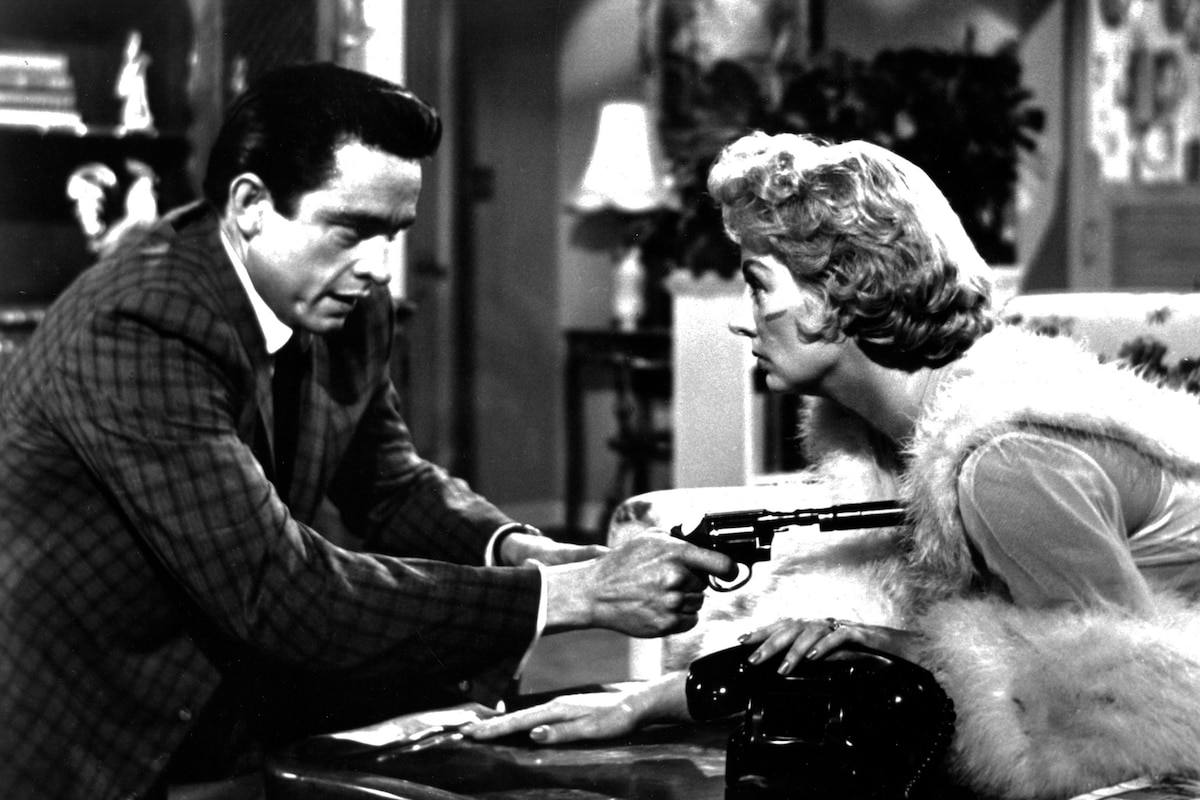
Cash plays Johnny Cabot, a heist man on the lam after shooting a cop during a robbery. Cash had a sober, sullen image as a performer and brings that personality to the role of the brutal, borderline psychotic criminal. Vic Tayback, who later made his fame playing Mel the diner owner and short order cook in the movie Alice Doesn't Live Here Anymore (1974) and TV sitcom spin-off Alice, is Fred, the mastermind of bank robbery who enlists Johnny as his sole accomplice. As Johnny invades suburbia to take the wife (Cay Forester) of the bank vice president hostage, Fred works on the vice president (character actor Donald Woods) in the bank and gives Johnny his orders through phone calls placed every five minutes. Thus the film's title, Five Minutes to Live.
Shooting began in June, 1960, on a tiny budget of $100,000. Cash received a mere $700 a week for a two-week shoot and when production halted after running out of money, Cash invested $20,000 of his own money to complete the picture. Shooting resumed after a three month break and, according to Cash biographer Robert Hilburn, the singer's schedule had become so hectic by then that he was popping amphetamines at an alarming rate to keep going. The gaunt, hollow appearance in Cash's face jumps out in these scenes, a sharp contrast to just a few months earlier.
If he wasn't a natural screen actor, Cash was right at home with a guitar and his character kills time by strumming songs and singing a few verses. He wrote and performed the theme song for the credit sequence and he also sings it during the hostage sequence, taunting his captive with a threatening smile.
Apart from Cash, the most famous member in the cast is little Ronnie Howard as the couple's precocious son. He wasn't well known when the film went into production but by the time the film was released in 1961, the hit sitcom The Andy Griffith Show had debuted on TV. Pamela Mason, the wife of James Mason, took a supporting role as the other woman in the bank vice president's life. But it's Vic Tayback who delivers the most commanding performance in the film. Though his screen time is limited, he's all confidence and calculation as Fred.
Five Minutes to Live had its world premiere in 1960 to scathing reviews and went into release in 1961, generally playing on the bottom of double bills. In 1966 it was re-released by American International Pictures under the title Door-to-Door Maniac, reportedly with new footage added by producer Robert Lippert. The purely exploitative title did nothing to enhance Cash's film career - he starred in only one subsequent big screen feature, A Gunfight (1971), with Kirk Douglas - but it helped turn the film into a cult item, playing up the most lurid aspects of the thriller and Cash's role as an unstable crook with a psychotic edge.
Sources:
Johnny Cash: The Life, Robert Hilburn. Little, Brown and Company, 2013.
Johnny Cash: The Biography, Michael Streissguth. Da Capo Press, 2006.
AFI Catalog of Feature Films
IMDb
By Sean Axmaker
Five Minutes to Live
by Sean Axmaker | July 07, 2014
SIGN UP FOR OUR NEWSLETTERS

CONNECT WITH TCM