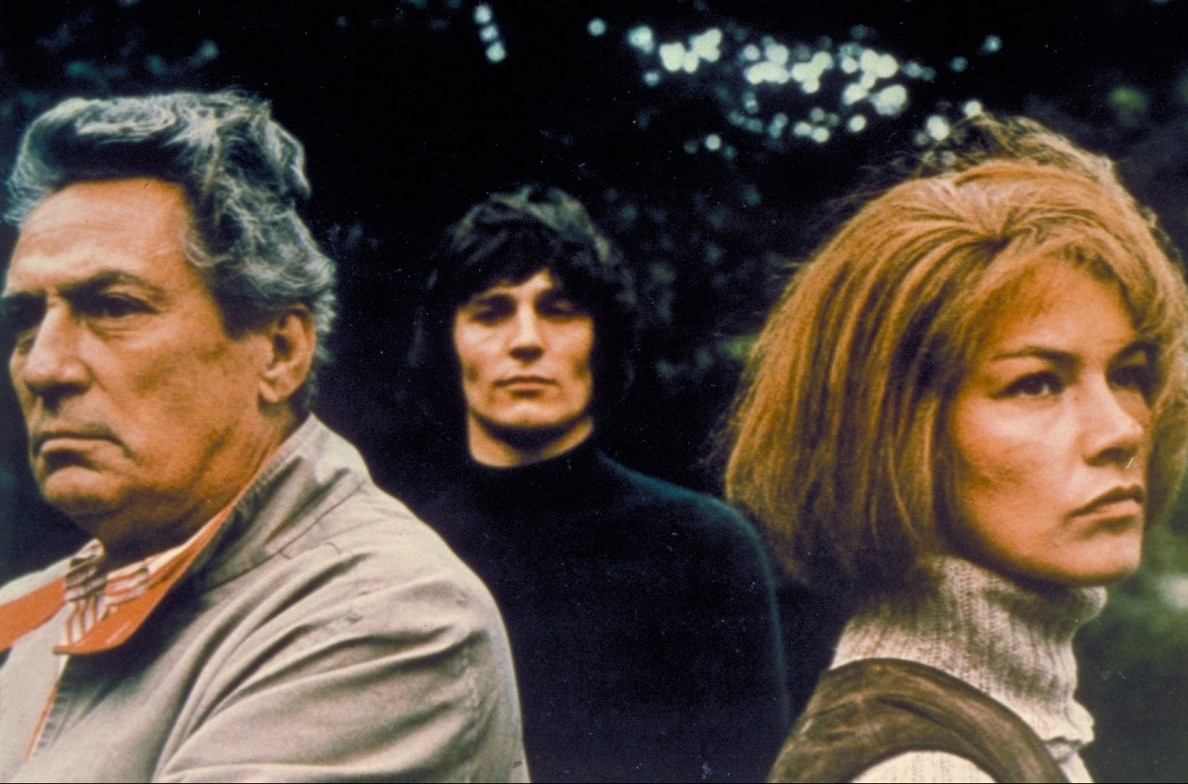
Filmmaker John Schlesinger was riding high on the popular and critical success of his American film debut, Midnight Cowboy (1969), when he returned to Britain to begin work on what would become the most personal film of his career. Sunday Bloody Sunday (1971) is an intimate, compassionate story of a romantic triangle with two middle-aged divorcees (Glenda Jackson and Peter Finch) sharing a handsome young bisexual artist (Murray Head) who flits between them. In his tape-recorded diary, Schlesinger made the personal connection more explicit: "It's my story, my own bloody Sunday - my affair with a young man."
While Schlesinger came up with the story idea and outline, he approached Penelope Gilliatt to write the screenplay. A novelist and film critic writing for The New Yorker, she had written to Schlesinger with the desire of working with him. It was a tense collaboration. "We didn't like each other much," Schlesinger later admitted. "She was an intellectual snob and I resented that. There was a kind of tension between us but I think perhaps out of that tension came a very good film." Gilliatt preferred to remain in New York and resisted Schlesinger's requests to rewrite the dialog in a more natural style. When Gilliatt refused to travel to London during production, he hired David Sherwin to rework the dialogue. When production began, he was rewriting pages and handing them to the actors the morning before shooting started on those scenes. Gilliatt, however, received sole screen credit.
According to Schlesinger biographer William Mann, the director was keen on Peter Finch to play the central role of Daniel Hirsh from the beginning - Finch had previously starred in Schlesinger's Far from the Madding Crowd (1967) and earned a BAFTA for his performance - but he was already committed to another project and Ian Bannen was initially cast in the lead. After a few days of shooting, Schlesinger decided it wasn't working and when Bannen fell ill, Schlesinger approached Finch, who was suddenly available, to take over the role. Finch had spent a year preparing for a major film that was cancelled just before it was scheduled to begin production. He flew from Rome to London, met with Schlesinger, read the script, and began shooting the next week with almost no time to prepare. "He knew the character in some way without, I think, ever having experienced any of it," recalled Schlesinger later. Finch was "exactly what I wanted for the part... a pair of open arms."
The role of Alex Greville was written with Vanessa Redgrave in mind but she turned down the part. Schlesinger offered the role to Glenda Jackson after seeing her performance in Ken Russell's Women in Love (1969). Though nervous about her reputation for being difficult and strident, he was immediately won over by her sense of humor. For the third leg of the romantic triangle, a young artist named Bob, Schlesinger cast Murray Head, who was better known as a singer than an actor. "I didn't have an easy time on Sunday Bloody Sunday," he told Finch biographer Elaine Dundy, and Schlesinger was hard on the young actor, who was only 24 at the time and splitting his time between the film and singing the role of Judas in the original cast recording of Jesus Christ Superstar.
The most talked about sequence in the film was the kiss between the two men. "I remember my uncle talking about the famous kiss scene between Peter Finch and Murray Head (both straight men, as it happens)," wrote Schlesinger's nephew Ian Buruma in an essay for the Criterion disc release of the film. "He didn't want it to be coy, and certainly not sleazy; the camera should be neither prurient nor primly looking away. The kiss was just a kiss between two loving people." The sequence caused discomfort on the set, not between the actors but among the crew. "Is this scene really necessary?" asked cinematographer Billy Williams just before shooting commenced. Schlesinger insisted "Of course it is!" According to Head, the crew was even nervous while watching the rushes. "Everyone smoking four cigarettes at a time, crossing and re-crossing their knees, coughing and sputtering," he recalled. "I mean, the more it went on, the more they were embarrassed."
The film's presentation of a loving romantic and sexual relationship between two men in the same naturalistic terms as a heterosexual romance was unprecedented for its time, at least in a mainstream movie. Finch's quiet performance makes Daniel a man first and a gay man second, a defining feature of the character without becoming the defining feature, and the physical and emotional intimacy between Finch and Head is presented with the same easy natural quality as the relationship between Jackson and Head: an enormous accomplishment for the time.
Reviews were unanimously enthusiastic in Britain and in the United States. New York Times film critic Vincent Canby called it Schlesinger's "wisest, least sentimental film," Roger Ebert proclaimed it "a masterpiece," and Pauline Kael declared it "instantly recognizable as a classic." The film earned Academy Award nominations for Schlesinger's direction, Gilliatt's screenplay, and actors Peter Finch and Glenda Jackson, and it won five BAFTA awards, including Best Actor, Best Actress, Best Direction, and Best Film. "Sunday Bloody Sunday is probably the best film I've ever made," Schlesinger later recalled. "And I probably won't make a better one."
Sources:
"Something Better," Ian Burma. Criterion Collection Booklet, 2012.
Finch, Bloody Finch, Elaine Dundy, Holt, Rinehart and Winston, 1980.
Peter Finch: A Biography, Trader Faulkner. Taplinger Publishing Company, 1979.
Edge of Midnight: The Life of John Schlesinger, William J. Mann. Billboard Books, 2005.
By Sean Axmaker
Sunday, Bloody, Sunday
by Sean Axmaker | July 07, 2014
SIGN UP FOR OUR NEWSLETTERS

CONNECT WITH TCM