Franchot Tone was not a famous face in Hollywood when he made The Stranger's Return in 1933 but he would be one before the next year was out. The Stranger's Return was only his fifth effort but he was fast becoming a reliable presence and occupying the same space with theatrical legend Lionel Barrymore didn't ruffle him one bit. Tone attended Cornell University, where he was the president of the Drama Club, and after graduation took only two years before finding himself acting on the Broadway stage with the "First Lady of the Theatre" herself, Katharine Cornell. Shortly after The Stranger's Return, Tone co-starred in the hit Dancing Lady with future wife Joan Crawford, and two years later earned his only nomination for Best Actor for Mutiny on the Bounty, with Charles Laughton and Clark Gable.
Though early in his career, The Stranger's Return finds Franchot in familiar territory, as the likeable, inoffensive All-American guy, only this time, he's the object of the leading lady's affection instead of losing out to someone like Clark Gable in Dancing Lady. The story begins at the breakfast table of the Storr family farm as Grandpa Storr (Lionel Barrymore) comes down to find corn flakes instead of bacon and eggs. The cornflakes are dumped, bacon and eggs are made, and the old Civil War veteran tells his son-in-law, Allen (Grant Mitchell); his wife Thelma (Aileen Carlyle); and his stepdaughter, Beatrice (Beulah Bondi), that his granddaughter is coming to stay with them. He's referring to Louise (Miriam Hopkins), recently separated from her husband in New York City, and coming back to the country for a time. Beatrice is dismayed as having a woman leave her husband is something likely to cause scandal in their little upstate New York community. When Louise finally arrives, on the midnight train no less, it's worse than she expects.
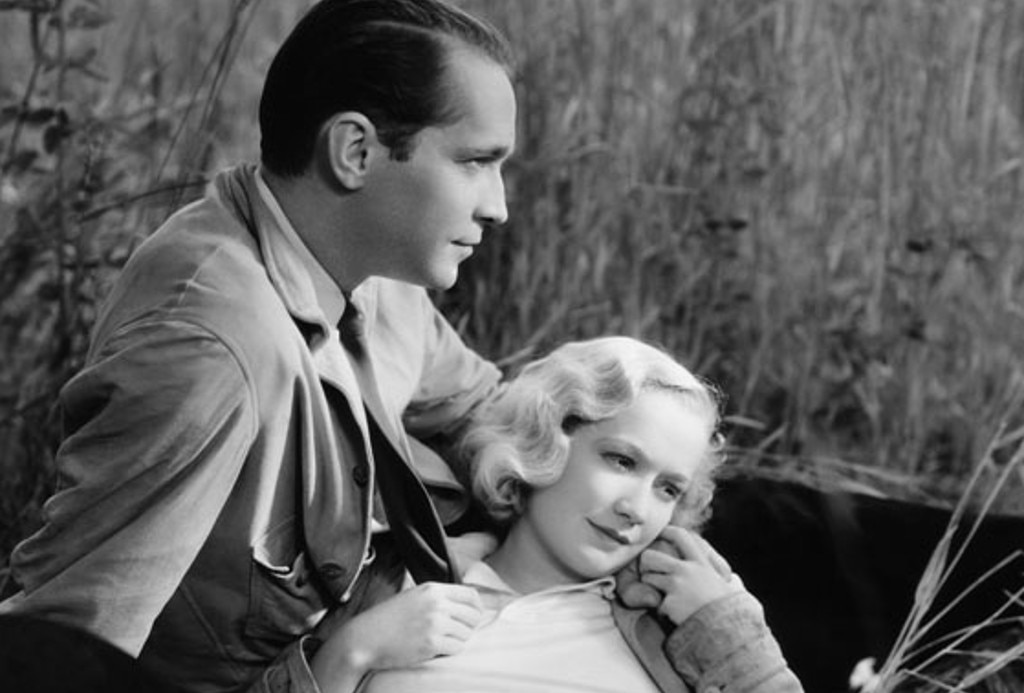
Louise is clearly more sophisticated, urbane, and intelligent than Beatrice (she even attempts to tip the farmhand that carries her bags, to Beatrice's disapproval - he ends up taking the tip anyway) and worst of all, she's beautiful. When Louise takes a short horse ride with her Grandpa to see the Cranes, the family that occupies the next farm over, she and Guy Crane (Franchot Tone) immediately connect. Later, at a community social, she dances with Guy several times, even after being warned by Beatrice that she is causing a scandal, not only because Guy is married but because his wife, Nettie (Irene Hervey), is right there watching. Of course, Nettie doesn't mind, only Beatrice.
Guy and Louise continue to socialize and discover they have much in common. Guy went to college at Cornell (like Tone did in real life) and the two talk about theater in New York while Nettie is left out of the conversation. Guy shows Louise around the massive acreage of his farm and, finally, in a moment of passion, reveals his love for her. The problem is, both Guy and Louise like Nettie and neither wants to hurt her. More importantly for Louise, Guy's reputation will be destroyed. She can leave and go back to the city any time she wants, she explains to him, but he will be stuck there among the ever watchful, ever judging eyes of the small farming community.
Dealing with social commentary was something that director King Vidor had been doing for years. In fact, one of the greatest social commentary dramas in all of cinema, the 1928 masterpiece The Crowd, was directed by Vidor. In The Stranger's Return, he deals in taboo subjects once again and guides the story masterfully. The outside locations, instead of soundstages, add an authenticity to the film, and all the actors are in fine form.
Miriam Hopkins, like Tone, was just starting out in the movies, although by this one, she had already become a star. In just her first four movies she had scored major successes with Dr. Jekyll and Mr. Hyde and The Smiling Lieutenant (both 1931) and she quickly became one of the biggest stars of the thirties. She's excellent here, playing well against both Tone and Barrymore.
Speaking of Barrymore, the old actor of the stage was in his stagecraft element here, wearing a beard and playing a character over thirty years older than his age at the time. He does so splendidly and manages to make a character almost defiantly rude and sarcastic at all times wholly loveable as well.
The Stranger's Return is one of those great films from the early thirties that doesn't get nearly enough recognition. The direction, production, writing, and acting are all supremely well done but for whatever reason, even with the newly minted star power of Miriam Hopkins, it didn't set the box office on fire and hasn't built up a reputation over the years like many others. It's time to change that and let The Stranger's Return return to the spotlight.
Producer: Lucien Hubbard
Director: King Vidor
Writers: Brown Holmes, Philip Stong (from his novel)
Cinematography: William H. Daniels
Film Editing: Richard Fantl, Ben Lewis
Art Direction: Frederic Hope
Cast: Lionel Barrymore (Grandpa Storr), Miriam Hopkins (Louise Storr), Franchot Tone (Guy Crane), Stuart Erwin (Simon), Irene Hervey (Nettie), Beulah Bondi (Beatrice), Grant Mitchell (Allen), Tad Alexander (Widdie), Aileen Carlyle (Thelma)
By Greg Ferrara
The Stranger's Return
by Greg Ferrara | July 07, 2014
SIGN UP FOR OUR NEWSLETTERS

CONNECT WITH TCM