The impossibility of writing, or even talking, about Alejandro Amenabar's The Others (2001) is no small matter - the film is a spring-trap gotcha machine, setting itself up in one long atmospheric stretch for an ending that turns the world exactly upside down. Knowing even that much could be a spoiler - what can we talk about when we talk about The Others, 13 years after its release? (Or 44 years after Richard Lortz's teleplay The Others, based on his older play, that ran on the BBC's Armchair Theatre in 1970, had the same set-up, and is uncredited on Amenabar's movie?)
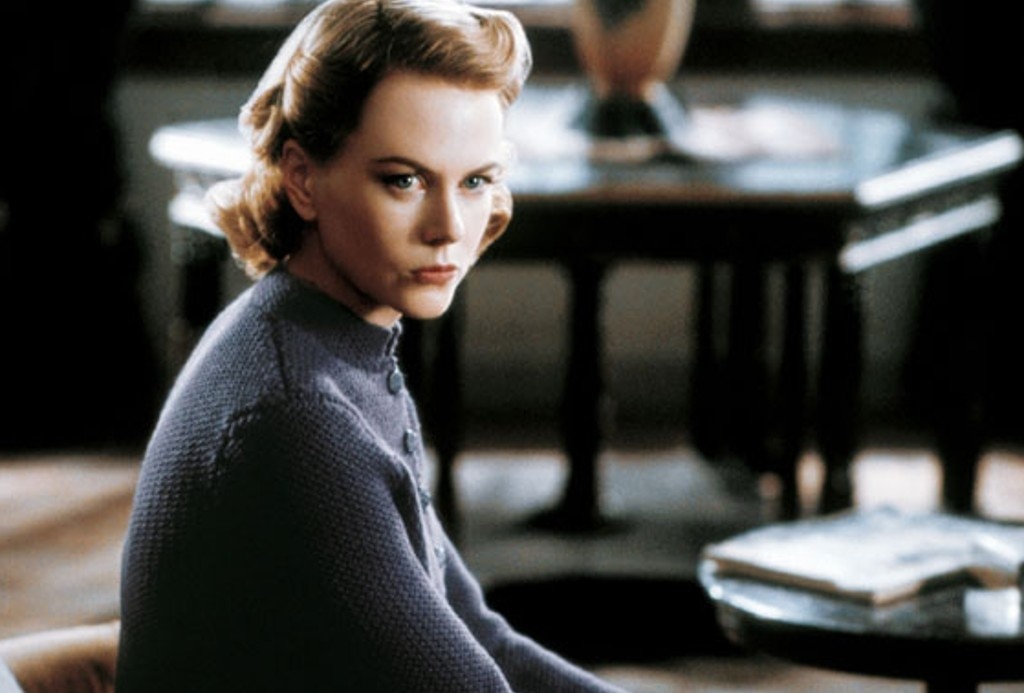
One doesn't want to be a piker, so we will not venture even now toward the film's climactic gambit, and luckily for us the film remains otherwise a rich and fascinating Gothic exercise, reeking with moody chills, repressed sexual power and enough semi-unconscious slippages to fill a Freudian notebook. Nicole Kidman, her crystal-clear eyes and dainty nostrils flaring, stars as Grace Stewart, the very high-strung matriarch occupying a massive and foggy estate manse on Jersey Island. The house is empty except for she and her two children, 11-year-old Anne (Alakina Mann) and 8-year-old Nicholas (James Bentley), and that's where things start getting strange, in a Poe-Dickens-Bronte-Shirley Jackson kind of way. As three new servants show up, led by Fionnula Flanagan's redoubtable Mrs.Mills, to replace the staff that just mysteriously left, Grace explains the situation: the children are beset with an "allergy" to light, and so curtains must be always drawn and every door must be locked behind you, to insure that no light leaks in. Silence is "highly prized" here. The kids sleep during the day, of course, and at first it seems obvious that Kidman's control-freak mom is both fraying from the stress and might in fact be enacting a Munchausen-by-proxy scenario, torturing all involved with her own delusions. (What Grace describes is an actual, if extremely rare, UV-shy condition called xeroderma pigmentosum.) Of course, eventually the children start saying they see and hear other people in the house, ghosts, and in time a near-hysterical Grace hears them, too, shifting into protective-uber-Mom gear.
In this sense, you can detect traces of neo-Gothic classics like The Innocents (1961), and The Haunting (1963), in which the ghostly manifestations may or may not be the product of the heroines' bottled-up psychosexual manias. The genre has always depended on this ambiguity, and Kidman's harpyish intensity certainly invites us to consider that she is the source of the film's various weirdnesses, as she grieves secretly for her absent husband and practically pops a blood vessel every time someone does anything that doesn't conform to her idea of how things should be.
Amenabar's essential cleverness is evident long before the ending - the house's interior, for instance, is a multilayered weft of staircases, arches and non-right angles, explicitly, it seems, designed to echo lithographs by M.C. Escher (particularly "Relativity" and "Concave and Convex"), and thereby injecting a ubiquitous sense of irrationality into the story. (Cinematographer Javier Aguirresarobe's lighting, for a scenario in which light itself is considered a threat, is magisterial.) The cast is the other secret weapon on hand - in addition to Kidman's domineering presence, the film's primary human hook is Bentley, whose almost unearthly little porcelain face, its tiny dark eyes set close together like a doll's, is cleaved throughout by worry and consternation. We look to him to tell us what the film's story really is, even though he's the most clueless and defenseless character present.
Clues do arise - the servants' shady hints, a hidden gravestone, the obfuscatory fog outside that never lifts - but do yourself a favor, and don't set your gears turning, trying to second-guess Amenabar's fictional twist. It wouldn't be hard, and you'd spoil the Gothic stew brewing in the meantime, which tense as it is could've actually used more sexual torque. (The prototype here is Deborah Kerr's nanny in The Innocents, fracturing under the pressure of the copulative nastiness she's not even supposed to be thinking about.) Trying to surmise the ending of such a film is a dead-end mode of movie-watching in any case -the effort boils the whole film and all of its textures and ideas down to the matter of conceptual predictability, pitting you against the scriptwriter. Generally, twist endings in general are delicate things, and should be ignored until they land in your lap.
In 2001, The Others jazzed nearly everyone - it was a hit the same season Kidman's soon-to-be-ex-husband Tom Cruise's Vanilla Sky died at the box office. (That film, ironically, is a remake of Amenabar's Open Your Eyes, 1997.) It remains the most popular Spanish-made film to play in Spanish theaters, and also swept the Goyas that year, a first for a film in which not a word of Spanish is spoken. It's that rare thing - a satisfying haunted-house saga that doesn't overdue the shock cuts and gore, honors its Gothic roots, and manages to take you somewhere new.
By Michael Atkinson
The Others (2001)
by Michael Atkinson | July 07, 2014
SIGN UP FOR OUR NEWSLETTERS

CONNECT WITH TCM