Zulu Dawn, an action-filled historical drama released in 1979, is a prequel to Zulu, a film of the same genre released in 1964. Although the movies premiered only fifteen years apart, the geopolitical attitudes they reflect - relating to colonialism, militarism, and Africa's long-suffering struggle against European domination - are different in fascinating and revealing ways.
Zulu is a British production made when traditional notions of queen and country still lingered and it was possible to believe that the sun wouldn't entirely set on Britain's global empire; accordingly, the 1964 film depicts a valiant battle in which steadfast British forces ultimately prevail over African warriors with inferior arms and less resolute spirits. Zulu Dawn is a coproduction made with American, South African, and Dutch resources at a time when the British Empire was virtually kaput; in this 1979 picture the Brits wage a losing fight that brings nothing but defeat, destruction, and death. While both films are smartly crafted and vigorously acted, Zulu Dawn is the more historically accurate and dramatically daring of the two.
Based on the bloody Battle of Isandlwana in 1879, the events of Zulu Dawn unfold in Natal, a province of British South Africa where the British used conflict between indigenous Zulus and land-grabbing Boers as an excuse to begin the Anglo-Zulu War, designed to weaken the Zulus' military and economic capabilities. Two of the British aristocrats who run Natal from their Cape Colony headquarters, Lord Chelmsford and Sir Henry Bartle Frere, send a message to the Zulu leader Cetshwayo commanding him to disband his army and dissolve his empire. Cetshwayo's rejection of the demand gives Bartle Frere cover to invade Zululand with troops led by Chelmsford, who foresees a resounding victory. "Well, gentlemen," he smugly says to his officers when the first Zulu falls, "first blood to us, and a rousing good report in the newspapers to satisfy the politicians, eh?"
Chelmsford's optimism couldn't be more mistaken, and his own actions are largely to blame. One of his most wrongheaded decisions - even a journalist observing the campaign advises against it - is to break a basic rule of battle and prematurely split his forces, sending his most powerful units toward the Zulu capital, Ulundi, because he believes a false report that the Zulu regiments, called impis, have their main staging area there. This overextends the supply line for ammunition, making bullets increasingly scarce, and thins the British ranks that must face the actual Zulu attack when it occurs.
Puzzled by his failure to find Zulus preparing their charge, Chelmsford makes the situation even worse by setting up camp near Mount Isandlwana but neglecting to circle the wagons and dig trenches for his troops. Before long the Zulus launch a full-scale assault on the main camp, helped by information from a couple of prisoners who escape their British captors, make their way to the Zulu command, and report what they've overheard. British weaponry is modern and spectacular, but it can't overcome the sheer numbers, ferocity, and tenacity of the Zulu army, which emerges victorious after fighting that grows steadily more desperate on the British side and steadily more vicious on both sides.
A chief creative force behind both Zulu Dawn and Zulu was Cy Endfield, an American writer and director who made his first feature in 1946. He drew attention in 1950 for two excellent, tough-minded noirs - The Underworld Story and The Sound of Fury, also known as Try and Get Me! - and relocated to England in 1951 when his left-wing politics put him on the Hollywood blacklist. Endfield directed and co-wrote Zulu, leading a first-rate cast with skill and assurance. By the time of Zulu Dawn he was no longer directing movies, so Douglas Hickox directed it from a screenplay co-written by Endfield, who gets solo credit for the original story and scenario.
Endfield was keenly interested in situations of panic and crisis, and also in the ways a group or crowd can be driven by emotions and manipulated by forceful personalities and authorities. That theme is at the center of Zulu Dawn, where soldiers allow themselves to be led to their doom by superiors who are essentially in the dark about what's going on. Also reflected in Zulu Dawn is Endfield's egalitarian philosophy. Film critic Jonathan Rosenbaum, a perceptive observer of Endfield's work, calls Zulu a "celebration of courage and nobility on both sides of the conflict," and while I think that statement goes too far - the ending of Zulu favors the British so heavily that even the Zulus celebrate their enemy's righteous persistence and resolve - it fully applies to Zulu Dawn, which comes to a darker and more uncompromising conclusion.
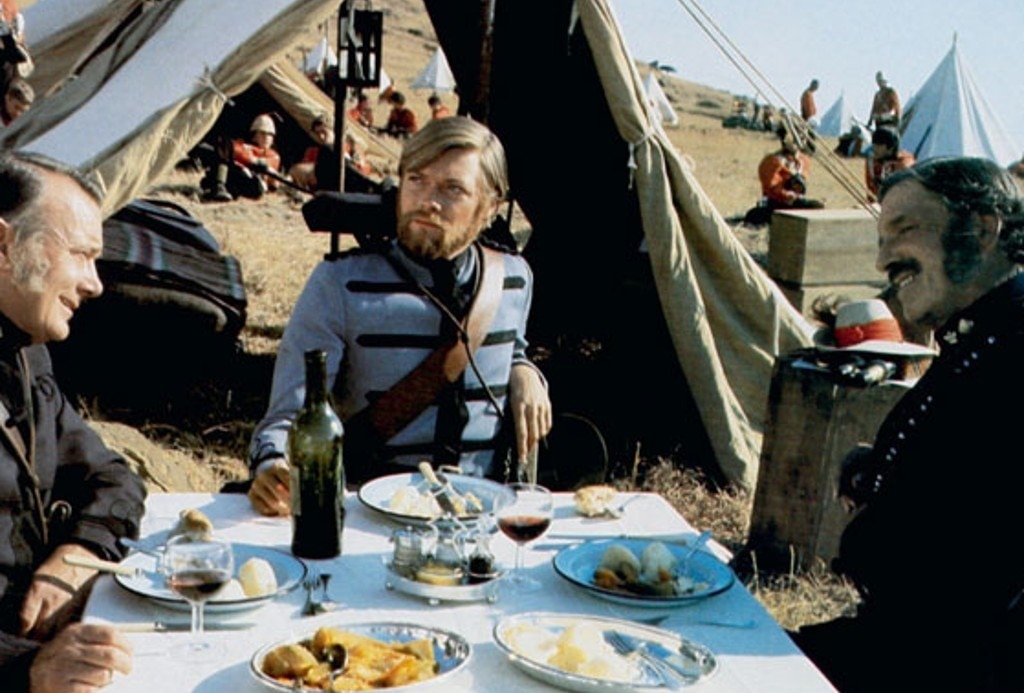
Zulu Dawn was an uncommonly serious project for Hickox, who usually made ephemeral entertainments like the crime drama Sitting Target (1972) and the droll horror movie Theatre of Blood (1973). He met the challenge of Zulu Dawn with colors flying as high as the Union flag in the film's early scenes. Hickox keeps the action moving briskly, injects wry humor into scenes parodying the upper-crust manners of officers in the field, and elicits lively performances throughout.
Standouts in the first-rate cast include Burt Lancaster as Colonel Durnford, the sympathetic leader of the African allies fighting on the British side; Denholm Elliott as Colonel Pulleine, out of his depth as the default commander of the Isandlwana camp; Peter O'Toole as Lord Chelmsford, the ambitious aristocrat who aims to pulverize the Zulus but instead brings disaster on his own troops; and Simon Ward as Lieutenant William Vereker, who starts out with high spirits that vanish when he sees the horrors of war. John Mills shows up briefly but memorably as Bartle Frere, who sets the catastrophe in motion, and Bob Hoskins's fans will enjoy seeing him as a hardnosed sergeant-major. Simon Sabela gives Cetshwayo a full measure of strength and dignity.
Although it takes place more than a hundred years ago, Zulu Dawn speaks articulately to issues of the twentieth century, as when Bartle Frere anticipates the phraseology of Nazi genocide by referring to "the final solution of the Zulu problem," and to issues of our own century, showing how the torture and humiliation of prisoners can rebound on the people who inflict it. All told, Zulu Dawn is an engaging action epic with unusually high degrees of historical savvy and humanitarian concern.
Director: Douglas Hickox
Producer: Nate Kohn
Screenplay: Cy Endfield, Anthony Storey; original story and scenario by Cy Endfield
Cinematographer: Ousama Rawi
Film Editing: Malcolm Cooke
Art Direction: Peter Williams
Music: Elmer Bernstein
With: Burt Lancaster (Colonel Durnford), Simon Ward (Lieutenant William Vereker), Denholm Elliott (Colonel Pulleine), Peter Vaughan (Quartermaster Bloomfield), John Mills (Sir Henry Bartle Frere), James Faulkner (Lieutenant Melvill), Christopher Cazenove (Lieutenant Coghill), Bob Hoskins (Colour Sergeant-Major Williams), Peter O'Toole (Lord Chelmsford), Simon Sabela (King Cetshwayo), Nigel Davenport (Colonel Hamilton-Brown), Michael Jayston (Colonel Crealock), Ronald Pickup (Lieutenant Harford)
Technicolor-117m.
by David Sterritt
Zulu Dawn
by David Sterritt | July 07, 2014
SIGN UP FOR OUR NEWSLETTERS

CONNECT WITH TCM