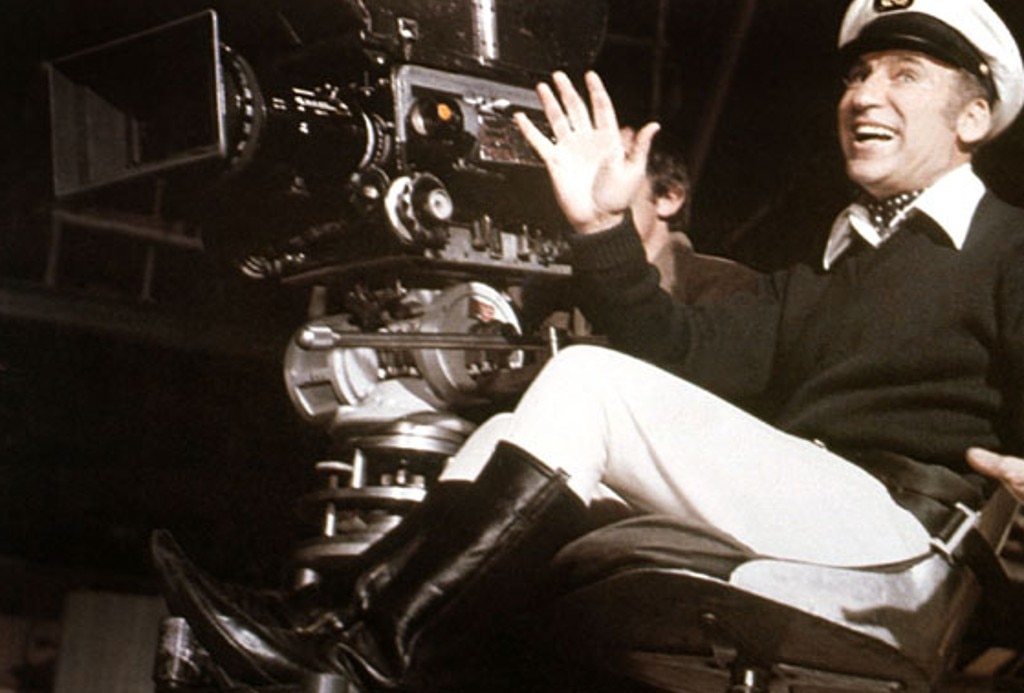
TCM salutes legendary writer-director-actor-composer Mel Brooks with a film that landed him a place in the Guinness Book of World Records for creating the sound movie with the fewest spoken lines. In his 1976 tribute to silent slapstick comedy, there is only one word spoken, ironically by famed mime Marcel Marceau, who built his career on silence. He joins a strong cast of Brooks regulars - including Marty Feldman, Dom DeLuise and Sid Caesar - and a host of cameos by celebrities like Brooks's wife Anne Bancroft and Liza Minnelli who play themselves in this comic romp. In addition, the film marks Brooks's first appearance in the leading role in one of his films.
Brooks, Feldman and DeLuise star as a trio of filmmakers out to make the first silent film in 40 years. Mogul Caesar thinks the film will save his studio, but the greedy heads of Engulf & Devour, a business conglomerate out to take over Hollywood, do everything they can to keep the movie from succeeding, including sending seductress Bernadette Peters to vamp Brooks and stealing the print, leading to a climactic car chase out of the Keystone Kops comedies.
Silent Movie was made after Brooks scored back-to-back hits with Blazing Saddles and Young Frankenstein (both 1974). Just as the former had spoofed Westerns and the latter poked affectionate fun at the Universal horror films of the '30s and '40s, his new film also was a feature-length parody of classic films. But it also marked a tip-of-the-hat to his early work on Your Show of Shows and Caesar's Hour, two classic comedy series that frequently included inspired pantomime sketches with stars Sid Caesar, Imogene Coca, Howard Morris, Carl Reiner and Nanette Fabray.
Brooks paid tribute to earlier Hollywood with an assemblage of classic jokes from the silent comedies of Hal Roach and Mack Sennett, like the tiny car into which Brooks, Feldman and DeLuise have to cram themselves, and spoofs of such classic films as The King of Kings (1927), Follow the Fleet (1936) and Ben-Hur (1959). He even includes an homage to his own works with a studio commissary fight modeled on the one from Blazing Saddles. In addition, Brooks created a cameo role for Harry Ritz of the Ritz Brothers, a man he considered the funniest person on Earth. It would be Ritz's last film appearance.
Even without spoken dialogue, Brooks knew how to milk sound for its comic potential. At one point, a shot of the New York skyline is accompanied by "I Left My Heart in San Francisco" on the score, only for the music to come to a screeching halt and switch to "Manhattan." The pratfalls are punctuated with sound effects that garner laughs in their own right, as when a gag in which Feldman gets caught between two elevator doors is scored to the sounds of a pinball machine. Ironically, Brooks originally wanted to make the film totally silent, without even a musical score. He only brought on John Morris to provide music at the insistence of 20th Century-Fox executives, who were afraid audiences would think there was something wrong with the theaters' sound systems.
Brooks also took some shots at contemporary Hollywood. For example, the evil studio Engulf & Devour, run by Harold Gould and Ron Carey, is a spoof of Gulf & Western, which had bought Paramount Pictures in 1966. The stars playing themselves appear as egotistical glory hounds addicted to conspicuous consumption. And the studio heads, surrounded by yes men, are incapable of telling good work from bad.
Because the high-priced cameo players were willing to work for union scale ($300 a day), Brooks brought the rich-looking film in for just $4.4 million. Reviews were mixed to good. Roger Ebert of The Chicago Sun-Timesloved it, praising Brooks as "an anarchist; his movies inhabit a universe in which everything is possible and the outrageous is probable, and Silent Movie, where Brooks has taken a considerable stylistic risk and pulled it off triumphantly, made me laugh a lot." Writing in The New York Times, Vincent Canby complained that the movie "doesn't contain a single moment that ever seriously threatens to split the sides," but acknowledged that it produced "a virtually uninterrupted series of smiles." But Brooks's popularity and the low cost helped turn it into a box office winner, with domestic rentals of over $21 million. More recently, it has been acknowledged as one of the treasures of Brooks's career, an experiment in film style that he pulled off triumphantly, beating the Oscar®-winning The Artist (2011) to the screen by 35 years.
Director: Mel Brooks
Screenplay: Mel Brooks, Ron Clark, Rudy De Luca, Barry Levinson
From a story by Ron Clark
Cinematography: Paul Lohmann
Score: John Morris
Cast: Mel Brooks (Mel Funn), Marty Feldman (Marty Eggs), Dom DeLuise (Dom Bell), Sid Caesar (Studio Chief), Harold Gould (Engulf), Ron Carey (Devour), Bernadette Peters (Vilma Kaplan), Carol Arthur (Pregnant Lady), Liam Dunn (Newsvendor), Fritz Feld (Maitre d'), Chuck McCann (Studio Gate Guard), Valerie Curtin (Intensive Care Nurse), Harry Ritz, (Man in Tailor Shop), Charlie Callas (Blind Man), Henny Youngman (Fly-in-Soup Man), Barry Levinson (Executive), Howard Hesseman (Executive), Jack Riley (Executive), Burt Reynolds, James Caan, Liza Minnelli, Anne Bancroft, Marcel Marceau, Paul Newman (Themselves), Dody Goodman (Tourist Woman #1)
By Frank Miller
Silent Movie
by Frank Miller | June 24, 2014
SIGN UP FOR OUR NEWSLETTERS

CONNECT WITH TCM