This tiny, speedy wartime chestnut comes to us by way of a play by
Anthony Paul Kelly, Three Faces East, first produced for a
successful stage run when Kelly was all but 21. He'd already been
writing silent movie scenarios for years, including the script for D.W.
Griffith's Way Down East (1920), and would die young in 1932.
Having his play put on in 1918 while World War I still raged -
literally, one day after the conclusion of the Battle of Amiens - makes
Kelly something of a pioneer. His quaint little espionage melodrama may
have been the first of its kind, on stage or on film, insofar as it
hinges on multiple double agentry, the sending and retrieval of secret
war messages, and the manufacture of "sleeper" identities that became
standard issue text in both spy fiction and spy reality, in the 20th
century. Before Kelly, you had "invasion fiction" from the turn of the
century, and a few military blackmailing scenarios, but not full-blown
espionage skullduggery as we've come to know it.
Kelly's play was shot in Hollywood three times in 15 years, in
1926, 1930 and 1940, and remained remarkably unchanged as a WWI thriller
even as Europe and America grew farther from one war and closer to
another. The first was a vehicle for forgotten Dutch vamp Jetta Goudal
and, in the key role as Valdar the spy-butler, Clive Brook; the second,
an early talkie, had Constance Bennett and Erich von Stroheim, and was
clearly the most high-profile and lavish of the three. The third, Terry
Morse's British Intelligence, is clearly one of those cheap and
fast quickies the studios - in this instance, Warner - ground out at the
onset of war, as the sheerest propaganda. In all likelihood, the
immediate demand for product that corresponded with the public's reality
probably prompted Warner to ransack its archive for quickly remakable
projects, and that's where Three Faces East waited. Hollywood
didn't want to wait for WWII stories to naturally emerge in 1939 and
1940, so they began converting WWI material and simply making the
Germans in 1917 rabid Nazis in behavior, if not in uniform. "Someday!"
the raving Commandant hollers, "Someday Germany will own the world!"
That didn't seem so campy in 1940. Still, there's a good deal to be
said for the comfy, calm, resplendently fake confines, for dramatic
purposes in any genre, of the aristocratically appointed English
mansion, and that's where most of Kelly's saga takes place.
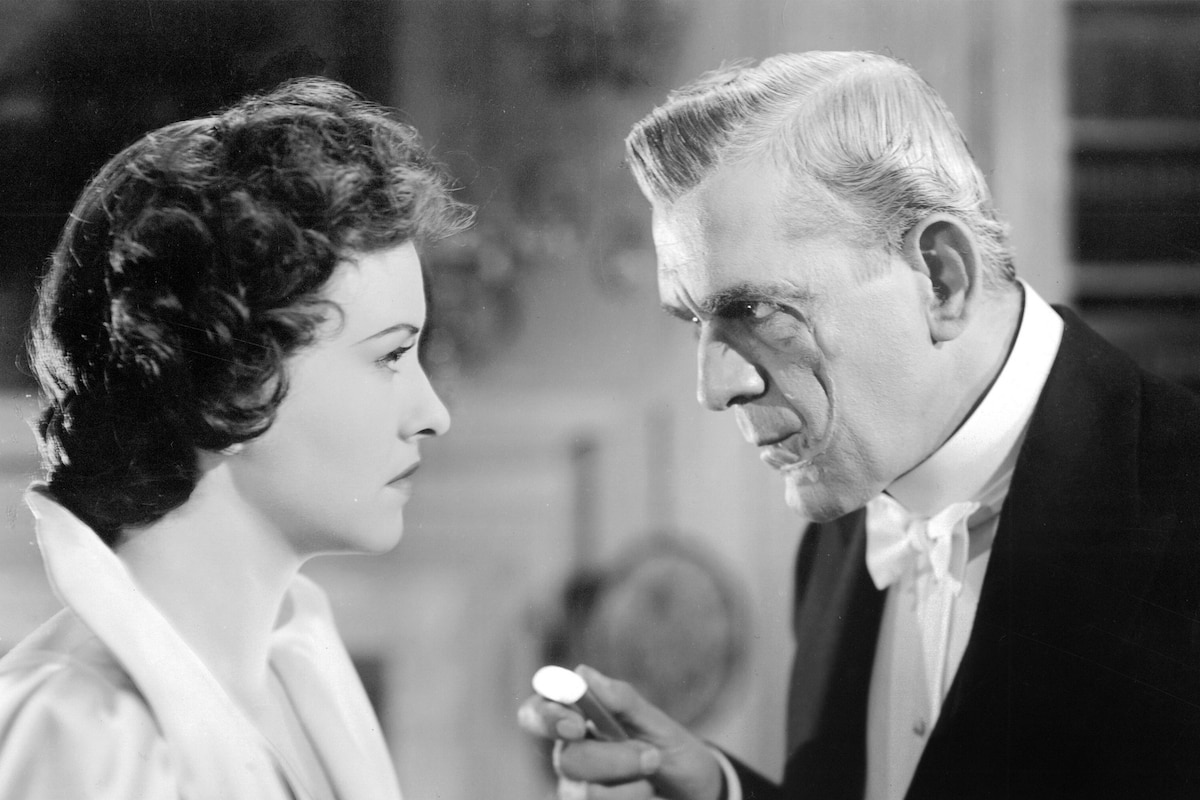
Specifically, the home of the Lord of the Admiralty, where Valdar (in
this incarnation, it's Boris Karloff, sporting an elaborate sword-slash
facial scar) butlers and where the heroine spy, played by Margaret
Lindsay, ventures, in pursuit of secret battle plans and/or the
mysterious master spy who's after the battle plans. Frankly, none of the
versions of Kelly's play are easy to vet, in terms of exactly which
double agent is actually for the Kaiser and which is actually for the
Brits, which was doubtless intentional. But in every case, the casting
of a savvy but sweet female lead against an unsavory and somewhat
creature-ish character actor tells us how things will pan out when it's
all said and done. In the meantime, Karloff tries on three different
accents as he discloses his "real" allegiances, and we're not sure if
Lindsay is in fact officially British, Belgian or German, while of
course being perfectly sure all the while.
You pay for your pleasure with the propagandistic cant -- a
climactic speech extolling the call to war is spoken directly at 1940
filmgoers -- but the fringe benefits are ample, including tons of
archival stock footage, some real, some culled from movies like 1930's
All Quiet on the Western Front, leading up to the German
strategic bombing of London featuring dreamy steampunk visions, from
where we do not know, of zeppelins floating through the clouds. Karloff
feels out of place in general, but of course his actorly commitment
refuses to weaken; he had the courtly gift of seeming to be invested in
his movie moments regardless of the film he's in. (For Karloff, that
meant lending dignity to hundreds of roles in undeserving films and TV
shows.) But Lindsay, in the lead, is the surprise here, amidst a Mount
Rushmore of craggy British supporting-role faces. A lovely brunette
almost-star who toiled in Hollywood not quite becoming famous for
decades, Iowa-born Lindsay has a disarmingly fetching middle-period Jane
Fonda smile and deep husk to her voice, and her mature sexiness and
unforced poise are hypnotic. What happened to her? Warner Bros. kept her
career at a low boil for most of the '30s, but once she went freelance,
even grabbing the female lead in the 1940 version of The House of
Seven Gables, she became a B-movie staple, mostly supporting Ralph
Bellamy in the Ellery Queen series. Her arc petered out in the
'60s with a predictable litany of TV parts, before she retired at 65.
Once you've noticed her in Morse's film, you'll be on the lookout for
her, popping up in dozens of Golden Age projects, many of which you've
probably already seen (G-Men [1935], Dangerous [1935], Jezebel [1938]), but now need
to see again.
British Intelligence is very much an artifact of its day:
hurried, utilitarian, living on borrowed sets and manufactured with
ulterior motives in mind, as was so much of America in the early '40s.
It's nostalgia that's nostalgic for the '10s, while never shaking the
immediate sense of preparing for war in 1940.
By Michael Atkinson
British Intelligence
by Michael Atkinson | June 19, 2014
SIGN UP FOR OUR NEWSLETTERS

CONNECT WITH TCM