Eleven years before Otto Preminger dramatized the birth of modern Israel in Exodus (1960), Universal-International produced this low-budget story, "torn from the headlines," about the Middle East crisis. Although the plot is formulaic, reading like Casablanca (1942) in the Holy Land, the 1949 film was the first from Hollywood to offer a picture of what was going on as European Jews, most of them refugees from World War II's concentration camps, sought a new homeland in a region set aside by the British as Mandatory Palestine.
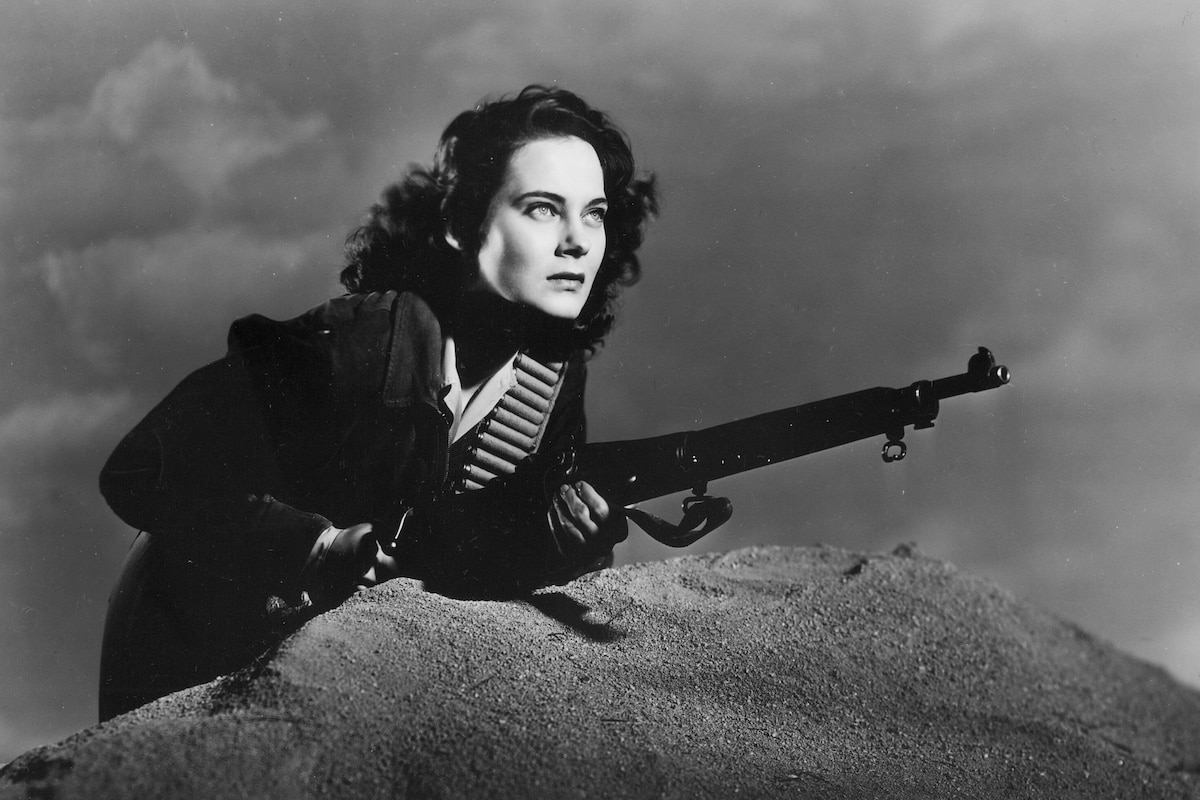
Dana Andrews stars as a ship's captain making $100 a head to smuggle Jews into Palestine. When the British close in on his ship, he's forced to flee into the new homeland with his human cargo. Originally all he wants is to get back to his ship and back into business, but as he moves through the land, sees the Haganah (the Jewish paramilitary group) at work to help the refugees and falls for a beautiful Jew (Marta Toren), he joins the many non-Jews who were helping to create the State of Israel.
The film is set in 1947, before the United Nations voted to split Palestine into separate states with Arab and Jewish governments. At that time, the region was still controlled by the British, a position that started at the end of World War I. Originally 1,500 Jews a month were allowed to emigrate to what they viewed as their Homeland, but in 1944, with the opening of the camps in Europe, all Jewish emigration was forbidden. That had led to the smuggling of Jews into the region, much of it under the auspices of Haganah, which also led resistance efforts against the Arabs and the British.
Writer-producer Robert Buckner had started out at Warner Bros., where he quickly became one of the studio's most successful writers with work on such hits as Dodge City (1939) and Yankee Doodle Dandy (1942). They valued his work so much that he was promoted to producing in 1942 with Gentleman Jim (1942). In 1948, he moved to Universal, where Sword in the Desert would be his second film.
Buckner had originally been a newspaperman, which had led to several visits to Palestine in the '30s. In 1934, he had written a short story, "How Still We See," about an atheist converted when he experiences Christmas Eve in Jerusalem. He would later call that story the inspiration for the film, first titled The Night Watch. With newspapers reporting on the Jewish resistance to the Palestinian Mandate, three different producers, including Walter Wanger and actor Robert Montgomery, tried to buy the rights, only to discover that none of the studios would finance the film. Eventually, Buckner pitched the project to Universal, which bought the story's rights for him, then immediately postponed production when members of the Zionist group Lehi assassinated UN mediator Folke Bernadotte, who was trying to end the Arab-Israeli conflict. In addition, the studio had received protests from their British associate, J. Arthur Rank, who felt that any film taking the Jewish side at that time would inevitably be anti-British. Within months, however, the film was put back in production.
Originally, the studio talked about casting contract player Ann Blyth as the love interest, a Jewish woman broadcasting anti-English statements as the "Voice of Israel." Dick Powell, the former crooner who had re-branded himself as a gritty film noir hero, was considered to play the American ship's captain. Those roles eventually went to Toren -- a Swedish actress who had appeared in Buckner's first Universal picture, Rogue's Regiment (1948) -- and Stephen McNally. When the actor cast as head of the refugees being smuggled into the country had to leave for health problems, Buckner moved McNally into that role and borrowed Andrews from independent producer Samuel Goldwyn. Early talk also indicated the film would be shot on location in Italy, but location-shooting was still new to Hollywood, so it was shot instead in California, with Monterey standing in for the Mediterranean beach and Victorville for the desert. The art department also refurbished a dude ranch in the San Fernando Valley to make it look like a kibbutz.
Of the actors cast in principal roles as members of the Haganah, only one, Jeff Chandler, was actually Jewish. Chandler, born Ira Grossel in Brooklyn, had been playing minor roles since signing with Universal shortly after the end of the war. His fourth-billed role as the Haganah leader would be his most prominent at the studio to date and would lead to better things, including his Oscar®-nominated performance as Cochise in Broken Arrow (1950). Because of its connection to his Jewish heritage, he would always call Sword in the Desert one of his favorite films.
As the film was nearing completion, members of the British press started writing about Hollywood slandering their country with the picture. Initially, Universal responded by barring all press from the film's sets. Buckner countered their claims by pointing out the British military had helped with research on the film, including providing photographs of the region for the studio's art direction department. Despite his assertions of fairness, the film opened in Great Britain to protests and even a bomb threat at one theatre. Five days after the opening, the London County Council had the film pulled from distribution in that city to prevent further disturbances. Even some U.S. critics complained that the picture was one-sided, with Bosley Crowther of The New York Times praising the picture as an effective melodrama while complaining that it made the sole enemy the British, while barely depicting any Arab resistance to Jewish settlers and ignoring dissension within the Jewish community.
Producer: Robert Buckner
Director: George Sherman
Screenplay: Buckner
Cinematography: Irving Glassberg
Score: Frank Skinner
Cast: Dana Andrews (Mike Dillon), Marta Toren (Sabra), Stephen McNally (David Vogel), Jeff Chandler (Kurta), Philip Friend (Lt. Ellerton), Liam Redmond (Jerry McCarthy), Hayden Rorke (Capt. Beaumont), Jerry Paris (Levitan), Joe Turkel (Haganah Soldier), Jack Webb (Hoffman).
By Frank Miller
Sword in the Desert
by Frank Miller | June 18, 2014
SIGN UP FOR OUR NEWSLETTERS

CONNECT WITH TCM