The first version of the Warner Bros. musical The Jazz Singer, released in 1927, had been such a sensation that a decade later studio executives had begun planning a remake. The groundbreaking original was the first feature-length film with synchronized dialogue sequences and is credited with heralding the arrival of the sound era. Based on a short story (The Day of Atonement) and a 1925 play (The Jazz Singer), both by Samson Raphaelson, the movie stars Al Jolson as Jakie Rabinowitz, a young singer who defies the traditions of his Jewish family to become a popular entertainer. Warner Oland plays Jakie's scandalized cantor father, and May McAvoy played love interest Mary Dale. Jolson sang six songs in addition to speaking such immortal lines as "You ain't heard nothing yet!"
A tenth-anniversary remake of The Jazz Singer was envisioned in 1936, with plans for Jolson to reprise his role alongside Jean Hersholt or Lionel Barrymore as the cantor and Ruby Keeler as Mary. A revised story was written, musical arrangements made and a starting date of October 15 was set - but the production never happened. It was yet another decade before the project was seriously discussed again, by which time Jolson was close to 60 years old and past the point of playing the young singer. But it was a good time for musical dramas and biographies including A Song to Remember and Rhapsody in Blue (both 1945), and the plight of European Jews during World War II had created a climate of sympathy for Jewish subjects.
So, on January 30, 1945, The Hollywood Reporter announced that Warners would be filming a "modernized" version of The Jazz Singer. Paul Muni was mentioned for the leading role. But eight months later a follow-up story indicated that Michael Curtiz would direct two up-and-comers on the Warners lot, Dane Clark and Eleanor Parker, in the film. Later it was suggested that John Garfield might take over the lead from Clark. By the end of 1945, however, the project was again shelved, presumably because Columbia Pictures was about to release The Jolson Story (1946), which covered some of the same ground.
In the early 1950s it seemed that the remake was finally about to happen, and Eddie Fisher was mentioned as a possible star. (Fisher would later say in his autobiography that he felt he was too young for the role at the time.) Finally, in 1952, production began on the new version, directed by Curtiz and starring Danny Thomas, a popular entertainer and radio actor who had enjoyed a success at Warner Bros. in I'll See You in My Dreams (1951), which costarred Doris Day and was directed by Curtiz. Day, a protégée of Curtiz since her earliest days at Warners, was also announced as Thomas's partner in The Jazz Singer. Thomas had adored working with Day and enthused to the press, "I wouldn't care of they re-titled it Mrs. Jazz Singer, just as long as they put Doris in it!" At the last minute, however, Day's name was removed from the remake and Peggy Lee, another top blonde songstress of the day, was tapped for the female lead.
Lee wrote in her autobiography that she was surprised and "elated" when Curtiz came to hear her sing at Ciro's nightclub in Hollywood and afterwards asked if she'd like to star in a film for him. She suspected that this might be "just another Hollywood conversation" but soon found herself sitting in studio head Jack Warner's office with Curtiz to discuss making The Jazz Singer. She had known Danny Thomas slightly through various show-biz connections and soon found him a "dream" to work with. "We established a friendship that will last forever," she wrote. "We laughed and sang and had a marvelous time while we worked like there was no tomorrow."
If Thomas had been disappointed with the loss of Doris Day as costar, he was equally thrilled to be working with Peggy Lee. He said in an interview for Lee's book that "Peggy's stage presence is so sweet, there's no cockiness about her. She's sure. There's a big difference between ego and assurance. Peggy has no ego, but she certainly has assurance. I mean, she takes the stage... She conducts an audience the way a conductor conducts a symphony orchestra. She gets anything she wants from them."
Thomas did allow that Lee was not an "actress actress" in the same sense that he was not an "actor actor." He noted that while she had "tremendous inner spirit," she didn't know "how to bring out these things that were in her mind as an actress -- the sadness, the inner sadness." Lee, who had never before had a real acting role in films, got on well with Curtiz but seemed uncomfortable with some of his efforts to direct her. "I don't know, Michael," she told him. "The way you talk and what you want... suddenly a door closes between us."
The Hungarian-born director, noted for his awkward use of English, persevered. Before filming one crucial sequence he said to Lee, "Now, Peggy, this time we are going to have a great scene, and we don't talk about no goddamn doors." Thomas recalled that "We all busted up laughing. She did too. But he got it out of her. He got it out of all of us." Thomas mentioned one scene in particular -- a telephone conversation in which Lee's character "was just a little high" and encourages Thomas's character to return to Broadway. "It was very sweet. There wasn't much dialogue but she had it in her face. And when she sang, forget it. The sun and the moon came out at the same time."
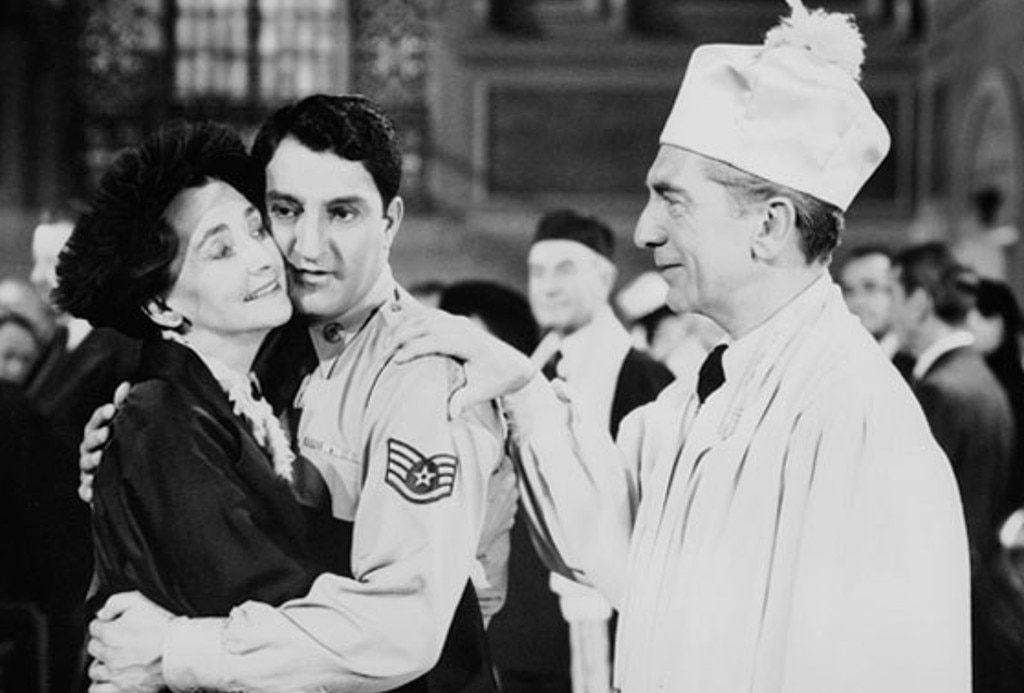
The screenplay by Frank Davis, Leonard Stern and Lewis Meltzer resets the story in a 1950s milieu, and the hero -- now called Jerry Golding -- is presented as a serviceman who has returned home to Philadelphia after seeing action in Korea. (In the original, Jolson had hailed from a Lower East Side ghetto in New York City.) But the basic conflict remains the same: the charismatic young entertainer whose plans for his future clash with those of his devout father. The remake has a more upbeat ending than the original, with the reconciliation of father and son after Jerry returns to the synagogue to sing "Kol Nidre" in the absence of his ailing dad.
In an afterthought late in the film, Lee's character, now named Judy Lane, is revealed to be Jewish by a dubbed bit of dialogue in which she says, "I haven't been to a Seder since I was a little girl." The line was added at the insistence of an influential rabbi who believed that the question of intermarriage had no place in the story. Thomas, annoyed by this addition, remarked, "Leave it alone, for God's sake. What's the matter with this guy being in love with a non-Jewish girl?" Lee recalled confused audiences at the New York opening responding to the line with "a wave of 'whatdidshesay, whatdidshesay?' "
Eduard Franz and Mildred Dunnock turn in sympathetic performances as the anguished parents, as does Alex Gerry as a concerned uncle. Also prominent in the cast are Allyn Joslyn, Tom Tully and Harold Gordon. Peggy Lee was especially pleased with costume designer Howard Shoup and his "lovely clothes, so beautifully made and fitting so perfectly." Cinematographer Carl E. Guthrie's Technicolor cinematography offers now-nostalgic views of New York City. The film was shot primarily in Hollywood during August and September of 1952. The imposing temple where key scenes occur is actually the Sinai Temple of Los Angeles.
Highlights among the musical numbers include "I'll String Along with You" and "Birth of the Blues" as sung by Thomas and "Just One of Those Things" and "Lover" by Lee, as well as a tune that Lee wrote, "This Is a Very Special Day" performed in a production number by both stars. Ray Heindorf and Max Steiner were Oscar-nominated for Best Scoring of a Musical Picture. In recordings, there were two collections of songs from the film. Danny Thomas recorded a 10-inch, eight-selection LP for RCA Victor with Frank De Vol and his orchestra, and Peggy Lee released a Decca EP with Gordon Jenkins and His Orchestra. Lee's album featured her Latin-flavored rendition of the Rodgers and Hart standard "Lover," which had become a hit single before the movie was released.
The film was released in February 1953 to largely approving but unenthusiastic reviews. The assessment of Variety was typical: "Warners' remake of Al Jolson's 1927 Vitaphone film hit is still sentimental, sometimes overly so. A drama with songs importantly spotted with beautiful Technicolor coating." Unsurprisingly, the movie did record business in wintertime Miami, although box office results in other areas of the country were sluggish.
Thomas said later that he would have liked to make more films with Peggy Lee, but his focus turned instead to television, where he starred in a long-running sitcom, Make Room for Daddy. Lee would prove her abilities as an actress in Jack Webb's Pete Kelly's Blues (1955), winning an Oscar nomination as Best Supporting Actress for her performance as a troubled Jazz-era singer. She continued to excel as a singer in concert and on television and as a songwriter, notably for Disney's animated film Lady and the Tramp (1955), where she also provided vocals. But her potential career as an outstanding leading lady of film musicals in the Doris Day tradition went unrealized.
The Jazz Singer was remade twice more. In 1959, Jerry Lewis starred in a Ford "Startime" series on NBC-TV, with Anna Maria Alberghetti cast as his love interest, Molly Picon as his mother and Eduard Franz repeating his role of the father from the Thomas version. In 1980 a movie version was produced through United Artists with Neil Diamond, Laurence Olivier and Lucie Arnaz in the key roles. For their performances, Diamond and Olivier won "Razzie" awards as Worst Actor and Supporting Actor.
By Roger Fristoe
Sources: The Jazz Singer by Robert L. Carringer, University of Wisconsin Press, 1979; Miss Peggy Lee: An Autobiography by Peggy Lee, Donald I. Fine, Inc., 1989
The Jazz Singer (1953)
by Roger Fristoe | June 18, 2014
SIGN UP FOR OUR NEWSLETTERS

CONNECT WITH TCM