Berry Levinson, when he's remembered today, is remembered for his debut, Diner (1982), and his Oscar-winner Rain Man (1988), but in truth he's hardly remembered, though he's still making movies, however small and unreleasable. Few American filmmakers of the last 30 years have such bifurcated filmographies--most of his movies have been pure money-making junk, pursued and executed, it seems, in order to finance the other Barry Levinson projects, the ones that have to do with Baltimore. This is why he should be rediscovered: somewhat under the radar, Levinson became a master of regional Americana, a key native cine-anthropologist, returning to his hometown in Maryland every few years, and crafting a tiny tetralogy of comedy-memoirs that stand together as a masterful, Renoirian portrait of mid-century American life. Diner, Tin Men (1987), Avalon (1990) and Liberty Heights (1999) are distinctively voiced films, so rich with detail and unfakable love for a bygone reality that they're destined to be his real legacy, as his other multi-million-dollar mastodons (from 1985's Young Sherlock Holmes to 1992's Toys to 2001's Bandits, and over a dozen others) vanish from the popular consciousness.
Diner was the trigger--a pitch-perfect recreation of the 1959, stuck-in-a-groove lifestyle of six Baltimore guys in their 20s, swapping yucks at the all-night eatery over gravied french fries like they have since they were kids, and not being much more savvy than that about adulthood or women. The around-the-table pop-culture banter was hilarious and convincing, and unprecedented in that it structured the film, and revealed these men to us while they talked about anything but themselves. (This was a significance not lost on a young fanboy named Quentin Tarantino.) Still occupying the transitional period of late-'50s-early-'60s, Tin Men moved into the ratpit world of pennyante middle-aged sales culture, and Liberty Heights steps back, into the awkward teenage Levinson's shoes for a coming-of-age struggle during the first stirrings of the Civil Rights era.
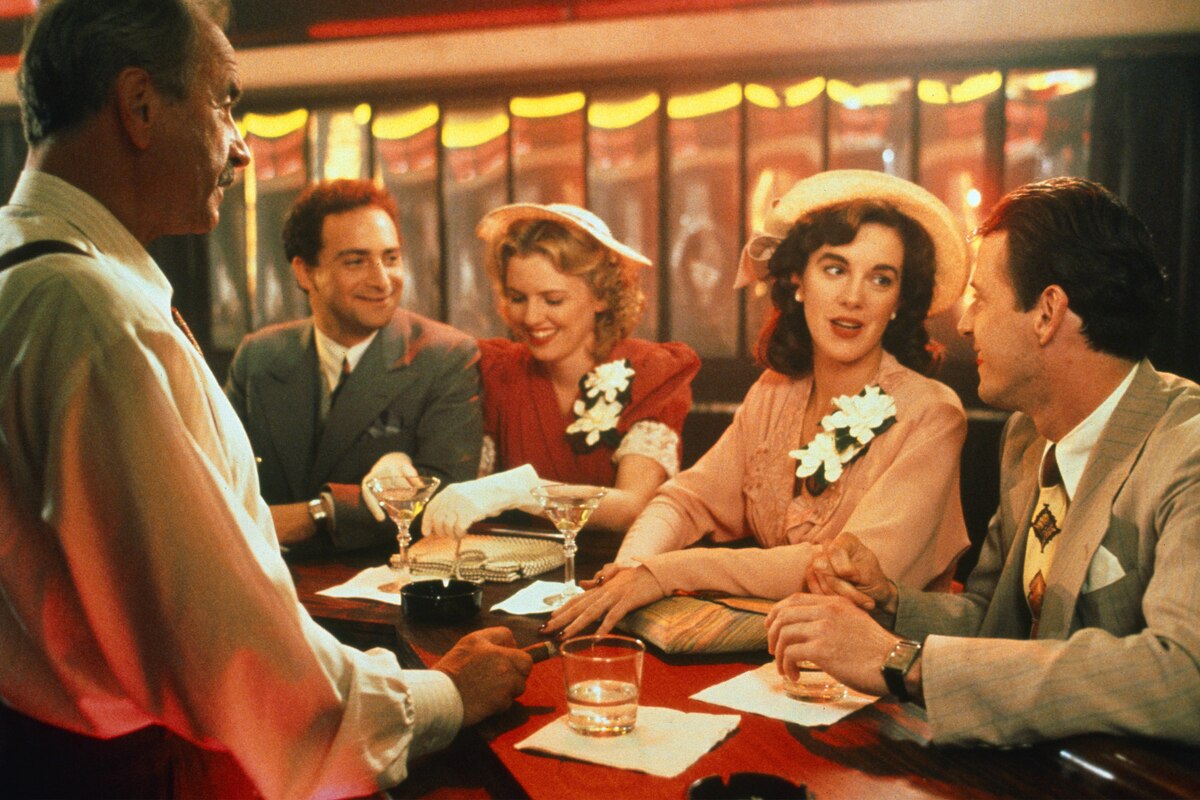
Avalon strides back further, into the late '40s, when the Barry avatar Michael (Elijah Wood) is all of nine and the youngest scion of the Krichinsky clan, led by four aging Polish Jew immigrant brothers who've already built and lost a department store business. We focus on one tale-spinning patriarch, Sam (Armin Mueller-Stahl), the testy mamele at his side (Joan Plowright), their grown son Jules (Aidan Quinn) and his wife Ann (Elizabeth Perkins) and Michael's parents, as the collected Krichinskys (Levinson's mother's maiden name, incidentally) gather for
Thanksgiving, converge on annual family meetings, and generally negotiate America, which means starting new businesses, buying the family's first TV (staring at the test pattern, the kids whisper, "Seems like something's about to happen."), moving to the suburbs, and watching the once-ironclad family slowly swap one dominant generation for another and drift apart.
It's a gentle, meandering movie, suffused with affection and patience--the same affection and patience we felt listening to the boys talk trash late at night in Diner, and the same we harbor ourselves at our lives' ruminative moments, looking at the arc of our families. The screenplay isn't made up of events, really, but decisions, reactions and observations. Nothing in Avalon ever feels arbitrary or emphatic; the scenes don't make plot points, they're just lived by the characters, with a natural gravity and grace. Mueller-Stahl's lordy grandfather is a natural performer, and so the actor makes him large, but otherwise you hardly ever catch the actors "acting" - it's just behavior. Watch them listen to each other - the space between characters is denser with feeling than most whole movies. Levinson knows how to orchestrate busy, fifteen-points-of-view dialogue scenes, around meals or merely in cramped domestic spaces, like nobody else in Hollywood, but the particulars are also sublime. A lengthy scene centered on Perkins's young wife complaining in bed to Quinn's affable Everyguy about her maddening mother-in-law could be a cliche, but the camera stays back, the actors keep their voices down so as not to be heard, and the back-and-forth kvetch-fest sounds so true and so respectful of the characters' intelligence that it has the feel of something lived, not something contrived in Hollywood. This is what you get when a film is invested with personal memory and feeling, not market-tested greed.
As it is, the people populating the fringes of the movie are indelible, and often are Baltimore citizens enlisted for their realness: Sylvia Weinberg, as Michael's stern elementary school teacher, is unmistakably the genuine article, and Avalon is in fact her only credit; Ralph Tabakin, as the crotchety school principal, is a Baltimore resident whose filmography is comprised only of every one of Levinson's films. Avalon is perhaps best appreciated as an deft fusion of details, some poetic and many mesmerizingly authentic: the school boys playing around on a discarded upright piano in the rain; the scurry of the family into the living room, carrying their dinner plates, at the start of The Texaco Star Theatre with Milton Berle; the circus elephants magically appearing down the center of the suburban street; Michael observing, out the car's rear window after a family fight, a work crew crane-lowering a prefab diner onto a street-corner; and so on. Even the textures of car grills and console-radio tuning dials bewitch Levinson.
Somehow, the filmmaker infuses Avalon with a nostalgic passion that never feels forced or coy or treacly. Sometimes Levinson moves too quickly past his beautiful moments, but the aggregate remains lovely and moving in a way Hollywood movies aren't allowed to be any longer. Since Liberty Heights, even Levinson can't raise the funds to go back to Baltimore, even though it's clear that's all he should've been doing all these years.
By Michael Atkinson
Avalon
by Michael Atkinson | June 18, 2014
SIGN UP FOR OUR NEWSLETTERS

CONNECT WITH TCM