Unconvinced of the necessity for a sequel to Planet of the Apes (1968), actor Charlton Heston agreed to appear in Beneath the Planet of the Apes (1970) with the caveat that his character - wayward Earth astronaut George Taylor, last spokesman for the human race in a future world governed by simians - be killed in the first scene. Not surprisingly, executives at 20th Century Fox choked at the concept but in reality Taylor's death had always been on the table, even as early as preproduction for the original film. In one draft of the screenplay signed by Rod Serling, Taylor met his doom when shot by a gorilla sniper at the base of the ruined Statue of Liberty. This bleak finish was carried over from the Serling draft to Michael Wilson's initial rewrites but dropped prior to the start of principal photography in the spring of 1967. In a series of treatments and drafts for Beneath the Planet of the Apes -- known in preproduction as Planet of the Apes Revisited -- contributed by a cadre of writers (among them Serling and even source novelist Pierre Boulle), Taylor lived and died alternatively, boldly fathering a new race of human-ape crossbreeds or piloting a spaceship kamikaze-style into Ape City, thus triggering a nuclear warhead, forever stopping the madness.
In the end, a compromise was struck: Heston's performance would frame the central narrative of Beneath the Planet of the Apes (1970), allowing his participation to urge a sense of continuity in the opening scenes and then granting his death wish in the closing frames. The final screenplay was authored by associate producer Mort Abrahams (the sequel's driving force) and novelist/poet Paul Dehn, author of a volume of apocalyptic verse for children. Sharing Heston's apprehension about the sequel was his Planet of the Apes costar Kim Hunter, who saw little to work with in the shooting script, her role of sympathetic chimpanzee scientist Dr. Zira reduced to a cameo. Worse for her, Hunter's scene partner, Roddy McDowall, was unavailable, off as he was in Scotland directing the supernatural thriller Tam Lin (aka The Devil's Widow, 1970) with Ava Gardner. Slotted in as McDowall's surrogate was reasonable sound-alike David Watson (who had, interestingly enough, played a singing Robin Hood for NBC-TV in a 1968 Emmy-nominated musical that featured McDowall as Prince John). To carry the narrative in Heston's absence, James Franciscus was brought in as newly-arrived astronaut Brent, a role refused by Burt Reynolds. Franciscus had just played a NASA scientist in John Sturges' Marooned (1969) and actually reworked much of his own dialogue for Beneath the Planet of the Apes.
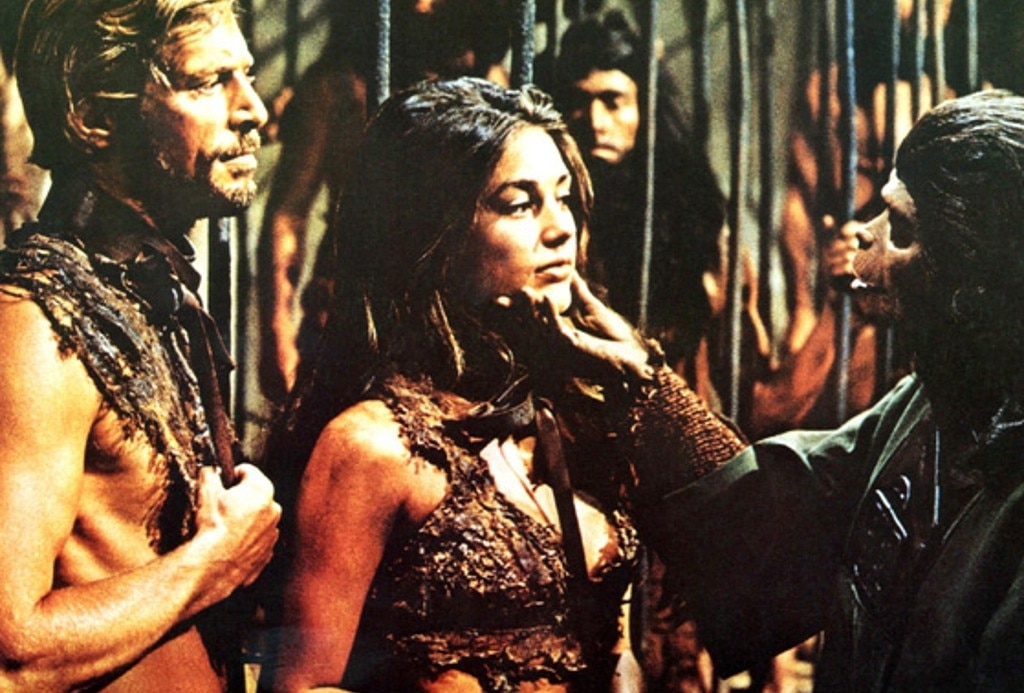
Despite the wealth reaped by 20th Century Fox with the release of Planet of the Apes, crafting the sequel was very much a scaled down affair as cameras rolled in February 1969. The budget for Beneath the Planet of the Apes was half that of the original, with the studio smarting over losses incurred by such extravagant flops as Star! (1968) and Tora! Tora! Tora! (1970) and finding economy in the reuse of standing sets and costumes. (Charlton Heston donated his entire SAG minimum salary to his son Frazer's preparatory school.) In truth, Beneath the Planet of the Apes feels cheap and downcast throughout until the narrative shifts to the cellar of the Forbidden Zone, where Brent and Linda Harrison's mute Nova discover the remnants of a long ago submerged New York City, where midtown's St. Patrick's Cathedral and downtown's stock exchange are smooshed together in a post-atomic congealment. Though the Forbidden Zone provides a ghoulishly fascinating backdrop for the sequel's best scenes (including Heston's third act return to the story), even these represented the redressing of existing sets from Hello, Dolly! (1969) and TV's The Time Tunnel. Cutting back an initially higher budget of $5 million cost the film its original director, Don Medford, who was swapped out by the more amenable journeyman Ted Post.
Despite its obvious lack of wherewithal, Beneath the Planet of the Apes landed another solid gutpunch to American moviegoers, strengthening themes fostered by the original film and seeing them through to their inevitably grim conclusion. The film's final setpiece, a triangulation of violence between man, ape, and mutants sired in the belly of the apocalyptic beast, offers a strange echo of the climax of David Lean's The Bridge on the River Kwai (1957), which shared a source novelist in Frenchman Pierre Boulle, and whose film adaptor Michael Wilson was a contributor to the shooting script of Planet of the Apes. As in the Lean film, two protagonists make a desperate run on an enemy encampment with an aim toward strategic destruction (here a doomsday bomb rather than a railroad trestle) and die graphically in the effort, leading to a climactic sense of futility. The horrors of war telegraphed by Bridge on the River Kwai are taken all the way in Beneath the Planet of the Apes, which wipes the slate clean by dint of an Armageddon triggered by the dying Heston (suffering the first of several Christ-like demises in 70s sci-fi cinema). The sequel's final frames (accompanied by Paul Frees' solemn epitaph) represented one of the most horrific fadeouts ever approved for general audiences. As end titles rolled, reluctant star Charlton Heston's wish had been granted at last... but of course this was only the beginning.
By Richard Harland Smith
Sources:
Planet of the Apes Revisited: The Behind-the-Scenes Story of the Classic Science Fiction Saga by Joe Russo and Larry Landsman, with Edward Gross (MacMillian, 2001)
Timeline of the Planet of the Apes: The Definitive Chronology by Rich Handley (Hasslein Books, 2009)
Planet of the Apes: An Unofficial Companion by David Hofstede (ECW Press, 2001)
Planet of the Apes as American Myth: Race and Politics in the Films and Television Series by Eric Greene (McFarland & Company, Inc., Publishers, 1996)
Beneath the Planet of the Apes
by Richard Harland Smith | June 18, 2014
SIGN UP FOR OUR NEWSLETTERS

CONNECT WITH TCM