One of the most surprising success stories from the independent film boom of the 1990s, The Crying Game (1992) marked a major critical and commercial return to form for Irish director Neil Jordan. The filmmaker had earned plaudits for his earlier U.K.-based films like The Company of Wolves (1984) and Mona Lisa (1986), but a two-year stint in Hollywood resulted in only two films, High Spirits (1988) and We're No Angels (1989), neither of which received much attention.
The four-year interim before the release of The Crying Game in 1992 gave him time to finely hone his script and gradually drum up financing for the project, which was entitled The Soldier's Wife well into production. Jordan later revealed that his friend Stanley Kubrick encouraged him to change the title, with the one you know now taken from a 1964 pop single penned by Geoff Stephens and performed by Dave Berry. While the original standard is heard in the film, a newly-recorded cover version sung by Boy George and produced by Pet Shop Boys was used to promote the film and became a chart hit in its own right.
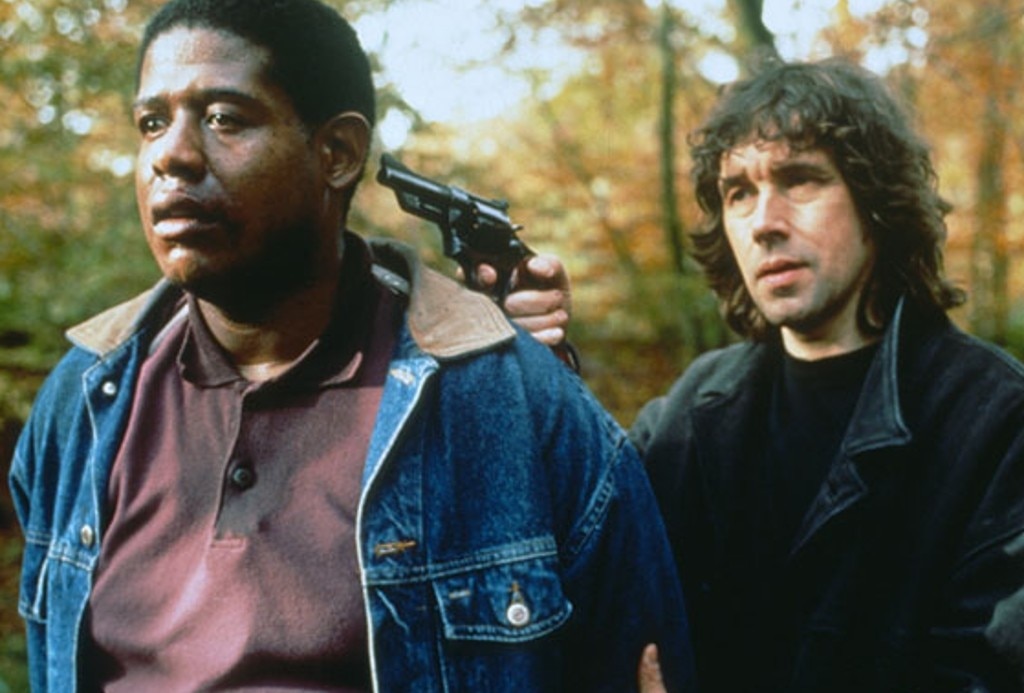
The film was initially ignored upon its original release in the U.K., where it was sold as a dark political thriller. The storyline proved a tough sell as well thanks to its nonjudgmental portrayal of Fergus (Jordan regular Stephen Rea), an IRA militant who kidnaps a British soldier, Jody (Forest Whitaker) with the aid of two compatriots, Jude (Miranda Richardson) and Maguire (Adrian Dunbar). After the plan goes awry, Fergus goes into hiding in London where, haunted by a photograph, he tracks down Jody's girlfriend, Dil (Jaye Davidson) and finds more than a few surprises in store.
Plot spoilers from this point are unavoidable, so if you haven't seen the film or have at least somehow managed to avoid hearing about the major reveal halfway into the film, just skip ahead two paragraphs. American distributor Miramax (who would be purchased the following year by Disney) revealed its marketing savvy once again by unveiling this film first at festivals, including a North American debut at Telluride, and then on a rollout basis in select cities with an emphasis on the tantalizing "secret." The enigmatic poster art of Richardson brandishing a pistol, coupled with rapidly accelerating word of mouth, turned the film into a major box office success as well as a pop culture sensation. In a welcome display of restraint, the revelation of Davidson's true gender was kept under wraps by both the media and the public throughout its theatrical run; perhaps even more surprisingly, the film's gender-bending twist played well even in states where the idea of running a gay-themed film would have been unimaginable at the time. Though the film wasn't explicitly acknowledged for breaking down barriers at the time, it clearly primed audiences for more adventurous fare with subsequent releases, most notably The Adventures of Priscilla, Queen of the Desert (1994), drawing in mainstream audiences as well.
In fact, the big twist behind the film's marketing wasn't spilled en masse to the public until the Academy Awards the following year, when Davidson earned a nomination for Supporting Actor. (Needless to say, the choice of an appropriate film clip proved to be tricky.) The film also scored five other nominations, with Jordan winning for Writing (Screenplay Written Directly for the Screen) and, in his acceptance speech saying, "It was a difficult script to write. People said to me it was about characters that were unappealing and would be unappealing to audiences at large. But I think the way audiences have responded to this film has told me anyway that audiences have it in their hearts to embrace any range of characters and any range of points of view."
Since its release, the film has become part of the public vernacular with numerous imitations, parodies, and various references, while film scholars jumped on the chance to dissect its themes and references (including the oft-noted allusion to Alfred Hitchcock's Vertigo [1958] in the names of the three main characters). Paradoxically, it has also continued to remain mysterious and highly durable over the ensuing years, rewarding repeated viewings with its emotional resonance, haunting atmosphere, and razor sharp performances. Even if you know the secret going in, there's nothing else quite like it.
By Nathaniel Thompson
The Crying Game
by Nathaniel Thompson | June 18, 2014
SIGN UP FOR OUR NEWSLETTERS

CONNECT WITH TCM