One of the most enduring genres of the silent cinema was slapstick comedy. Some of the screen's first great stars were the clowns who regularly threw pies, destroyed property and took pratfalls -- anything to get a laugh. TCM presents a quartet of classic comic shorts featuring some of the best in the business, including early star Fatty Arbuckle, his protégé Buster Keaton, daredevil Harold Lloyd, the team of Stan Laurel and Oliver Hardy and the great Charlie Chaplin. Each brought his own unique character to the screen. Arbuckle was an overgrown bad boy, Keaton the stone-faced stoic, Lloyd the all-American go-getter, Laurel and Hardy the perfect team of social misfits and Chaplin the broke and often broken-hearted Little Tramp.
Nothing was safe from Laurel and Hardy. Houses, pianos and society soirees were all destroyed by the twosome, sometimes called the most destructive silent screen comics. So it's no surprise, when they get caught in a traffic jam in Two Tars (1928), that before long they and the other frustrated motorists are tearing each other's cars apart. That bit of cinematic magic was made possible by prop man Thomas Benton Roberts, who appears briefly as the man with car full of tomatoes. He constructed special breakaway cars, including one that fell apart when a wire was pulled. The sequence has made this one of the most popular of their silent shorts. It helps that the cast includes two of their best comic foils, Charlie Hall and Edgar Kennedy, the latter the master of the slow burn. In addition, the film had one of the pair's best directors, James Parrott, and one of their best writers, future director Leo McCarey.
Never Weaken (1921) was the last of Lloyd's shorts. With his growing popularity, the move to features was only natural. But first, he created one of the funniest suicide scenes in movie history. Thinking the woman he loves (Mildred Davis, the future Mrs. Lloyd) loves another, he sets out to kill himself, which somehow or other strands him atop a skyscraper under construction. The rest is pure Lloyd, as the athletic comedian dangles from girders, only a gust of wind away from a fatal fall -- or so it always seemed. For the films dubbed his "Thrill Comedies," Lloyd created the illusion that his character was in grave danger. In truth, he always had safety nets and mattress-covered platforms just outside the shot and was a master at shooting scenes a few feet off the ground while creating the illusion that he was high in the air. Most of those films include long shots in which his character clearly is at a dangerous height, but after Lloyd's death historians discovered that he was usually doubled by stuntman Harvey Parry.
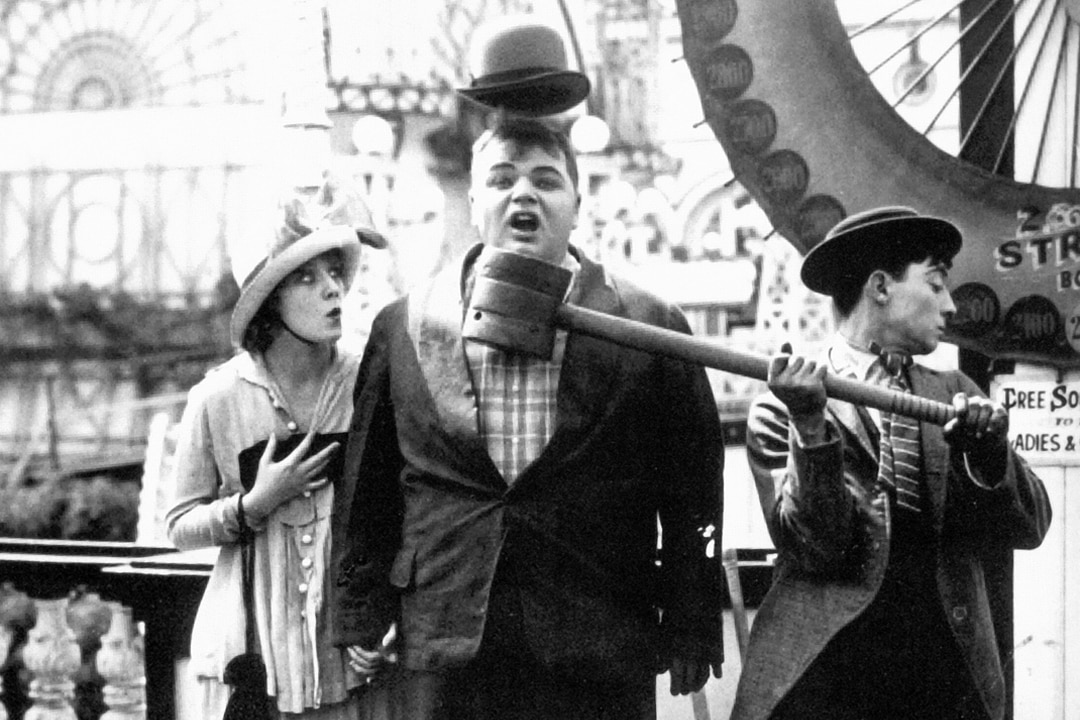
Arbuckle was one of the most popular clowns of the early silent days and Chaplin's biggest rival. As Chaplin would later do, he took complete control of his films, directing, writing and starring in Coney Island (1917). He also had a strong eye for talent, discovering Buster Keaton in vaudeville and bringing him into films initially to act as a comic foil. In this early slapstick short, Keaton is one of two men (with Al St. John), whose girlfriend married-man Arbuckle steals during a Sunday at Coney Island. With his rivals and wife in pursuit, the star partakes of some of the amusement pier's most popular early rides, including The Witching Waves and Shoot-the-Chutes, and even masquerades as a woman to elude his pursuers, only to have St. John make a pass at him. This was only Keaton's fifth film, and he had yet to establish his screen persona as "The Great Stone Face." The film offers a rare chance to see the usually subtle comedian over-act, proving that he could move his face when he wanted to.
As good as the other films in this collection are, the true masterpiece is Chaplin's The Immigrant (1917). Chaplin made the film at Mutual, the studio at which he worked in 1916 and 1917. While there he solidified the character of the Little Tramp, which he had used in earlier films, as a mischievous but sensitive romantic, eternally down on his luck. He also developed his painstaking approach to filmmaking, using multiple takes and spending more time on his short films than anybody else in the business would have. The Immigrant started as a film about two people, the Tramp and a pretty young woman (frequent co-star Edna Purviance), who meet in a café. But before he'd even appeared on screen, Chaplin decided to make the café scene the film's second half. To motivate his character's poverty he rented a tramp steamer and shot scenes of himself and Purviance and building their relationship on the ship carrying them to the U.S. only to be separated by heartless immigration officials. The restaurant scene then became their reunion. He filled the film with slapstick gags that kept audiences buying tickets, but also drove his producers mad by stretching out production and shooting countless takes. By the time the film was completed, he had shot 90,000 feet of film, almost as much as director D.W. Griffith had shot for his feature-length epic Intolerance (1916).
By Frank Miller
Silent Comedians
by Frank Miller | June 17, 2014
SIGN UP FOR OUR NEWSLETTERS

CONNECT WITH TCM