The work of French director Jacques Demy invites viewers to connect the dots between each film, with characters, plot elements, and even musical themes drifting from one to the next in the most unexpected places. However, he hadn't quite refined that sensibility yet when he made his second film, Bay of Angels (1963), one of the earliest films to treat gambling as an addiction rather than an amusing pastime or an element of the criminal underworld.
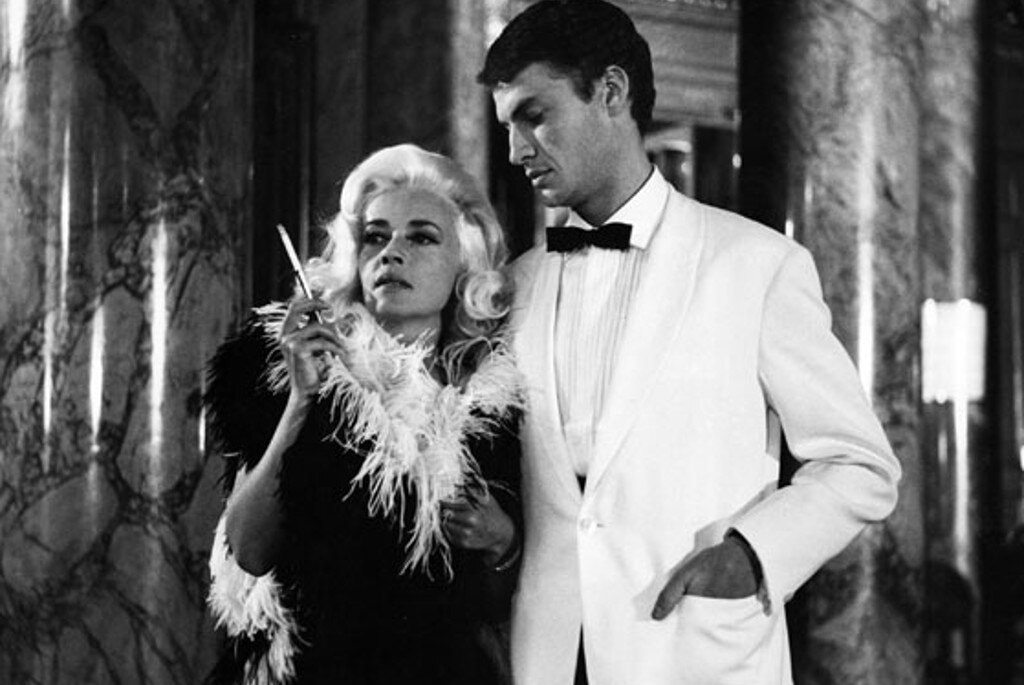
Despite its subject matter involving a pair of lovers stuck in a cyclical and often destructive relationship with games of chance in Nice, this is ultimately the most optimistic of Demy's first three features, also including Lola (1961) and The Umbrellas of Cherbourg (1964), which all involve vulnerable women whose lives and romances are dramatically jeopardized. Exactly how much stock one puts in this film's glorious final shot depends on the level of optimism a viewer brings to the table, but it's a testament to Jeanne Moreau's performance as Jackie (sporting a striking peroxide hairdo and Pierre Cardin outfits) that we still root for her after an hour and a half of compulsive misbehavior.
The other side of the coin here is Jean (Claude Mann), a young banker whose big roulette score catapults him into the glittering but turbulent world of big wins and heavy losses. Though he had written one short film, Bay of Angels was his acting debut and led to a handful of roles throughout the years, most notably Jean-Pierre Melville's Army of Shadows (1969), Claude Lelouch's Happy New Year (1973), and Luchino Visconti's The Innocent (1976).
Of course, this is really Moreau's show all the way. A veteran stage actress who got her start with the Comédie Française, she had been acting in films since the late 1940s but didn't become a major French star until 1958 with the releases of Elevator to the Gallows and The Lovers. That acclaim was solidified one year before Bay of Angels in 1962 with her celebrating starring role in Jules and Jim as well as Orson Welles' The Trial and Joseph Losey's troubled but effective Eva, whose jazzy Michel Legrand score anticipates the same composer's rhapsodic work here.
Of course, Legrand and Demy themselves proved to be a nearly inseparable team until Demy's final film in 1988. While Umbrellas remains their most celebrated achievement, they had formed a solid musical partnership since Lola and would later collaborate on the colorful musicals The Young Girls of Rochefort (1967) and Donkey Skin (1970), among others. Interestingly, there isn't a single song in Bay of Angels, a rarity for a partnership famous for integrating music, song and dialogue.
Bay of Angels was released in American theaters to little fanfare in 1964 by Pathé Contemporary Films, though reviews were generally positive if dismissive; for example, the Motion Picture Herald praised its acting and technical execution but chided it for the "strong aroma of the cheap romantic novel." After it finished play dates in 1965, the film became virtually impossible to see until a restoration spearheaded by Demy's widow, Agnès Varda, and a theatrical reissue alongside Lola in 2001 from Wellspring. Seen in context with the director's subsequent work, it was quickly reappraised with Moreau in particular earning kudos for her difficult, multi-faceted role. Perhaps Combustible Celluloid phrased it best: "I've never seen her as lively and engaging as she is here - a part-time femme fatale shedding the ice-queen image she cultivated over the years."
By Nathaniel Thompson
Bay of Angels
by Nathaniel Thompson | June 17, 2014
SIGN UP FOR OUR NEWSLETTERS

CONNECT WITH TCM