"There are not many prettier girls in Hollywood than Arlene Dahl, whose white-and-pink complexion and red hair always gets admiring glances from the opposite sex."
Louella Parsons, In Hollywood, October 1950
Though she bore about her an air of fiery unpredictability, Arlene Dahl found herself rutted, early in her film career, in good girl roles. A fleeting association with Warner Brothers netted her a plum but passive role as Dennis Morgan's fiancée in My Wild Irish Rose (1947) but she enjoyed a wider breadth of assignments at Metro-Goldwyn-Mayer. Though her beauty relegated her to Other Woman status in a fair number of cinematic love triangles, Dahl alternated such silly assignments (among them, two leading lady gigs opposite fellow ginger Red Skelton) with flintier fare, such as the thriller Scene of the Crime (1949) with Van Johnson and Reign of Terror (1949), a chronicle of the French Revolution in which the actress had to be rescued in the nick of time by hero Robert Cummings from Robespierre's torture chamber. An early opportunity to play at being the bad girl came with the costumer Inside Straight (1951), in which Dahl donned the saucy accessories of a Barbary Coast fortune hunter, but her ascension to full-on femme fatalery came in No Questions Asked (1951), which reteamed her with her Inside Straight costar Barry Sullivan.
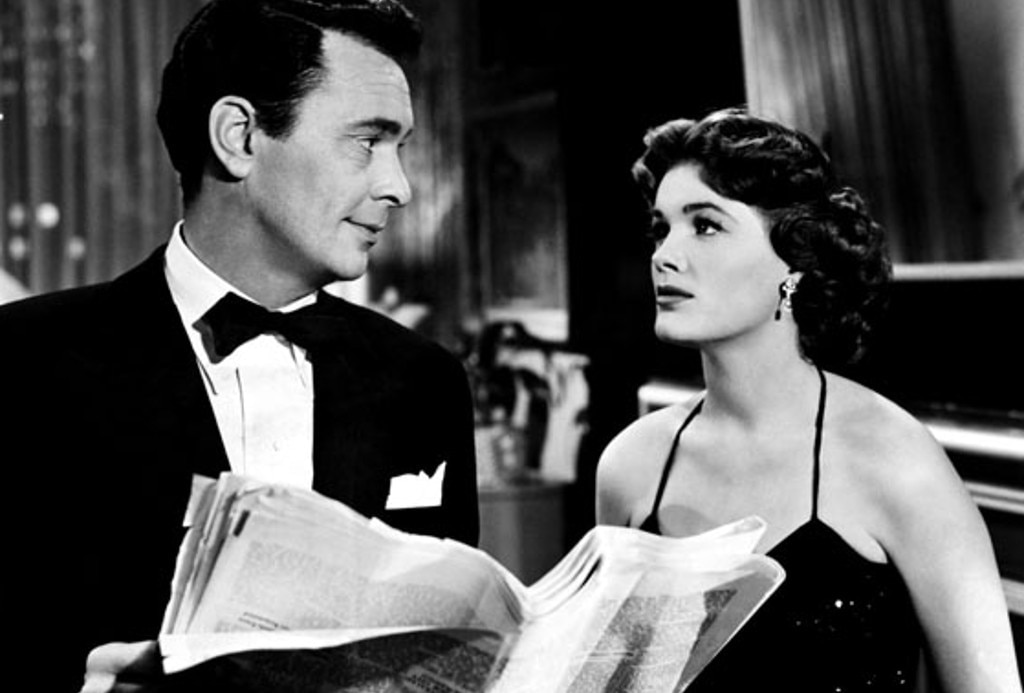
Based on an original story by Berne Giler, No Questions Asked married film noir shadows to an expose of the insurance business, in which policy carriers were growing far too accustomed to dealing directly with the underworld in a bid to stave off having to pay off on weighty insurance claims. Top-billed Sullivan plays the wide-eyed employee of such a company, whose adherence to the straight and narrow costs him acquisitive gal pal Dahl (who dumps him on principle, without admitting that she has already remarried). Beginning near the end and rolling into a flashback on "how it all happened," No Questions Asked treads on Night and the City (1950) territory, with Sullivan's fall from grace tied up with the false charge of killing a cop, and the ensuing manhunt pushing desperate characters to desperate measures. Dahl has a ball as the greedyguts Ellen Sayburn (a role intended for Donna Reed), leaving Jean Hagen to play the nice girl. If the proceedings have a melodramatic aspect, blame screenwriter Sidney Sheldon, then a busy (and Academy Award-winning) writer-for-hire who went on to pen such trash classics of summer reading as The Other Side of Midnight, Bloodline, and Rage of Angels.
Arlene Dahl's career never ran apace with the superlatives offered up in testimony to her beauty. She continued appearing in films through the decade, costarring with Alan Ladd in Desert Legion (1953), with second husband Fernando Lamas in Sangaree (1953), and with Rock Hudson in Bengal Brigade (1954), but none was particularly worthy of her. She played a kleptomaniac struggling with reform in Slightly Scarlet (1956), opposite John Payne, but traveling to England paid better dividends, character-wise. In She Played with Fire (1957), costarring Jack Hawkins, Dahl appeared to be back up to her old tricks in a tale of an insurance investigator who becomes the prime suspect in a murder-for-profit plot after rekindling a romance with an old flame (guess who). Though she retired from acting after pairing with James Mason for Journey to the Center of the Earth (1959), Dahl kept busy, redefining herself as a Chicago Tribune columnist, business woman, and health and beauty expert, while occasionally taking small roles in such films as the French The Pleasure Pit (1969) and Night of the Warrior (1991), in support of actor son Lorenzo Lamas.
By Richard Harland Smith
Sources:
The Other Side of Me by Sidney Sheldon (Grand Central Publishing, 2004)
Biography of Arlene Dahl by Rolf J. Canton, Minnesotans in the Movies (Nodin Press, 2006)
No Questions Asked
by Richard Harland Smith | June 17, 2014
SIGN UP FOR OUR NEWSLETTERS

CONNECT WITH TCM