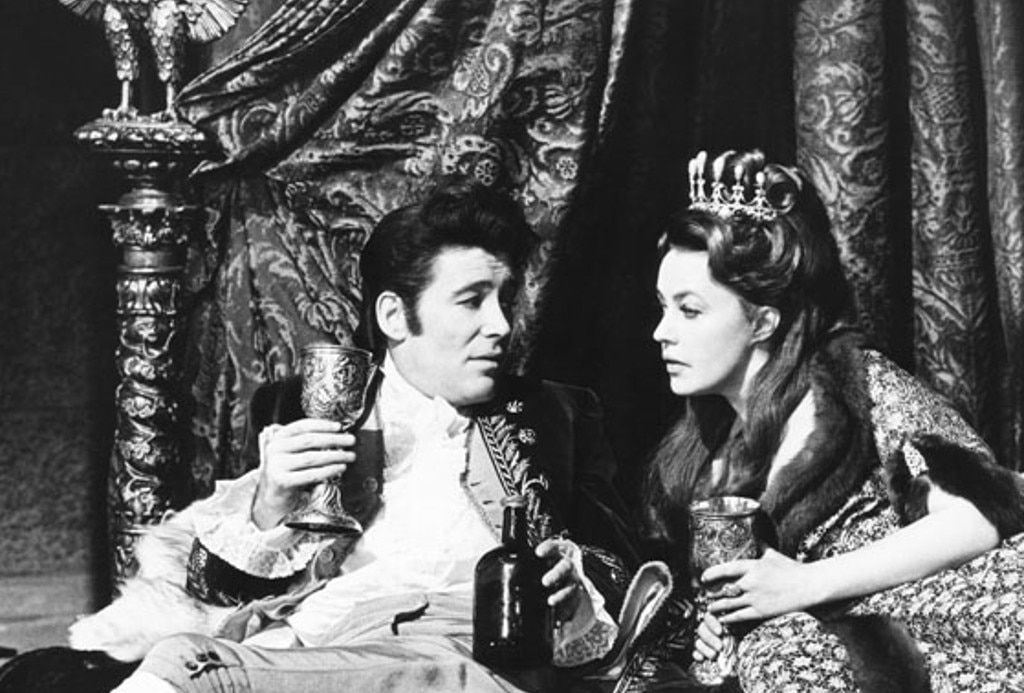
Dozens of divas have played Russian Empress Catherine the Great onscreen, among them Pola Negri, Marlene Dietrich, Tallulah Bankead, and Bette Davis. Few have been as captivating in the role as Jeanne Moreau in Great Catherine (1968). While most of the films have concentrated on Catherine's seductiveness, leadership, or political skills, Great Catherine, based on a 1913 play by George Bernard Shaw, emphasizes her playfulness and wit. In his introduction to the play, Shaw writes, "Exception has been taken to the title of this seeming tomfoolery on the ground that the Catherine it represents is not Great Catherine, but the Catherine whose gallantries provide some of the lightest pages of modern history... .It is clear to me that neither she nor the statesmen with whom she played this mischievous kind of political chess had any notion of the real history of their own times, or of the real forces that were moulding Europe."
Great Catherine begins with the arrival of the British ambassador (Jack Hawkins) and his aide and future son-in-law, the handsome but priggish Captain Edstaston (Peter O'Toole), at the court of Empress Catherine of Russia in St. Petersburg. In spite of the magnificence of the palace, it is slovenly and barbaric by their British standards. The most outrageous of her courtiers is Patiomkin (Zero Mostel), Catherine's closest advisor, who decides that the attractive soldier would make a good lover for the voracious queen. Edstaston, who is engaged to the ambassador's daughter, panics and flees, but is captured and returned. All of this is played as over-the-top slapstick, and no one is more adept at slapstick or over-the-top than Mostel. He not only steals the film, but from the very first scene, he grabs it by the scruff of the neck, shakes it, and consumes it as rapaciously and messily as his character consumes a meal.
By the mid-1960s, Peter O'Toole was at the height of his fame and one of the most in-demand actors in the world, having starred in both critically-acclaimed films such as Lawrence of Arabia (1962) and Becket (1964), and mainstream hits like What's New Pussycat (1965). Perhaps the commercial prospects for an historical film based on the work of a revered playwright were iffy at best, but O'Toole was willing to gamble on it, not only as the star, but as a co-producer. He and fellow producer Jules Buck chose a cast that included proven British talent, and stars with worldwide recognition.
br>
Like O'Toole, French actress Jeanne Moreau was an international superstar. Not only did she have the enormous talent and charisma that the role required, but she was also fluent in English - her mother was British, and a former music hall dancer. Great Catherine was shot at Shepperton Studios outside of London, and the British press followed Moreau everywhere, filing numerous stories about her "homecoming," although she had never actually lived in England. The other Moreau story that the press adored was that she would wear the actual Romanov crown jewels in the film. She also made news when, during production of Great Catherine, she was named as co-respondent in Vanessa
Redgrave's divorce petition against director Tony Richardson, with whom Moreau had made two films.
British actor Jack Hawkins had also established an international career, with supporting roles in blockbusters such as Ben-Hur (1959), and had shared the screen with O'Toole in Lawrence of Arabia and Lord Jim (1965). In 1966, Hawkins -- a heavy smoker -- had been diagnosed with throat cancer, and had his voice box removed. The surgery left him unable to speak, but did not end his career. He appeared in over a dozen more films, including Great Catherine, with his voice dubbed, and continued to work until shortly before his death in 1973.
Zero Mostel, a New York theater and television actor, had been blacklisted in the early 1950s after being named as a communist and refusing to name names when called to testify before the House Un-American Activities Committee. By the mid-1960s, Mostel was enjoying renewed stardom after the success of the stage and screen versions of A Funny Thing Happened on the Way to the Forum, and the original Broadway production of Fiddler on the Roof (1964). His manic performance as Patiomkin in Great Catherine was his first film role after re-establishing his screen career with A Funny Thing Happened on the Way to the Forum (1966).
Inevitably, Mostel got the best reviews for Great Catherine. Howard Thompson's review in the New York Times was the most enthusiastic: "The glorious hamming of the portly American makes the picture," he wrote, but added, "Mostel, who all but pulls down the palace with his bare hands...comes on so strong in the opening 20 minutes, and explodes thereafter with such wild, slapstick abandon that the rest of the picture pales and teeters uncertainly." Others were less enamored with Mostel's antics. Joseph Gelmis of Newsday called the film "noisy rather than funny," and lamented that "one of the great comics of stage and screen...is squandering his abilities in a film such as Great Catherine." The reviews were so discouraging that the film did not go into wide release, and was little-seen in the U.S. Nevertheless, O'Toole and Mostel apparently enjoyed working together. In 1967, it was announced that they would co-star in a New York production of the London stage hit, Staircase, a comedy about an aging gay couple. When O'Toole became unavailable, Mostel backed out. A 1969 film version of the play starred Rex Harrison and Richard Burton.
After making Great Catherine, Moreau returned to France, and quickly went into production on Francois Truffaut's The Bride Wore Black (1968). But she wasn't quite finished with Catherine. In 1996, she played Empress Elizabeth Petrovna, Catherine's predecessor, in a television movie starring Catherine Zeta-Jones as Catherine.
Director: Gordon Flemyng
Producers: Jules Buck, Peter O'Toole
Screenplay: Hugh Leonard, based on George Bernard Shaw's play
Cinematography: Oswald Morris
Editor: Anne V. Coates
Costume Design: Margaret Furse
Art Direction: John Bryan
Music: Dimitri Tiomkin
Principal Cast: Peter O'Toole (Captain Edstaston), Zero Mostel (Patiomkin), Jeanne Moreau (Catherine), Jack Hawkins (Sir George Gorse), Akim Tamiroff (Sergeant), Marie Lohr (Dowager Lady Gorse), Marie Kean (Princess Dashkoff), Kenneth Griffith (Naryshkin), Angela Scoular (Claire), Kate O'Mara (Varinka)
99 minutes
by Margarita Landazuri
Great Catherine
by Margarita Landazuri | June 17, 2014
SIGN UP FOR OUR NEWSLETTERS

CONNECT WITH TCM