Faye Dunaway became a superstar in a very short span of time. After only a couple of films, and a very bad experience with director Otto Preminger in which she had to sue to be released from her five film contract, she was cast in Bonnie and Clyde (1967), received an Oscar nomination for Best Actress for the very same film, and found herself starring next to international superstar Steve McQueen only a few months later in The Thomas Crown Affair (1968). Of course, the first thing that happens to superstars is they seek out more personal films now that they have the clout to do so (Puzzle of a Downfall Child [1970], The Deadly Trap [1971]), those small personal films perform poorly, they take supporting roles in more commercial ventures (The Towering Inferno, 1974) and then, after a few years, poise for a comeback. This happened to Dunaway as well and when Chinatown (1974) brought her back, and Network (1976) won her an Oscar, she found herself on top again. But five years later, while the theatrically released Mommie Dearest (1981) proved to be a disappointment, her work in television, in Evita Peron and The Country Girl, proved a great success. It was this work that she would return to for inspiration when her theatrical career faltered and the opportunity to bring a cherished novel to life presented itself.
Olive Ann Burns wrote only one complete novel in her life, Cold Sassy Tree, published in 1984, but one was enough to make her beloved to readers everywhere. The novel became an instant hit and Faye Dunaway saw herself in the role of Love Simpson, a woman who comes to the town of Cold Sassy, Georgia, to work in the shop of Enoch Rucker Blakeslee, a man very much her senior who, nonetheless, wishes to marry Love after his wife passes on. Dunaway worked hard to bring the movie to the screen and surrounded herself with talented people who brought the same devotion to the project as she.
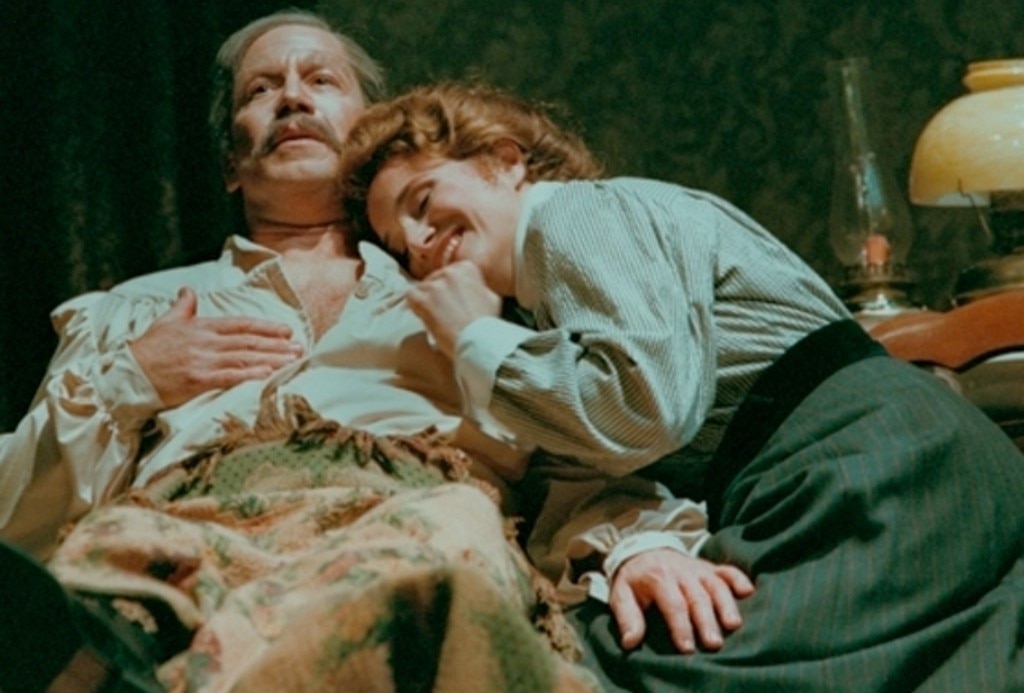
The story of Cold Sassy Tree is told through the eyes of young Will Tweedy (Neil Patrick Harris) as he reflects on growing up in Cold Sassy. After Enoch Rucker Blakeslee (Richard Widmark) loses his wife, he enters into an agreement with Love Simpson that he will marry her and she will become his housekeeper and in return he will deed his house and belongings to her when he dies. The townspeople realize the marriage is a sham but Rucker doesn't care and Love feels secure for the first time in her life. Will doesn't understand what the marriage is about but wonders if it could turn into a real marriage at some point. Eventually, Rucker and Love begin to fall in love but when Rucker wants the marriage to finally become real, Love refuses. She has a secret and believes that once that secret is revealed, Rucker will no longer love her.
Cold Sassy Tree brought together generations of actors, some on their way into show business and others on their way out. Richard Widmark, that legendary actor who electrified so many Hollywood classics over the years, was just three years away from retirement when he played Rucker Blakeslee and gave as good a performance as he'd ever given. Neil Patrick Harris, on the other hand, was just starting his career and showed how good he was by easily holding his own against the two towering talents of Dunaway and Widmark. The movie also saw some of the earliest work from Samantha Mathis as well as fine work from eighties and nineties staples Frances Fisher and Jay O. Sanders.
Cold Sassy Tree is the kind of gentle yet powerful story that works perfectly for television. Done today, it might be turned into a longer, eight episode series on cable but one has no complaints for how it was done originally. With fine unobtrusive direction from Joan Tewkesbury, who also adapted the teleplay, and an intimate, personal feel, Cold Sassy Tree might even qualify as the oft touted, rarely seen "kind of a movie they just don't make any more." Only they did make it and they even managed to include an entire song belted out by Faye Dunaway while boisterously playing the piano. That alone may be reason enough to give it a look but the story and the actors are the reason to stay.
Producers: Karen Danaher-Dorr, Faye Dunaway, Don Ohlmeyer, Barry Rosenbush
Director: Joan Tewkesbury
Writers: Joan Tewkesbury
Original Music: Brad Fiedel
Cinematography: Michael Watkins
Film Editing: Robert Seppey
Production Design: Peter Jamison
Art Direction: Rick Frisch
Costume Design: Jane Robinson
Cast: Faye Dunaway (Love Simpson Blakeslee), Richard Widmark (Enoch Rucker Blakeslee), Frances Fisher (Loma Williams), Lee Garlington (Mary Willis), John M. Jackson (Hoyt), Jay O. Sanders (Clayton McAllister), Jo Harvey Allen (Effie Belle Tate), Ken Strong (Camp), Samantha Mathis (Lightfoot McClendon), Neil Patrick Harris (Will Tweedy)
By Greg Ferrara
Cold Sassy Tree
by Greg Ferrara | June 17, 2014
SIGN UP FOR OUR NEWSLETTERS

CONNECT WITH TCM