You look at American WWII propaganda movies today, and the surface tropes are familiar enough: the stock characters, the earnest flag-waving speeches, the literally flag-waving musical numbers, the sense of eager, sunny, fearless American righteousness. It all seems fastidiously palatable, designed for easy quaffing, lingering afterwards during the war as a vague prideful sigh in your chest, and afterwards as nothing much at all. But if you look a little more carefully, at the films' unshaking smiles and inspirational narratives and aw-shucks rube-ness in the face of a global decimation with the clearest-cut villains in human history and raw memories of the last world war's unprecedented carnage hardly far from view (the transpired time roughly equals the span between today and fall of the Berlin Wall in 1989), a different kind of human experience emerges. Beneath the enthusiastic surface, as you might expect but rarely do, there's almost always an aura of dread, of uncertainty, of small-town America posturing as though we're totally up to giving it to the Reich, but actually only so far from being schoolboys unprepared for war by the American Dream.
This sense of modest hesitancy is the sweetest thing about movies like Parachute Battalion (1941), a paradigmatic wartime rouser made for RKO mere months before the bombing of Pearl Harbor. The film's prefiguration of America's entry into the war was not unusual - for almost two years, and with dozens of projects, Hollywood had been priming the American populace for entry into the European war with gusto, enough so that a Senate Subcommittee on War Propaganda was formed by isolationist congressmen, to look into 48 different movies and their "anti-American" Production Code-violating agenda. It may have been just politics in September, when Parachute Battalion was released, but of course by December 1941 the question of Hollywood's hawkishness was a moot point in all regards.
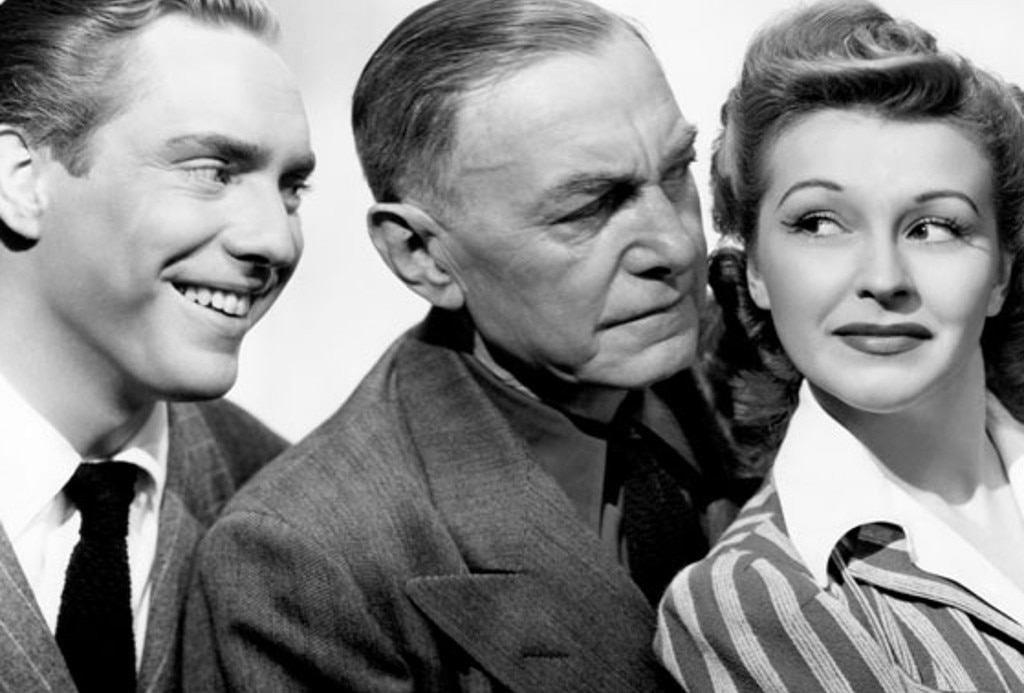
Which gives director Leslie Goodwins' spry little melodrama a feeling of wary anticipation, as buoyant and chin-up as it is on its face. It is a bald-faced recruitment movie, relegating its action to training camp in the titular troop at Fort Benning (the real parachutists of which did the actual jumps). Four young recruits, because they're green, sign up for all the wrong reasons: Edmond O'Brien's fatherless rebel has something to prove, Robert Preston's Ivy League playboy is escaping a scandal, and Buddy Ebsen's corn-pone country boy is just a dumb hick, while Richard Cromwell's tense and unstable loner is a mystery to everyone, including himself, once he loses his nut for good and pulls a gun rather than jump out of an airplane. The extra pay paratroopers get, in contrast to a regular infantryman, irritates a nagging sense of guilt for everyone but the financially-oblivious Preston - you enlist to serve, after all, not to profit.
Naturally, boot camp is seen as rather tranquil and relaxing, and just as naturally there's a love triangle, with officer's daughter Nancy Kelly shruggingly choosing between savvy O'Brien and bravado-oozing Preston, and the issue of O'Brien's paternity - his father turns out to be the platoon's colonel - raises its head for further conflict down the training-course pike. In the meantime, there's so much rudimentary instruction about paratrooping, chute packing and descent management that you come away thinking all you'd need is a little hands-on
practice, and you're set. (These were the days, however, when a parachutist had his pack open thanks to a tether attached to the plane itself - your fluency with and confidence in your ripcord was a matter for emergency secondary release only.) Predictably enough, cowardice is the main crucible up in the air, for O'Brien (whose manly self-doubt makes him the subtlest of the protagonists) and the near-psychotic
Cromwell, who played essentially the same role six years earlier in Henry Hathaway's Lives of a Bengal Lancer (1935). "Sink or swim!" is the almost inevitable cri de coeur, as O'Brien is shoved out the hatchway against his inner demons.
As so often happens, the primary delight in Parachute Battalion is the octane of personality in use, in the day when Hollywood movies were comprised of interesting people you'd want to spend time with, not computer-generated mayhem you endure as sheer spectacle. O'Brien, still thin, and Preston (fresh from 1939's smash Beau Geste) make for a beguiling pair of mismatched buddies, and as the crotchety master-sergeant in charge John Ford veteran Harry Carey has the gravity and genuineness of an authentic elder statesman, the kind of man whose words are few and therefore precious. In the gallery of familiar faces it's always a pleasure to see Paul Kelly (best remembered as the mysterious man in Gloria Grahame's apartment in Edward Dmytryk's Crossfire, from 1947) as a drill sergeant who at one bizarre point joins in a hoe-down with gangly hoofer Ebsen. Throughout, the characters toil along in their mini-dramas with barely a mention of the war beckoning overseas, but always with an undercurrent of grave apprehension. As well they might; the early pro-war films of '40-'41 offered a kind of war-game idyll, serious about fighting the Nazis in concept but still safe at home, courting the CO's wisecracking daughter and playing pranks in the barracks. Soon, that would all change.
By Michael Atkinson
Parachute Battalion
by Michael Atkinson | June 17, 2014
SIGN UP FOR OUR NEWSLETTERS

CONNECT WITH TCM