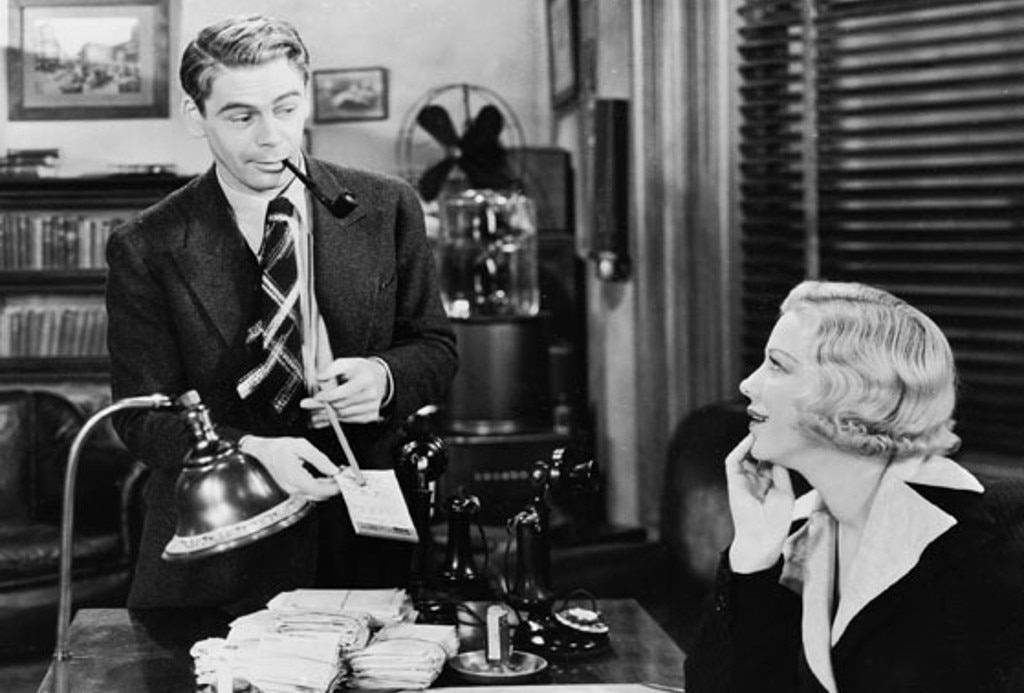
Paul Muni won fame for his versatility on both stage and screen, transforming himself almost completely for his roles, and for the seriousness of his dramatic portrayals. His career spans from the ambitious thug turned gangland boss in Scarface (1932) to historical figures in The Story of Louis Pasteur (1936) and The Life of Emile Zola (1937) to the aging doctor dedicated to helping the urban poor in The Last Angry Man (1959). For his sixth film, the 1934 release Hi, Nellie!, Muni took on something different: his first screen comedy.
Hi, Nellie! is a newspaper picture, a genre that thrived during the depression thanks to its high energy press room scenes, hard-boiled reporters, snappy patter, and street-smart sensibility. Muni plays Samuel "Brad" Bradshaw, a tough, up-from-the-streets editor of a big city newspaper, taking on the task with the soul of a reporter and a code of ethics that balances headline scoops with responsibility to the news. When he refuses to sensationalize a story that smears a respected citizen, the publisher demotes him to the "lovelorn" column, which goes under the byline Nellie Nelson. "Hi, Nellie," is the derisive salutation that the bullpen reporters give to the heartthrob columnist, a sneering insult that Brad himself is guilty of giving until he finds himself in that undignified position. Of course, Brad is a born newsman and even saddled with the column, he sniffs out a major news story with the help of his loyal leg-man Shammy (Ned Sparks).
It was Muni's third collaboration with director Mervyn LeRoy, who first directed him in I Am a Fugitive from a Chain Gang (1932), one of the films that established Muni as a Hollywood star and a serious screen actor. Hi, Nellie! "was an unlikely part for him," wrote LeRoy in his autobiography, "but he handled it magnificently," and according to Muni biographer Michael B. Druxman, the actor enjoyed making the picture.
Hi, Nellie! also reunited Muni with his Chain Gang co-star Glenda Farrell, who plays a wise-cracking reporter and former girlfriend who begins the film as the resident advice columnist, a job she despises. Farrell was one of the resident brassy blondes of the Warner Bros. stock company and went on to take the lead in another newspaper picture, Smart Blonde (1937), the first in a series of "Torchy Blane" films. Farrell played Torchy in seven of the nine films, applying that rapid-fire delivery that defines her veteran newspaperwoman here.
"Of all the studios of [the mid-1930s], Warner Brothers was the most exciting," wrote LeRoy in his autobiography. "Under contract to the studio then were stars and, even more important, a coterie of character actors, great supporting players who could do anything." That stock company gave studio directors a shorthand to instantly define a character in a small role and Hi, Nellie! was full of such performers. Berton Churchill, who plays the publisher that demotes him to the lonelyhearts column, made a specialty of fat cats and cynical politicians, most famously playing the arrogant banker in the original Stagecoach (1939). Another future Stagecoach passenger, whisky drummer Donald Meek, can be seen as the paper's Man Friday looking out for Brad from behind the scenes. Ned Sparks, who plays Brad's investigator, was one of the most recognizable players in the Warner stock company, a wiry fellow with an etched face with a perpetually sour expression and a nasal voice that delivered sarcastic lines in dozens of Warner pictures through the thirties, most notably in Blessed Event (1932), 42nd Street (1933), and Gold Diggers of 1933 (1933).
New York Times film critic Mordaunt Hall found the film familiar but well done: "Mr. Muni acts his part with spontaneity and a sense of humor. The episode devoted to his drowning his sorrow with alcohol is thankfully brief, but, as Bradshaw, he hoodwinks evil-doers with remarkable ease." It was remade in 1942 under the title You Can't Escape Forever with George Brent and Brenda Marshall.
Sources:
Paul Muni: His Life and His Films, Michael B. Druxman. A.S. Barnes and Co., 1974.
Mervyn LeRoy: Take One, Mervyn LeRoy with Dick Kleiner. Hawthorn Books, 1974.
"Hi, Nellie!" film review, Mordant Hall. The New York Times, February 1, 1934.
IMDb
By Sean Axmaker
Hi, Nellie!
by Sean Axmaker | June 17, 2014
SIGN UP FOR OUR NEWSLETTERS

CONNECT WITH TCM