Betty Grable takes a rare dramatic role in I Wake Up Screaming (1941), a key example of the film noir style that was springing up from all corners of Hollywood: RKO had released Stranger on the Third Floor (1940) a year earlier, and Warner Brothers had released The Maltese Falcon (1941) just a few weeks earlier. I Wake Up Screaming was the first film noir from 20th Century-Fox, and it's a superb one, as visually stunning as any other example of the style. (Incidentally, the one element that unites all three of these aforementioned films is the presence of actor Elisha Cook, Jr. -- himself a mainstay of film noir for years to come.)
I Wake Up Screaming is a murder mystery adapted from a pulp novel by Steve Fisher, who would go on to write noir screenplays including Dead Reckoning (1947), Lady in the Lake (1947), I Wouldn't Be in Your Shoes (1948) and Roadblock (1951). Here, Victor Mature plays a New York sports promoter who's accused of murdering a beautiful woman (Carole Landis) he had transformed from a waitress into a successful model and actress. Mature teams up with Landis's sister (Betty Grable) to try and solve the murder as a creepy police detective (Laird Cregar) hounds Mature, positive he's the guilty party.
The story anticipates other Fox noirs like Fallen Angel (1945) and especially Laura (1944). Just as in Laura, I Wake Up Screaming presents a female victim as dead right off the bat, tells much of its story in flashback, depicts the male characters as obsessed with the dead woman, and even incorporates a portrait of her into the proceedings. Both films are also located in New York, although Fisher's novel had been set in Hollywood. Fox studio chief Darryl Zanuck had the setting altered to New York as he wasn't partial to movies about Hollywood, and he also changed the title to Hot Spot before production began because he found "I Wake Up Screaming" to be too sensationalistic and disturbing. It was only at the very last minute that he changed it back, after the cast lobbied him to do so.
Zanuck assigned Betty Grable to this picture because he wanted to try broadening her appeal. It was still early enough in her career -- before she became a pinup girl -- that audiences could accept her in such a role. In fact, her wholesome, all-American persona still resonates strongly, and establishes her character as the film's moral center. As film scholar Jeanine Basinger has written: "The film wasn't all that much of a departure for her. She was playing her own familiar type -- just not singing and dancing." Still, Zanuck played up the publicity of his big star acting in such an unusual picture, and the posters declared: "Betty Grable as you've never seen her before!" According to Basinger, when Zanuck considered doing this again by placing her in The Razor's Edge (1946) as "a dipsomaniac whose dead body turns up in the Paris river," Grable shot him down by telling him, "Are you kidding? Fans would expect me to rise up out of the water with lily pads in my hair, singing 'Hooray for Hollywood.'" The difference was that by 1946, Grable was too firmly entrenched as a musical star for such a departure to have worked.
Zanuck presumably was covering his bases when he ordered the filming of a scene in a record shop where Grable sings a song, Harold Arlen's "Daddy," but the number was rightly not included in the finished film. (It can be seen as a supplement on the DVD release.) But Zanuck still made sure to give Grable's fans a little bit of what they expected, by including a totally gratuitous scene in a swimming pool with Grable and Mature in swimsuits -- and Grable's famous legs on full display. Grable was not pleased. "[It] could just as easily have taken place in a drug store or a bar," she said, "but Zanuck would have me and Victor strip down. I loathed that scene."
Victor Mature had appeared in three pictures before this one, but he always thought of I Wake Up Screaming as his first "real" movie. It was certainly his first serious drama and he is superb in it, establishing himself as a credible dramatic actor. He would go on to star with Grable in three musicals -- Song of the Islands (1942), Footlight Serenade (1942) and Wabash Avenue (1950). Mature's interplay here with Laird Cregar is especially effective and entertaining, with crackling dialogue often spoken by Mature at Cregar's expense, such as: "You make me feel like I'm driving a hearse" and "First time I ever had a bad dream with my eyes open." Cregar's hulking presence and soft-spoken voice make for a unique combination. The actor researched his role by accompanying real policemen on calls, and was caught up one night in a real shooting.
And lovely Carole Landis had previously worked with both Mature and Grable. In fact, the two women had also played sisters in their previous film, Moon Over Miami (1941). Landis's character of Vicky in I Wake Up Screaming bore some eerie similarities to Landis in real life. Landis had been waiting tables herself about seven years earlier in San Bernardino, waiting for her own Hollywood break. She got it -- but she also got a decade of heartache and, ultimately, tragedy. She married and divorced several times, was used for sex by film executives, and ultimately was driven to suicide at the age of 29. (In a further strange coincidence, when Landis committed suicide in the summer of 1948, she was actually set to start appearing in a stage version of Laura the next week.) But she had talent and could have become a top star if only she'd been given the chance. Critics often remarked upon her beauty and sex appeal, but not as often on her acting, which was underrated.
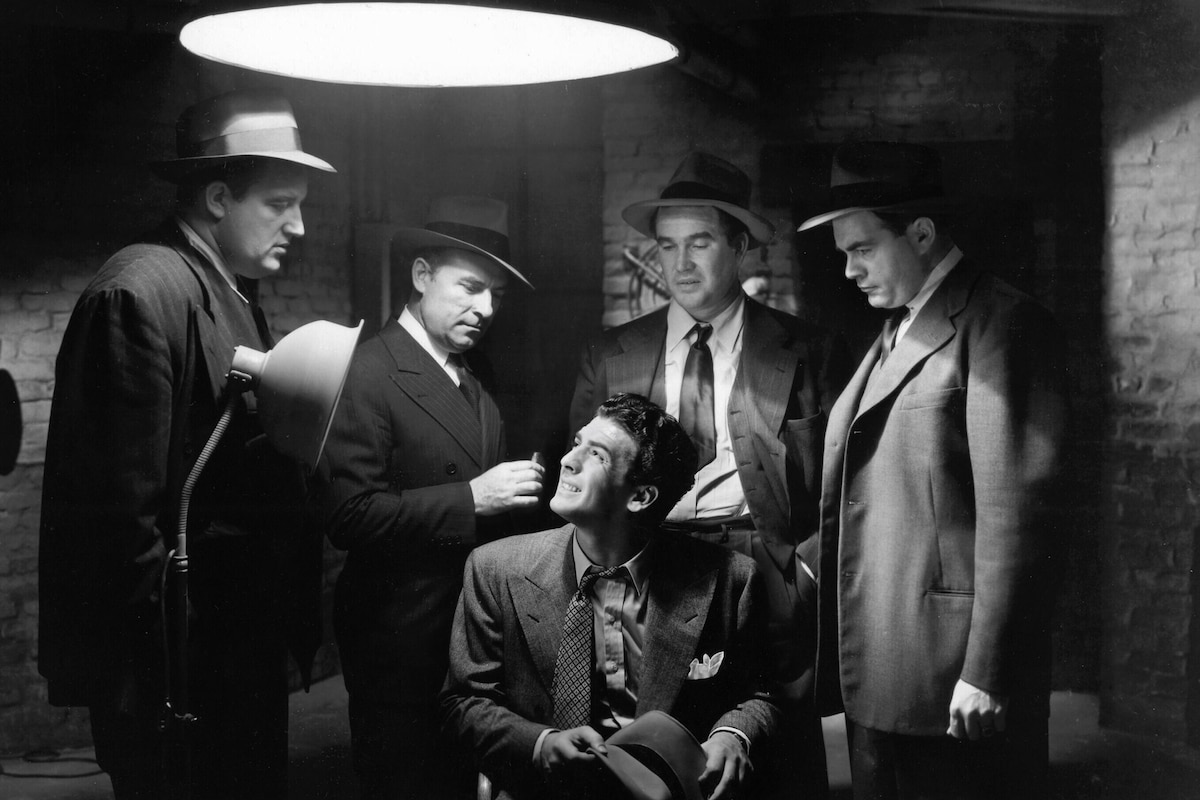
Director H. Bruce Humberstone was not usually known for dark, dramatic movies. I Wake Up Screaming is his only real film noir, though he also directed the prison drama Within These Walls (1945). Mostly Humberstone is remembered for a number of Charlie Chan movies and for big musicals like Sun Valley Serenade (1941) and Hello Frisco, Hello (1943). In fact, it was in 1941 that he was promoted out of the 'B' world into these splashy 'A' movies. Working with cameraman Edward Cronjager, with whom he had created some beautiful photographic effects of Sonja Henie skating on black ice in Sun Valley Serenade, Humberstone achieved an extremely stylish look for I Wake Up Screaming, with crisp, high-contrast photography, off-kilter angles, and faces and figures bathed in beautiful darkness. Right from the stunningly composed opening interrogation sequence, this movie shows it's doing something special.
I Wake Up Screaming was a box-office winner. Variety deemed it "first-rate entertainment... Betty Grable is enormously appealing." In 1953, it would be successfully remade as Vicki, starring Jeanne Crain and Jean Peters.
By Jeremy Arnold
SOURCES:
Jeanine Basinger, The Star Machine
Eric Gans, Carole Landis: A Most Beautiful Girl
Ed Hulse, The Films of Betty Grable
Tom McGee, The Girl With the Million Dollar Legs
I Wake Up Screaming
by Jeremy Arnold | June 17, 2014
SIGN UP FOR OUR NEWSLETTERS

CONNECT WITH TCM