John Hodiak's career was jump-started by World War II -- specifically, by the fact that he was unable to serve, due to his hypertension, and was called on by his studio (MGM) to fill in for bigger stars who had gone off to war. Many stars were produced in this way during the war years. After some two dozen movies for MGM and other studios in ten years, culminating with The Sellout (1952), Hodiak's contract was not renewed. He went to New York to make his Broadway debut in The Chase, directed by Jose Ferrer, then returned to Hollywood to freelance in several war movies and westerns, all of them on the routine side. The first was Battle Zone (1952), directed by Lesley Selander and released by Allied Artists.
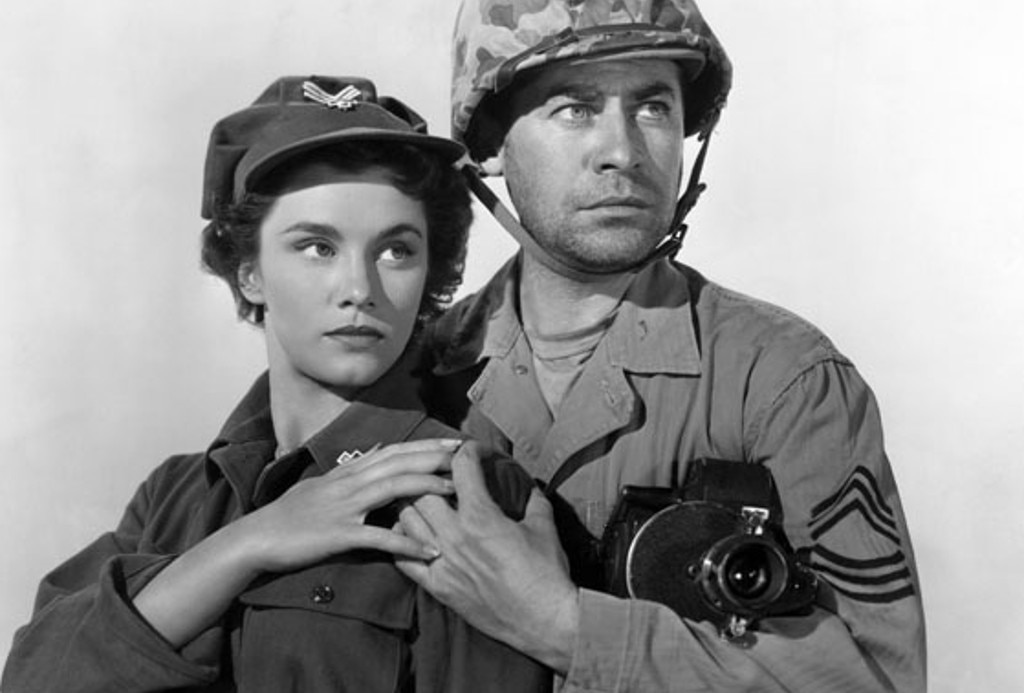
A Korean War story, it cast Hodiak and Stephen McNally as Marine combat photographers -- former WWII buddies and friendly rivals who are immersed in combat but also develop a romantic triangle with a Red Cross nurse played by Linda Christian. The film was shot in two weeks at a cost of $200,000.
Allied Artists was a unit of Monogram Pictures that made somewhat costlier films than typical Monogram fare, and at this point Allied had a new policy of using more prominent names in its main roles. Hodiak and McNally actually made for a pretty strong cast for an Allied Artists title. Also, right around the time this film was made in the summer and fall of 1952, Monogram was transitioning entirely to the Allied Artists name.
Battle Zone bears the name of Walter Wanger as producer even though he had nothing to do with making it. The longtime, respected producer had just been embroiled in one of Hollywood's biggest scandals and was actually in prison. In 1951, he had shot agent Jennings Lang in the groin after discovering that Jennings was having an affair with Wanger's wife, actress Joan Bennett. He pled insanity and was sentenced to four months in prison; he served 98 days. (When he was released, he was so appalled by the prison conditions that he made Riot in Cell Block 11 [1954], a first-rate prison drama that also functioned as a personal appeal for prison reform.)
But while Wanger was in prison, Monogram, his current employer, produced three genre films -- Fort Vengeance (1953), Kansas Pacific (1953), and Battle Zone -- and gave Wanger credit, salary, and profit participation for all three. Partly this was because the studio saw value and prestige in having Wanger's name in the credits. But it was also because, as Allied Artists executive producer Walter Mirisch said, "It was something we did for a friend in trouble." When Wanger got out of prison, he had $86,000 waiting for him from these films.
Battle Zone caused no great shakes upon release. Critics deemed it average at best, though some praised the film's use of actual documentary combat footage, integrated with the staged scenes, as making the picture look and feel bigger than it really was. The New York Times, on the other hand, thought the transitions between the two were poorly done.
A few weeks after the movie opened, Hodiak's wife, actress Anne Baxter, filed for divorce. They had first met and started dating on the set of Sunday Dinner for a Soldier (1944), and married five years later. Hodiak made only a handful more films as he died suddenly in 1955, at the age of 41, of a coronary thrombosis.
Linda Christian was best known for her turbulent marriage to heartthrob Tyrone Power, Jr. Critics echoed each other in their assessment of her work here, with The New York Times calling her "very attractive but dull," and Variety proclaiming, "Miss Christian is okay, although scoring more on looks than thespic expressiveness."
Battle Zone opened one day after the bigger-budget The Happy Time (1952), which also featured Linda Christian.
By Jeremy Arnold
SOURCES:
Matthew Bernstein, Walter Wanger: Hollywood Independent
Karen Burroughs Hannsberry, Bad Boys: The Actors of Film Noir
Battle Zone
by Jeremy Arnold | June 17, 2014
SIGN UP FOR OUR NEWSLETTERS

CONNECT WITH TCM