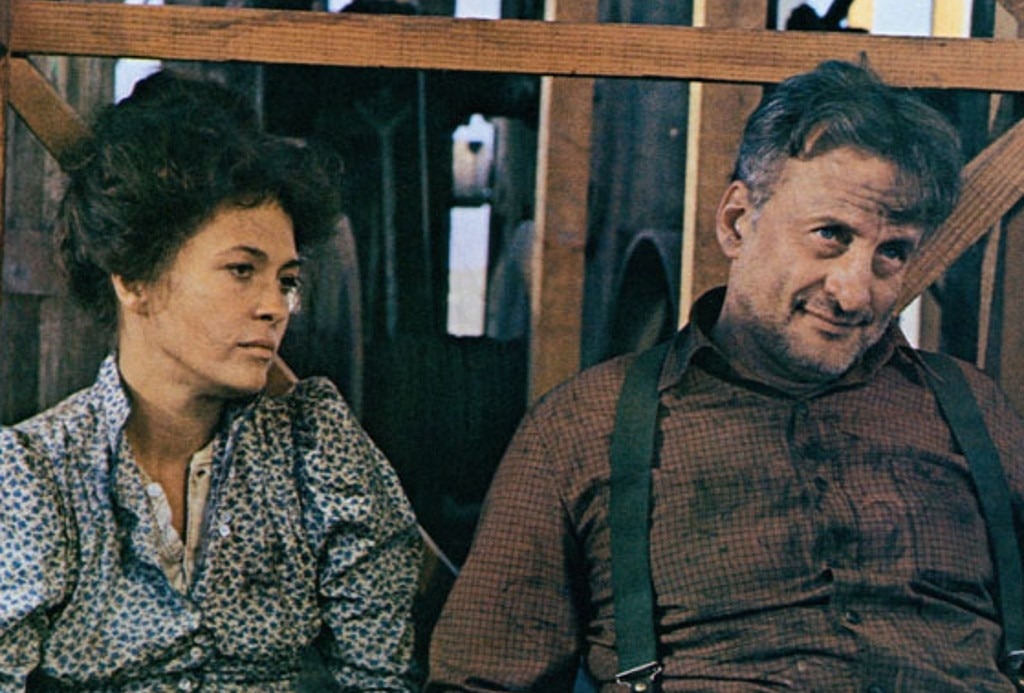
In 1973, just before a run of big hits that included The Three Musketeers (1973), Chinatown (1974) and Three Days of the Condor (1975), Faye Dunaway starred in one of her least-remembered pictures: Oklahoma Crude (1973). Marc Norman's screenplay was set in 1913 Oklahoma and centered on a woman, Lena, who is wildcatting an oil rig -- operating it independently in an area not known to contain oil. She gets into a battle with a big oil company, whose representative (Jack Palance) seems ready to stop at nothing to take her land. Though strong and self-reliant, Dunaway turns for help from her alcoholic father (John Mills) and a drifter who becomes a hired hand and lover (George C. Scott).
There are some 1970s feminist undertones to the film, much examined at the time, but in truth Oklahoma Crude, while produced and directed by the socially conscious Stanley Kramer, has more in common with movies like Boom Town (1940), with Clark Gable and Claudette Colbert, or The African Queen (1951), with Humphrey Bogart and Katharine Hepburn. As critic Roger Ebert wrote in his review, "The buried plot is always the same: Beautiful woman and uncultured man find themselves thrown together in a colorful enterprise. They have nothing in common except the enterprise, they think, but gradually their co-operation breeds respect, affection and finally love.... This seems like a perfectly satisfactory scenario to me and has inspired some of the most interesting male-female relationships in movies."
If anything, the social theme this film is most concerned about is the individual vs. the corporation. From Dunaway's perspective, Oklahoma Crude was really about "a woman who is caught between her ambition and her femininity," someone who must, in the course of the story, open up emotionally to the psychologically distant male characters in order to win her fight. "I understood that dilemma well," Dunaway later wrote, "the conflict between ambition and love, the fear of trusting someone else with your love."
Dunaway also saw parallels between her character's journey and her own real-life career trajectory: "Lena was tough, an ambitious woman who was not going to bow to the male establishment. Very real this woman was, and that's the direction I wanted to head my career in. I had come to a time in my life when I wanted to reconnect with my roots. I wanted to strip away the veneer of glamour that had attached itself to me and remind everyone that there was more to me and my talent than the slick, sophisticated, urban woman roles I seemed to be offered more and more."
Stanley Kramer scouted locations all over Oklahoma and nearby areas, but couldn't find appropriate-looking landscapes that weren't marred by electrical wires or telephone lines. So he ended up shooting near Stockton, California, on a 5000-acre sheep farm that very much resembled turn-of-the-century Oklahoma. Still, crews worked to build roads, move fences, and build structures, including 26 wooden oil derricks to scale. In fact, while the crew spent thirty weeks on location, just ten weeks were for actual filming -- with ten of those days for the single climactic sequence that required 50,000 gallons of (fake) oil to burst out of the rig. A month was required after shooting for the farm to be restored to its original condition.
Weather was a constant problem. Local weather records were broken as the company endured extreme heat (as high as 110 degrees), below-freezing cold, fog and rain. On the cold days, the actors sometimes had ice cubes in their mouths so that there wouldn't be visible steam when they spoke. "The cast really suffered," Kramer said, "and they were all splendid about it."
Kramer and Dunaway were blown away by the abilities of George C. Scott, who married the actress Trish Van Devere just four days before production began. Kramer said, "I never thought I would have the opportunity to work again with as great an actor as Spencer Tracy. But then I met George C. Scott... He has the same skills and genius Spence had: an ability to say more with an expression than with a page-long speech. They're the kind of actors who react better than most actors act."
Dunaway recalled, "It was as if he came to the set each day with his part in a briefcase. To conjure up the character, all he had to do was pop open the case, pull out the part, act the scene, then pack it all away again at the end of the day. It was just there. Never a false move."
Critics were mixed to negative, with The New York Times deeming it simply "a brawling adventure film," and The Hollywood Reporter calling it "confused... In trying to cover all bases, none is touched firmly." But Dunaway's performance was roundly praised, and probably the biggest pleasure of the film today is in seeing four marvelous actors (Dunaway, Scott, Mills and Palance) turn in very strong pieces of acting.
Oklahoma Crude was a notable hit in the Soviet Union, where it resonated as an attack on capitalism and won an award at the 1973 Moscow International Film Festival.
The train used on screen was the exact same train seen in High Noon (1952) -- an earlier Stanley Kramer production.
By Jeremy Arnold
SOURCES:
Faye Dunaway with Betsy Sharkey, Looking For Gatsby: My Life
David Sheward, Rage and Glory: The Volatile Life and Career of George C. Scott
Donald Spoto, Stanley Kramer: Film Maker
Oklahoma Crude
by Jeremy Arnold | June 17, 2014
SIGN UP FOR OUR NEWSLETTERS

CONNECT WITH TCM