Warner Brothers' production notes for Montana (1950) refer to Alexis Smith as "the long-limbed young woman whose sex appeal has only recently been high-lighted... [She] was a star for four years before somebody discovered that her long legs looked as good in a saddle as they did in the drawing-room."
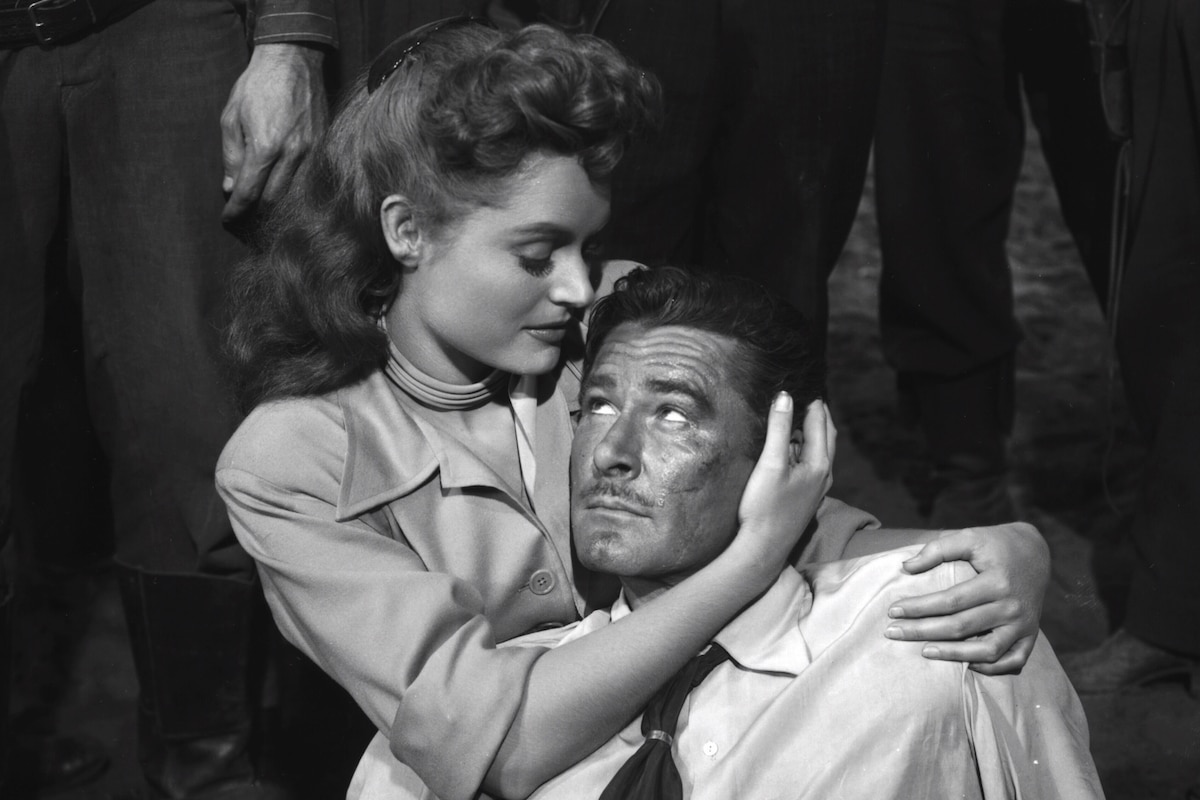
Smith was an elegant beauty whom Warner Brothers had cast for the previous nine years primarily, and decoratively, as socialite characters. Nonetheless she had managed to make a few films in other genres, including westerns, though she really yearned for the chance to make comedies and musicals -- a wish mostly denied by the studio. (An exception was the broad 1944 comedy The Doughgirls.) Montana, her last Warner Brothers picture, was a rather routine western, but Smith was happy to be paired with her good friend Errol Flynn, cast as an Australian sheep rancher setting down roots in 1879 Montana -- major cattle country. Smith plays a cattle rancher whose father was killed in a previous sheep vs. cattle range war, and she and Flynn even get the unusual chance to sing a duet on screen: "I Reckon I'm Falling in Love."
Smith had worked with Flynn on her first major movie, Dive Bomber (1941), and again in Gentleman Jim (1942) and San Antonio (1945). Smith's husband, actor Craig Stevens, later said that Smith and Flynn had struck up a great friendship on Gentleman Jim, but that Flynn, a notorious womanizer, kept his hands to himself. "He had feelings for her," Stevens told author Daniel Bubbeo, "but he also had great respect for her. He treated her with dignity, respect and humor. He never made a pass at her." Years later, shortly before his death in 1959, Flynn invited Smith to lunch on the Warner Brothers lot. When she came home, Stevens recalled, "there were tears in her eyes." Smith said that Flynn had told her "he knew he didn't have much longer to live. He wanted to tell me how much he enjoyed working with me and also that he loved me."
Author Bubbeo wrote that Smith and Stevens were so inseparable by the time of Gentleman Jim that it's very unlikely she would have gotten involved with Flynn in any case. Though Stevens had had a small part in Dive Bomber, the two really developed their romance on their next film, the B title Steel Against the Sky (1941), at the end of which their characters got married! In real life, they would marry in 1944, a union that lasted just shy of forty-nine years until Smith's death.
Warner Brothers did not renew Smith's contract after Montana, Stevens said, because "they didn't want to pay the gain in her contract." But she was not bitter and went on working independently for other studios. Soon she was acting for Frank Capra in a picture she had really wanted to do: Here Comes the Groom (1951). And later in her life she finally got the chance to sing her heart out when she turned to the stage, most memorably in Stephen Sondheim's Follies (1971), for which she won the Tony Award for Best Actress in a Musical.
Errol Flynn had already made plenty of other westerns by the time of Montana, including Dodge City (1939), Santa Fe Trail (1940), They Died with Their Boots On (1941) and San Antonio, among others. As Jeanine Basinger has written, "it's a credit to Flynn's strong screen personality that he could appear in American westerns and seem right at home on the range" -- since his features, accent and physique are not really what we usually think of as "western."
Flynn's wild off-screen life prompted studio chief Jack Warner to hire a private detective, posing as an extra, to keep an eye on Flynn and make sure he wasn't drinking or using drugs. Flynn got wind of the detective and one afternoon noticed him climbing a ladder to a hayloft -- presumably to spy on Flynn. Flynn took the ladder away and stranded him there overnight.
Reviews of Montana were lukewarm, with most criticizing it for unoriginality, the same old concept of sheepherders vs. cattlemen that had been seen many times before. The gorgeous Technicolor photography by Karl Freund was roundly praised, however. Freund used his own newly-designed light meter for the first time here. Called the Spectra, it was, according to the production notes, "a color temperature meter designed to eliminate guesswork and the human variable from color photography. The Freund instrument is the first device to undertake direct readings of the quality of light measured in degrees of Kelvin."
Montana was directed by Ray Enright, who had previously worked with Alexis Smith on the 1949 western South of St. Louis. Some sources, however, indicate an uncredited Raoul Walsh also directed parts of this picture.
Flynn was coached for his singing debut by actor and friend Dennis Morgan.
By Jeremy Arnold
SOURCES:
Jeanine Basinger, The Star Machine
David Bret, Errol Flynn: Satan's Angel
Daniel Bubbeo, The Women of Warner Brothers: The Lives and Careers of 15 Leading Ladies
Montana
by Jeremy Arnold | June 17, 2014
SIGN UP FOR OUR NEWSLETTERS

CONNECT WITH TCM