Still one of the most rudely unsung directorial voices in Hollywood
history, Cornel Wilde began producing and then directing his own movies
in the mid-'50s, as he saw the decline of choices loom in his
leading-man career. The big picture is that on the strength of three
fast, vicious, pulp-amok films, all of them struggles for survival -
The Naked Prey (1965), Beach Red (1967) and No Blade of
Grass (1970) - Wilde fashioned crude, startling visual argot as
abrupt, savage, churlish and, finally, infantile as any the movies have
ever seen. Watching the films, you may certainly get the sense, as
critic David Thomson memorably suggests, of "watching the first films
ever made," but what's more, you may sense that an untamed id is being
stoked, and you can get a reawakened sense of how deep in our reptile
brains the fears, hatreds and needs of being alive still lurk unappeased
by the narcotics of technology, fame, ritual and entertainment. For this
later chunk of his career, Wilde's breakneck brand of genre moviemaking
had the cruel simplicity of folk art, and the achievement can still
leave friction burns on your eyeballs, and exclamation points exploding
in your head.
Where this sensibility came from can be a vexing question, if you
start with his rather bland acting career, in which he is best
remembered as being noir-persecuted, and overshadowed, by strong and
secretive women - Gene Tierney in Leaver Her to Heaven (1945),
Linda Darnell in Forever Amber (1947), Ida Lupino in Road
House (1948). There were scads of grade-B swashbucklers, and only
his reliance on brawn and anxiety gave any indication of his future
filmmaking M.O. As an actor, his personality couldn't find a foothold.
But if you look at the first film he directed - Storm Fear (1955)
- you can see the real Wilde emerge, as if from a strait-jacket. A
palm-sized, claustrophobic noir scripted by Horton Foote (his first
screenplay), the movie is stagey but madly intense, as though three or
four people trapped in a room together is the de facto equivalent of a
barrel of gasoline and a thrown cigarette. The set-up is peeled for us
like an onion, and it's not simple: in a remote cabin in the
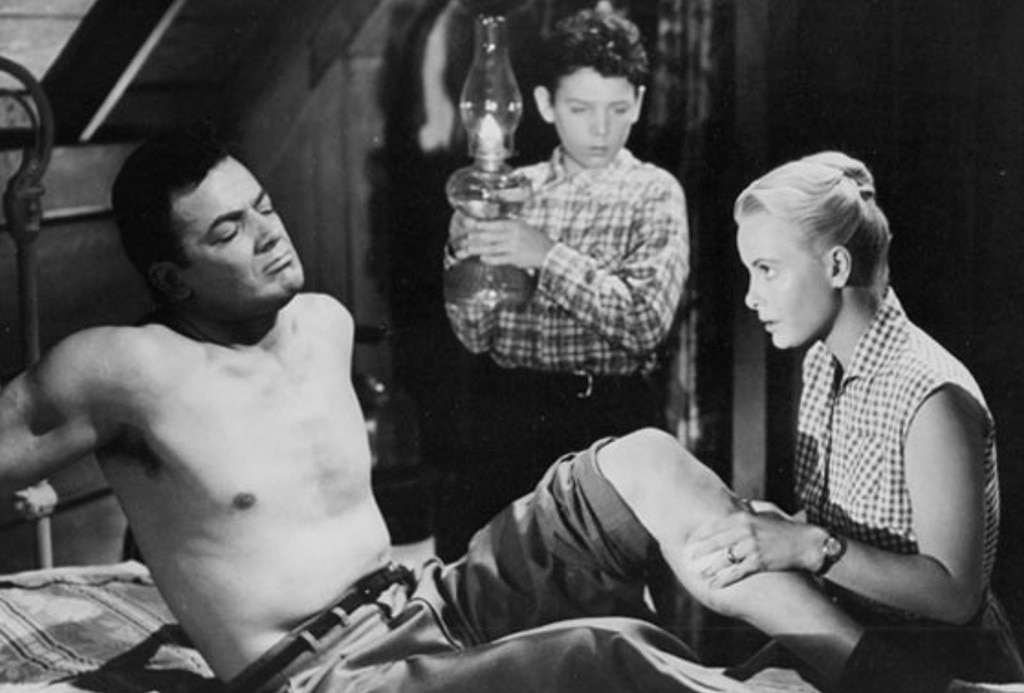
Adirondacks, an uneasy and destitute family dynamic idles, between
anxious Mom (Jean Wallace, aka Mrs. Wilde), watchful 12-year-old son David
(David Stollery) and sick and depressed Dad (Dan Duryea), whose writing
career is at a dead end. In through the door without announcement comes
a familiar noir ingredient: the small band of outlaws on the run (a
gunshot Wilde, Lee Grant's weathered but empathic moll, and Steven Hill
as the sociopathic muscle with no taste for the wilderness), looking to
hole up after a robbery in the city, and possibly take the quaint
domestic unit as hostage if need be.
Only slowly do we realize that Wilde's gangster is in fact the
Dad's bad-seed younger brother, and that the boy is actually his - and
everyone knows it except David, whose dawning awareness parallels our
discovery of the lingering, sexually impulsive, bitter romantic bond
between Wallace's Mom and Wilde's hood. (As she grows angrier with his
endless pattern of irresponsible neglect and criminal instinct, he grows
guiltier about the boy's situation, and therefore more sympathetic.) Of
course the situation in that tiny cabin begins to boil over, as the kid
looks to subvert the interlopers, the despairing Dad becomes instantly
convinced that his brother and his wife are planning to run off together
again, Hill's hair-trigger gangster (who's already left one body behind
him) begins to get violent, and with the law presumably approaching, the
bank robbers decide to force the boy to guide them on foot over the
mountains. The journey takes up the third act, on snowshoes, shifting
the moral weight of action away from all of the adults and onto David,
who realizes he alone must put an end to the story.
Pile onto all of that, in 88 minutes, the directorial climate Wilde
brings to the situation - everything percolates in the key of Goddamn,
with everyone ready to ignite at any second. The relationship between
Wilde's bad boy, crippled from a bullet and trying for the moment to
keep everybody satisfied, and Wallace's furiously heartbroken Mom begins
at a sweaty, stricken pitch and then rather graphically moves toward
moments of stunning sexual stress. In fact, we're pelted with concerns
about Wallace's sexual availability - a bizarre narrative element to
jump out at you from a '50s noir, and especially in regards to Wallace,
who's no vamp but instead a warm and self-sacrificial hausfrau. Dennis
Weaver, as a kind and courtly ranch hand, shows up drunk, and as
everybody else hides and listens, confesses to his ardor for Mom, and
makes a plea to take her David away. Wilde cuts back to the secret
eavesdroppers, guns at the ready, and we're in Wallace's shoes as she
tries to fend off the only completely decent adult in sight, in order to
save everyone's lives.
Storm Fear is distinctively thick with anxiety; the
characters in aggregate suffer more humiliations and guilty freight than
in any other noir one could think of. Wilde's budgets were never large,
and he never cared for the professional polish that might've made a
cheap movie feel slick, and his debut in particular is glaringly
inexpensive, with studio pickup inserts standing out obviously from the
mix. But those are formal details, which in the case of noir is never
much of a pertinent matter. In the case of Wilde, it can be seen as part
of his directorial signature - a willful disregard for fluid
professionalism that translates into a love for raw, cut-to-the-bone
emotional tension. Index him against Samuel Fuller, Phil Karlson and Don
Siegel (not to mention contemporaneous Japanese New Wavers like Seijun
Suzuki and Kinji Fukusaku), and he shines as a hyperbolist auteur of
struggle and human damage.
By Michael Atkinson
Storm Fear
by Michael Atkinson | June 17, 2014
SIGN UP FOR OUR NEWSLETTERS

CONNECT WITH TCM