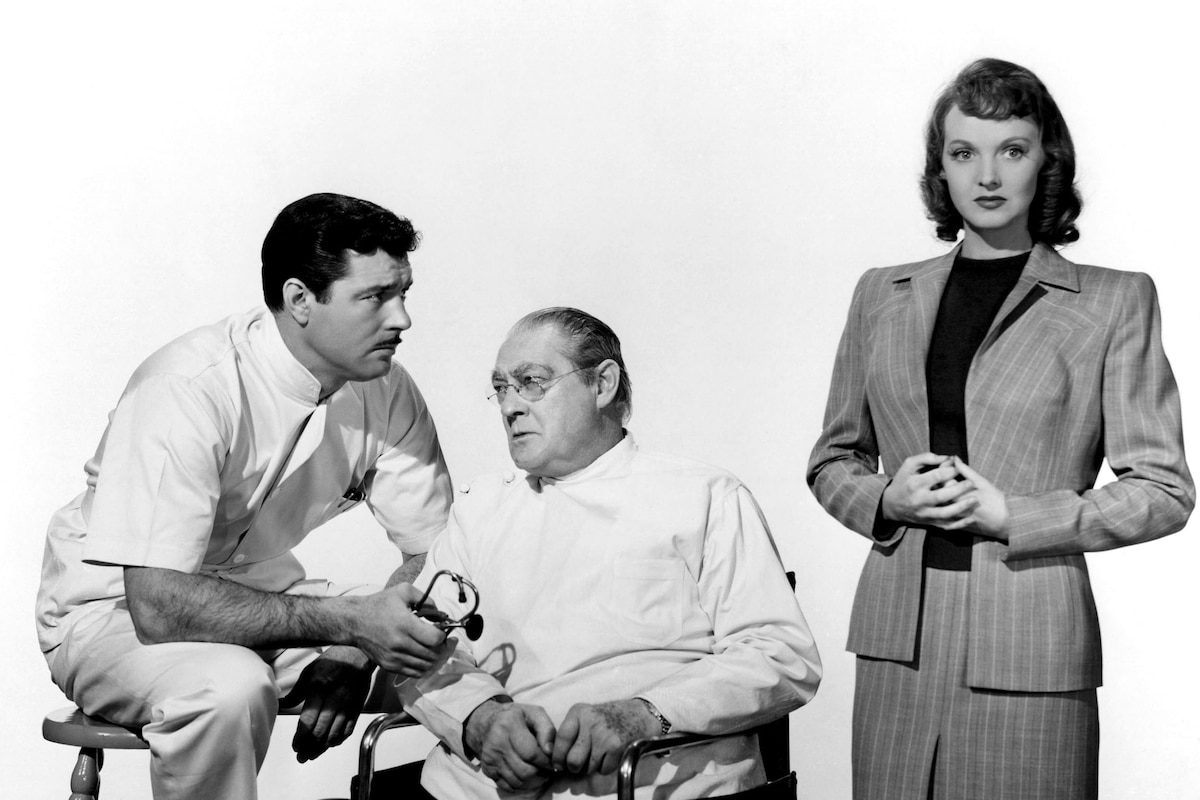
This 1947 medical drama marked the end of the road for one venerable MGM institution and one of the studio's least appreciated performers. The Dr. Gillespie series, which had followed the Dr. Kildare series after leading man Lew Ayres left MGM in 1942, was on its last legs by 1947. In fact, the series had not produced a film in two years. When this low-budget picture (the Dr. Kildare and Dr. Gillespie films were always second features) ended up losing money, the writing was on the wall. The writing was also on the wall for leading lady Lucille Bremer, a young dancer discovered by MGM producer Arthur Freed. Her role as a small-town heiress with mental problems, would be her last at the studio after only three years.
James Kildare had first reached the screen in 1937 in Paramount's Internes Can't Take Money, with Joel McCrea starring as the idealistic intern trying to help ex-con Barbara Stanwyck find her child. This adaptation of Max Brand's short story had none of the features of MGM's later films. Always in search of another series concept to showcase young talent and fill the bottom halves of double bills, MGM bought the rights to Brand's other stories and introduced the characters who would become mainstays of the series. Over the course of 15 films, Lionel Barrymore, as Dr. Gillespie, would lord it over the younger doctors at Blair General Hospital. The staff there included Dr. Kildare's love interest, Nurse Mary Lamont (Laraine Day) and comic orderly Joe Wayman (Nat Pendleton), to be joined in later films by switchboard operator Sally (Marie Blake), enterprising intern Lee Wong How (Keye Luke) and stern Head Nurse Molly Byrd (Alma Kruger).
Ayres starred in nine Dr. Kildare films. Then the announcement that he had registered as a conscientious objector during World War II caused a backlash that ended his MGM contract (Ayres would win back fans after the war with the revelation of his heroic service as a medical assistant in combat). Not ready to drop what had become a popular and profitable series, MGM switched the focus to Barrymore's character, bringing in a group of young interns to compete for a position as his assistant. Van Johnson, just starting out at the studio, filled that position for five films from 1942 to 1945. By the time the studio returned to the series for Dark Delusion, Johnson had become too big a star, so they created the role of Dr. Tommy Coalt for another young actor, James Craig.
Coalt is a young surgeon who does good work but has serious problems with his bedside manner. To give him a crash course in patient relations, Gillespie orders him to fill in for a vacationing doctor in the small town of Bayhurst. His first assignment is to sign commitment papers for the local heiress, Cynthia Grace (Bremer), but he refuses until he can check for organic causes for her instability. That decision triggers conflict with her doctor (Henry Stephenson) and father (Lester Matthews), requiring Barrymore's intervention when Craig risks his medical license to help the young woman.
Bremer had been discovered dancing in a New York nightclub by MGM producer Arthur Freed. Some sources, including fellow dancer Ann Miller, claim they were having an affair. Whatever their involvement, studio head Louis B. Mayer was impressed with her screen test and, with Freed, planned a slate of films to make the young dancer a star. After a promising feature debut as Judy Garland's older sister in Meet Me in St. Louis (1944), she was given a starring role opposite Fred Astaire in the whimsical musical fantasy Yolanda and the Thief (1945). Though now more appreciated by film buffs, the film was a rare box-office flop for Freed and Astaire, and Bremer bore most of the blame. After two star-studded musicals where she couldn't do any real harm (1945's Ziegfeld Follies and 1946's Till the Clouds Roll By), she was assigned to her first dramatic role in Dark Delusion.
If Dark Delusion represented the studio's throwing Bremer into deep dramatic waters to see if she would sink or swim, she pretty much floats. There are moments of stiffness, particularly in her more subdued romantic scenes with Craig, but also some impressive emotional displays, helped greatly by her unconventional look. Although she was quite beautiful in her Technicolor musicals, from certain angles in this black-and-white programmer she seems to be a strange amalgamation of Bette Davis and Agnes Moorehead. When the film lost money, a pretty big accomplishment for a second feature, MGM ended the Dr. Gillespie series and burned off Bremer's contract with three loan-outs to low-budget studio Eagle-Lion. Off-screen, at least, she managed to come out on top, marrying a Mexican millionaire and retiring from the screen in 1948.
Producer: Willis Goldbeck, Carey Wilson
Director: Willis Goldbeck
Screenplay: Jack Andrews, Harry Ruskin
Based on characters created by Max Brand
Cinematography: Charles Rosher
Score: David Snell
Cast: Lionel Barrymore (Dr. Leonard Gillespie), James Craig (Dr. Tommy Coalt), Lucille Bremer (Cynthia Grace), Jayne Meadows (Mrs. Selkirk), Warner Anderson (Tommy Selkirk), Henry Stephenson (Dr. Evans Biddle), Alma Kruger (Molly Byrd), Keye Luke (Dr. Lee Wong How), Lester Matthews (Wyndham Grace), Marie Blake (Sally)
By Frank Miller
Dark Delusion
by Frank Miller | June 17, 2014
SIGN UP FOR OUR NEWSLETTERS

CONNECT WITH TCM