La Haine, or Hate, caused a sensation when it was released in France in 1995 for its gritty, vivid and shocking snapshot of life in the "banlieue," or the suburban Parisian housing projects full of low-income immigrants. In the film, three young men, of Jewish, Arab, and black African descent, seethe with anger against the police and the establishment for the beating that left their friend in a coma and triggered a riot. When they find a policeman's gun that was lost in the riot, they vow revenge and head toward Paris, planning to kill a policeman if their friend dies.
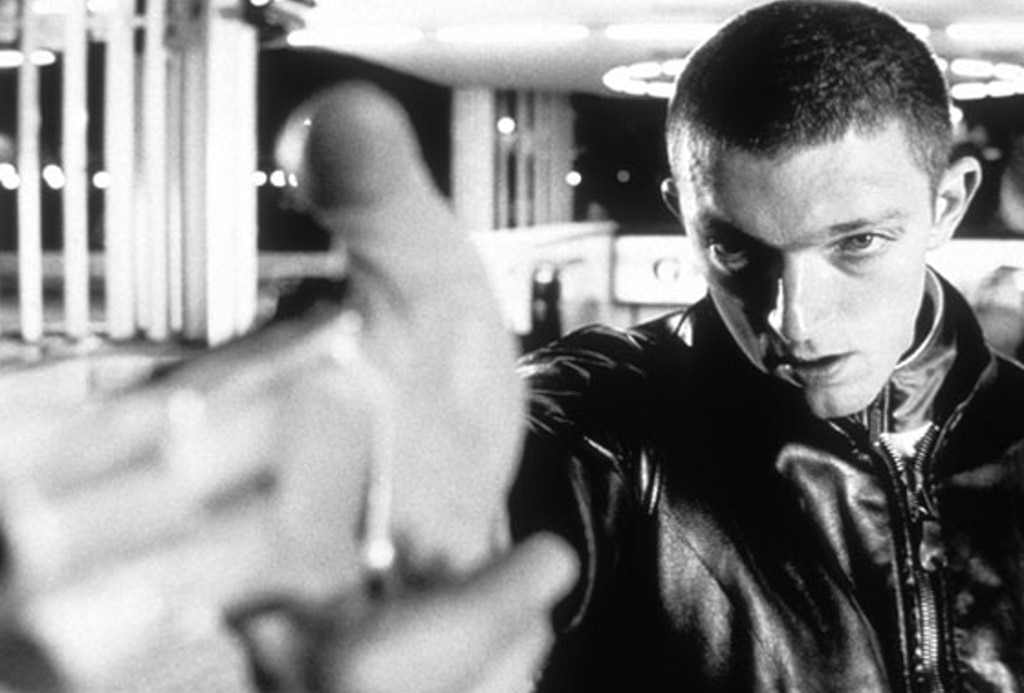
The film covers less than 24 hours, with title cards noting the passage of time, and striking, black-and-white, documentary-style camerawork creating a feeling of authenticity. There's also overlapping dialogue, jump cutting, and a mix of professional actors and non-actors on screen. The result is that La Haine achieves a feeling of hyper-reality as it unravels the genesis of the hatred it depicts.
Its 28-year-old writer-director, Mathieu Kassovitz, was inspired by a 1993 incident in which a Zairian youth named Makomé was fatally shot while in French police custody. "When Makomé died in Paris," Kassovitz said, "the victim of police brutality, I asked myself, 'How does one get into this vicious cycle of hatred where the young insult the cops who insult the young?' You can be sure that there's a bad ending each time. But since it's the cops who are armed, they're the ones liable to push things too far.
"I wanted to make a provocative film [that] is definitely a statement against the cops. I clearly wanted people to see it that way, even if I show some good guys among the cops and some dirty bastards among the youth."
Kassovitz shot his film on location in a housing project twenty miles outside Paris. "Our ghettos are very interesting places," he said, "where races and cultures mix and are a source of life. La Haine is not just a film about brutality, it's a major lesson in friendship." Of his shooting style, he added: "To me the only way to remind the audience that they are not watching a comedy or a sentimental drama is to make a movie in black and white. It feels more real."
La Haine premiered at the 1995 Cannes Film Festival, where Kassovitz won the Best Director award. He also snared an American distribution deal thanks to an unlikely source: Jodie Foster. The actress/director/producer was simply floored by the film: "I left my seat thinking here is a young filmmaker who finally has the maturity and depth to deal with urban unrest without losing his soul. Mathieu Kassovitz talks about 'hate' with love and humanity, something I haven't seen in the myriad of American urban genre films."
In 1996, La Haine won French Cesar Awards for Best Picture, Best Producer and Best Editing. In February that same year, Foster's company Egg Pictures, in conjunction with distributor Gramercy, released it in the United States. Variety called it "extremely intelligent," and The New York Times declared, "The eeriest part of Mr. Kassovitz's precise and troubling film is how easily it reflects our own societal problems."
Kassovitz himself echoed that assessment in 2004, when he was publicizing the film's tenth anniversary release. He said the film traveled well because it illustrated "a worldwide problem. Youth from every country could recognize themselves in the three characters. It did well in England, of course. Maybe it also made an impression abroad because people hadn't seen that side of French life before."
By Jeremy Arnold
La Haine
by Jeremy Arnold | June 17, 2014
SIGN UP FOR OUR NEWSLETTERS

CONNECT WITH TCM