They called it the Great War. It wasn't. They called it the War to End All Wars. It didn't.
What it was, instead, was a phenomenally efficient mechanism for turning once beautiful cities into smoking rubble, destroying wealth, and rendering human beings into piles of meat. When all was done, 10 million people had died. That didn't even count the wounded and missing, which would push the number closer to 40 million.
Most people who saw this horror firsthand didn't live to tell about it. Abel Gance did. He was not yet one of the world's most acclaimed film directors--it would take the nightmare of WWI to turn him into that.
Gance was conscripted into the French army's Cinematograph Section, a natural enough home for him and a tolerable posting, all things considered. But it didn't last. Soon he was transferred to the Ecole Militaire, and then to the Transport Corps, and then to the poison gas factory. It was emblematic of the idiotic priorities that took over during this dark time to take one of the country's great cultural treasures and send him off to manufacture poison gas.
He sickened, his skin turned yellow. Gance was already stricken with early stages of tuberculosis, and the conditions of the poison gas plant only hastened his deterioration. Every night, the officers dragged away the corpses of those workers who died during that day's shift. This was surely the end for Abel Gance.
But a poison gas factory that kills your own troops is a bad military strategy, and even the madmen running WWI could see that. The Inspection Committee came to swap out the sickest troops for fresh replacements, and thereby minimize the on-site death toll. They didn't just reassign Gance, they dismissed him--back to civilian life, and his art.
But Gance did not return easily to his old life. He brought something back with him, and it would not leave him be.
In 1918, Gance embarked on an ambitious multipart epic called Ecce Homo (originally titled The Black Sun). After shooting hours upon hours of footage, he was still far from finished. Distributor Pathe inquired about the status of the project they had been financing, and Gance had to admit he was now compelled by his conscience to switch gears. He started to describe a completely different thing to Pathe--a film designed to expose the stupidity of war.
As the story goes, Pathe read his impassioned pitch, and was sold. We'll write off the debt on Ecce Homo, you go make J'Accuse (1919), they wrote back.
This he would do in the names of his friends who had died in battle, giving their lives to a pointless cause. The idea had been percolating in his head since he first scribbled it in his journal in 1917--what if the dead rose from their graves to indict the living? What if you had to face the fallen soldiers who had laid down their lives in the service of this stupid war--could you look them in the eye and honestly tell them their sacrifice was worth it? Who could?
Gance's film would have other elements, too--conventional characters, a melodramatic plot--but the heart of the epic was this simple idea. Face the dead, and dare not look away in shame.
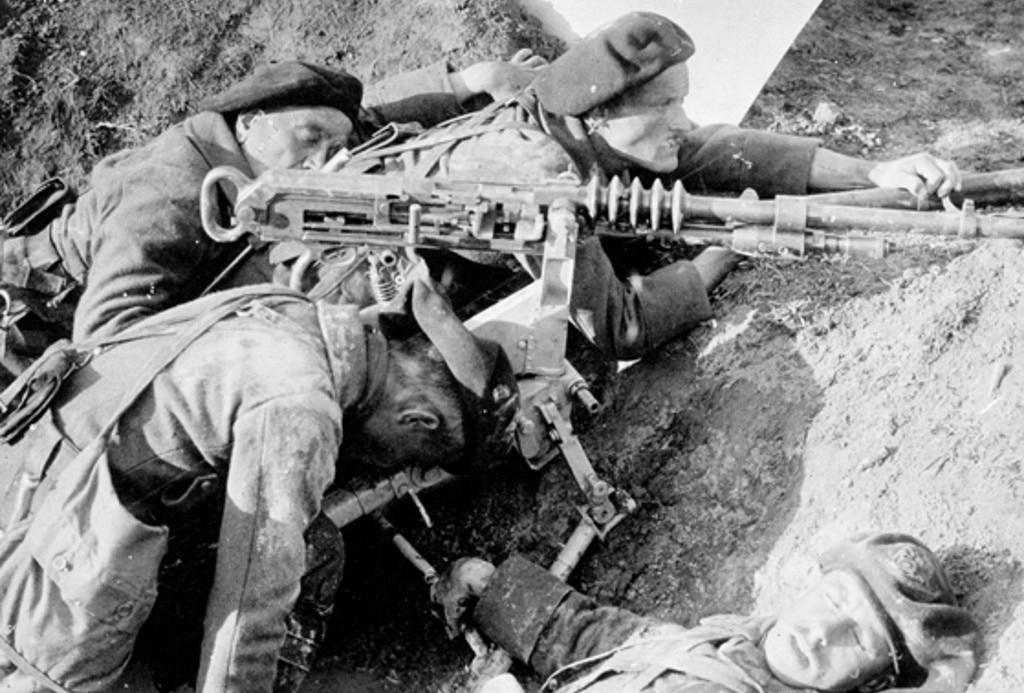
To film this sequence, Gance turned to the military for assistance. If the army could enlist a filmmaker, then why couldn't a filmmaker enlist the army? Gance got permission to film at the front, using real soldiers to stage a fake battle. And he borrowed 2,000 troops, on a brief respite from fighting in Verdun, to play their own ghosts.
This is no metaphor. The living dead soldiers depicted in the film were played by real soldiers, each one of them destined to return to the front lines just a week later. They had been there already and knew what to expect. They knew to expect to die. But before they returned to their certain slaughter, they played the angry, anguished casualties of war, accusing the world of their own murders. Their performances are authentic, and horrifying. J'Accuse sits uncomfortably close to the line of being an arthouse snuff film. True to his word, Gance dared audiences not to look away in shame.
To film the opening sequence in which soldiers in formation spell out the title "J'Accuse," Gance and his assistant director, the surrealist Blaise Cendrars, choreographed masses of soldiers under the command of a certain General Vincent. The General watched Gance direct the men into position, but did not yet realize what was happening. He asked the director what word they were spelling, and Abel tersely replied, "You'll see." The title came into clarity--a phrase charged with political connotations. A generation earlier, those words had been used in Émile Zola's incendiary criticism of the Dreyfus affair, and had since become an all-purpose slogan for any attack on the powerful.
General Vincent shuddered. "This is very moving, but we are at war. So what can I do?"
"Try and stop the war," answered Gance.
From its audacious opening title to the sucker punch of its climax, Gance filled the frame with emotion and energy. It was an instant sensation. At the age of 29, Abel Gance was in the elite of world-renowned film directors, his name uttered in the same breath as D.W. Griffith's.
In the home country of D.W. Griffith, however, the story was different. The American perspective on WWI was substantially different from Europe's--the American death toll was comparably less. The United States had the privilege of distance, which made it easier to believe that the Great War might End All Wars. J'Accuse did not reach American theaters until 1921, under the title I Accuse. By that point, United Artists had edited out almost two-thirds of the original running time, but found time to insert an opening address to the audience by President Harding, and new footage emphasizing how American troops had come to the aid of the French. I Accuse was so bowdlerized as to undercut much of Gance's original intentions.
For generations, the recut versions proliferated. Thanks to the diligent work of dedicated film restorationists, the original 1919 version of J'Accuse has been recovered, allowing Gance's angry masterpiece to return from the dead to indict the living all over again.
By David Kalat
Sources:
Kevin Brownlow, liner notes to the Flicker Alley DVD J'Accuse
Charles Drazin, The Faber Book of French Cinema
James M. Walsh & Steven Philip Kramer, "Abel Gance's Accustaion Against War," Cinema Journal (Spring 1975)
J'Accuse
by David Kalat | June 17, 2014
SIGN UP FOR OUR NEWSLETTERS

CONNECT WITH TCM