Based on an Edgar Wallace short story, Sanders of the River (1935) (aka Bosambo) is a melodrama of warring tribal chieftains in British colonial Nigeria and the white territorial commissioner who oversees them. The film was originally conceived as a low-budget quota quickie to be called Congo Raid. (Quota quickies were British films made swiftly and cheaply in order to satisfy a British law that demanded a certain number of home-grown productions.) But after the big success of The Private Life of Henry VIII (1933) and Catherine the Great (1934), producer Alexander Korda negotiated a new, more generous 16-film distribution agreement with United Artists' Joseph Schenck, replacing their previous five-picture deal. This allowed Korda to obtain much more financing from his investors, and as a result, Congo Raid became the lavishly-budgeted Sanders of the River. (The budget increased from 30,000 to 150,000 pounds.)
Korda hired his brother Zoltan Korda to direct, and Zoltan spent many months of 1933 and 1934 in Africa, shooting 160,000 feet of tribal singing, dancing, and other native customs to be integrated into narrative scenes shot back in England. Upon Zoltan's return to London, the Kordas set about casting the film. When first choice Ralph Richardson proved unavailable, Leslie Banks was hired to play Sanders, the commissioner. For the other lead role, the tribal chief Bosambo, the Kordas reached out to the great American actor/singer Paul Robeson.
Robeson knew from the Edgar Wallace story and the screenplay that the film would glorify the British Empire. But he thought Zoltan's footage from Africa was "magnificent," and depicted the African culture with dignity and respect. Mostly, Robeson was fascinated by the music Zoltan had captured, which he said revealed "much more melody than I've ever heard come out of Africa. I think the Americans will be amazed to find how many of their modern dance steps are relics of an African heritage -- a pure Charleston, for instance, danced in the heart of the Congo." In the end, Robeson later claimed, he believed that these positive, noble qualities would outweigh the negative, stereotypical elements of the story, and he turned down a lucrative offer of Aida from the Chicago Opera in order to make this picture. "I am sure it will do a lot towards the better understanding of Negro culture and customs," he told one reporter.
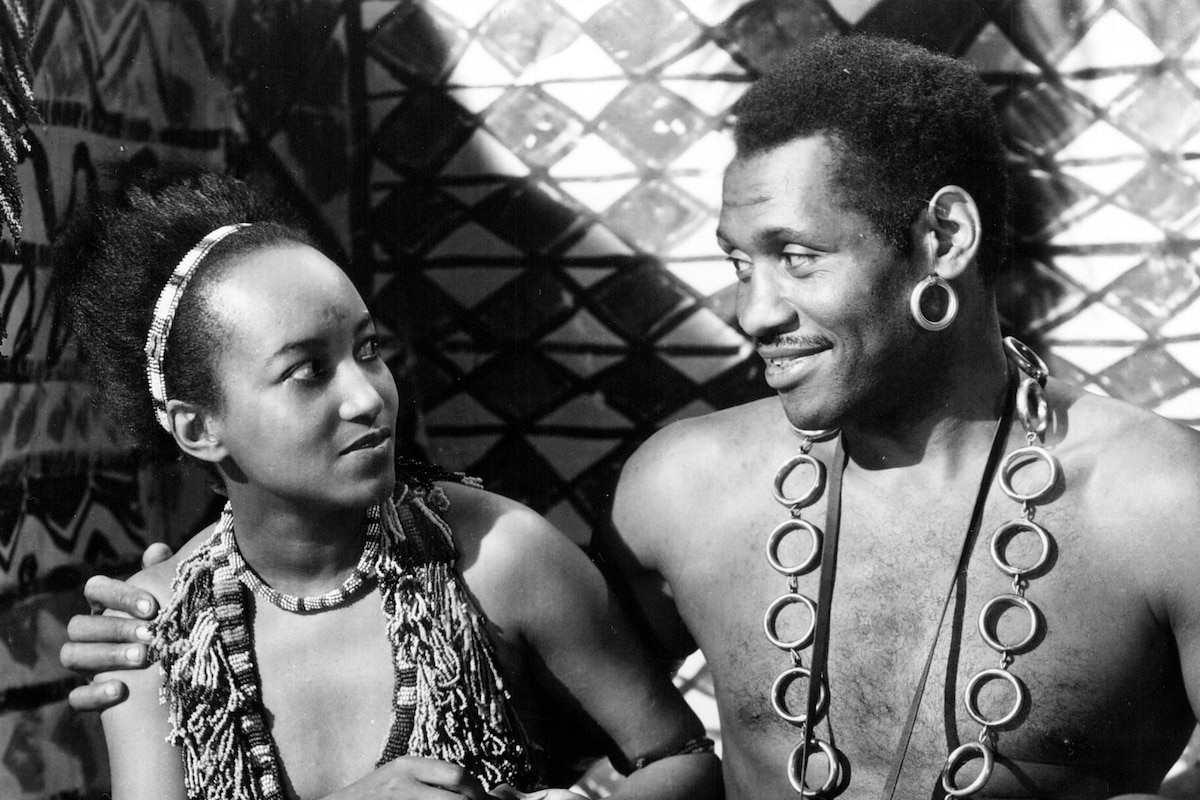
Robeson reported to Shepperton Studios in the summer of 1934. To play extras, four hundred blacks had been brought in from all over the British Isles, mostly from Welsh port towns where they worked on the docks. Some had originally come from the actual Nigerian tribes portrayed on screen. According to a book by Paul Robeson, Jr., one group of Nigerians on set became convinced, due to the rhythm and tonalities of Robeson's voice, that Robeson himself was descended from their Ibo tribe. Robeson, in turn, "felt a natural kinship to their spoken language and their songs even though he had never studied either." Robeson's son visited the set a few times and recounted "that he carried his near-regal dominance of his surroundings with a natural ease, making himself accessible to everyone. He was a popular superstar who belonged to the outside world, yet behaved like a regular person."
When Robeson saw the finished film the next year at its Leicester Square premiere, he was distraught to find that the pro-imperial jingoism vastly overshadowed the respectful African atmosphere that had so excited him. In fact, the film even carried an on-screen dedication to "the handful of white men whose everyday work is an unsung saga of courage and efficiency." Robeson claimed that re-shoots and editing had changed the film's tone without his knowledge. By now a vocal supporter of British anti-colonialist movements, he was mortified. At first he publicly expressed an ambivalence about the film, telling a left-wing New York newspaper, "To expect the Negro artist to reject every role with which he is not ideologically in agreement is to expect the Negro artist, under our present scheme of things, to give up his work entirely -- unless of course he is to confine himself solely to the left theatre." But in later years, when asked about the film, he came down on it hard, calling it a "faux pas" and even telling one newspaper, "I hate the picture." Yet Sanders of the River was a big hit internationally, and ironically helped Robeson to become more independent of Hollywood and better known in Europe, where he would have a greater say in the types of films he made.
The movie's tension between flag-waving imperialism and cultural celebration really had its genesis in the relationship between Alexander and Zoltan Korda. The Kordas were Hungarian emigres with a left-wing past, but Alex had become a conservative Anglophile, proud to celebrate the British Empire, while Zoltan's politics had not changed. Their nephew Michael Korda later wrote that Zoltan wanted "to show the reality of the Africans' lives and aspirations in the bondage of colonialism," while Alex wanted "to make films that would present the Empire to the British audience in a positive and patriotic light. Not that Alex was unaware of the black man's burden, or even unsympathetic to it; he simply felt that the white man's burden was more acceptable and commercial to Anglo-American audiences." Inevitably, as both the movie's producer and the head of the London Films production company, Alex's views won out, and that is why the final product so disillusioned Robeson.
While making Sanders of the River, Zoltan had other headaches to deal with. One of the most entertaining episodes came about when he accidentally intercepted a telegram meant for one of his unit managers. "The information you have sent about Z.K. is most useful," it said. "Send us some more and we'll soon be able to make it hot for A.K." Apparently the crewmember had been supplying details of the Kordas' "extravagance and inefficiency" to a London Films board member who wanted to throw Alex Korda off the board. According to Michael Korda, Zoltan "threatened to shoot the informer on the spot, extracted the whole story from him, and rushed home by camel, train and plane to thwart [the] attempted takeover..., then proceeded back to Africa to finish the film."
Sanders of the River opened to mixed reviews, with The New York Times praising the "splendid photography and excellent [atmosphere]," but criticizing the unwieldy combination of Zoltan's atmospheric footage and Alex's imposed flag-waving tone. "There is a curious absence of punch and conviction," The Times said. "Though it sounds like a merry paradox, Mr. Korda's expedition to Africa in search of authentic locales and tribal atmosphere is probably the reason for his inability to blend his materials into the kind of driving melodrama which admirers of the original [Sanders] stories automatically expect to find. An interesting and ambitious work, Sanders of the River vitiates its great potential power by overemphasizing its purely atmospheric elements. Mr. Korda, seemingly enchanted by the original song-and-dance material which he filmed in Africa, inserts so much of it at critical points in the narrative that the story is always bogging down like the libretto of a musical comedy."
Film scholar William K. Everson, writing years later, found the movie's technical merits to withstand the test of time: "Technically it dates hardly at all, even the sparingly used back projection being far more convincing than most such from the '30s.... [It] has some of the best documentary footage since Trader Horn (1931), standouts being the lovely shots of the canoes skimming along the river, and the beautifully photographed sequences of the aerial flight and the various small animal stampedes it causes.... [But] like so many British films of its type, it never quite makes the most of its action sequences."
American actress/singer Nina Mae McKinney was a huge talent and had been a sensation in Hallelujah (1929), but she was miscast here in the role of Lilongo, with critics complaining that she looked more like she stepped out of a stylish Harlem nightclub than she did an authentic African tribeswoman.
The film's music seems to have left quite an impact in Africa. Michael Korda recounted that during a trip to the continent many years later, Zoltan Korda "heard a group of fishermen in the remote reaches of the Congo singing the theme from the movie as they paddled their canoes upriver. It apparently had worked its way back to Africa in the form of folk music, though it was written by Mischa Spoliansky, who had never been to Africa in his life." Zoltan remained fascinated with Africa throughout his life and made other films that were set there. In 1951 he finally got the chance to make his dream project, Cry, the Beloved Country, a film that is specifically about the plight of the black man in a racist society.
Sanders of the River was very loosely remade in Britain as Death Drums Along the River (aka Sanders) in 1963, starring Richard Todd. However, the original Wallace story was virtually unrecognizable in this version. A sequel to the remake, again with Todd, was entitled Coast of Skeletons (1965).
By Jeremy Arnold
SOURCES:
Charles Drazin, Korda
Martin Bauml Duberman, Paul Robeson
Michael Korda, Charmed Lives
Paul Robeson, Jr., The Undiscovered Paul Robeson
Anatol I. Schlosser, "Paul Robeson in Film: An Iconoclast's Quest For a Role," contained in Paul Robeson: The Great Forerunner
Paul Tabori, Alexander Korda
Sanders of the River
by Jeremy Arnold | June 02, 2014
SIGN UP FOR OUR NEWSLETTERS

CONNECT WITH TCM