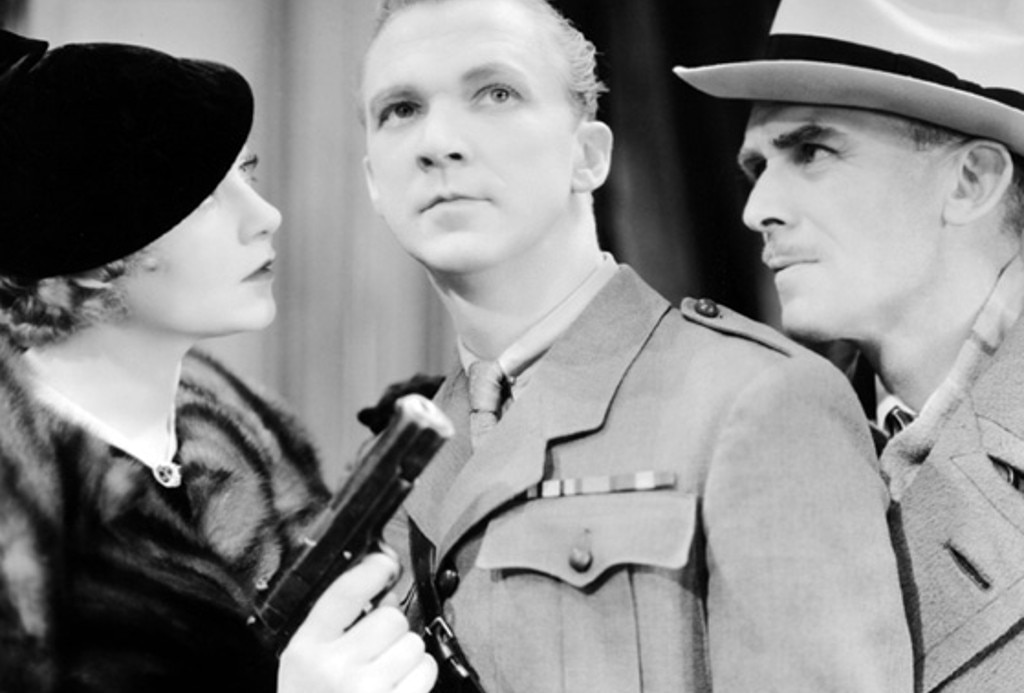
From the exclamation point in the title to the machine-gun pace of the dialogue, the 1933 comedy-drama Clear All Wires! is a high-octane specimen of the newspaper picture, a genre that Hollywood has worked on like a string of front-page stories throughout its history. The movie is far from a classic, but its energy is unstoppable and its convoluted plot opens an interesting window on Hollywood's attitude toward Soviet Communism less than twenty years after the Russian revolution.
The main character is Buckley Joyce Thomas, a smart-alecky newshound who covers the international beat for the Chicago Globe, spars with rival reporter Pettingwaite of the New York Times, and chases women whenever he can - including an airhead named Dolly, who happens to be involved with J.H. Stevens, his editor and boss. After a somewhat confusing start in the desert sands of Morocco, the story moves to Moscow, where Buck goes to get the scoop on what he regards as the greatest social experiment in history. He's accompanied by his sidekick, Lefty, who's always willing to help with a scheme, a ruse, or a con.
Within minutes of arriving Buck steals Pettingwaite's hotel room and hires away Pettingwaite's assistant. Then he orders his new aide to supply him with a peasant, a worker, and a "New Woman" he can quiz for information. He also demands a meeting with the chief of the secret police, ignoring the fact that the Commissar never grants interviews to anyone. Visits from several women add to his crowded agenda. One is ditzy Dolly, who wants to move in with him; another is old flame Eugenie, now stuck in a marriage of convenience with a distant relative of the ousted czar; and the third is sophisticated Kate, an ace newspaperwoman who wishes Buck would get some sense and settle down with her.
Further complications ensue when Stevens gets wind of Buck's relationship with Dolly and sends a wire firing the reporter. Hoping to save his career by getting a spectacular story, Buck sets up a bogus assassination attempt with the former czar's relative as the supposed target. Everything goes wildly wrong, of course, but after numerous hairpin turns the plot somehow screeches to a happy ending.
Clear All Wires! predates World War II, when the struggle against Nazi Germany made relations between the USA and the USSR relatively cordial, and of course it predates the cold war, when capitalists and communists were fierce ideological enemies. Hollywood tended to swing whichever way the political winds blew, and since Soviet authorities were banning American movies on principle by the middle 1930s, the studios could be as irreverent as they liked toward Communism and other Russian isms. Sometimes they were very irreverent indeed, as when MGM allowed the working-man character in Clear All Wires! to be an aspiring revolutionary with a perplexing platform: "Leninism is not Stalinism! Stalinism is not Bolshevism! Bolshevism is not Communism! And Communism is not Marxism!" Lefty promptly labels him a nut, but Buck thinks there may be a story in him yet. According to his platform, "Nuts make news."
The movie originated as a play by Bella and Samuel Spewack, a married couple who worked as foreign correspondents before turning to the stage and scoring big Broadway hits like Boy Meets Girl in 1935 and Kiss Me Kate in 1948. The theatrical version of Clear All Wires opened (without the exclamation point) in 1932, racking up a lukewarm three-month run. (Five years later the Spewacks turned it into the successful musical Leave It to Me! with music and lyrics by Cole Porter.) It played long enough to catch the eye of MGM, which hired the Spewacks to adapt their play and assigned George W. Hill to direct. Hill had been a cinematographer before becoming the director of significant movies like The Big House and Min and Bill (both 1930), and he was slotted to direct a very high-profile production, The Good Earth, when he went through a bad car accident and then committed suicide. He was only 39, and Clear All Wires! was his last picture.
Lee Tracy was an inspired choice to play Buck, since he had created the character of newspaperman Hildy Johnson in the first Broadway production of The Front Page in 1928, and had just finished playing journalists in no fewer than four movies released in 1932. The role of Dolly went to Una Merkel, whose dozen (!) pictures of 1933 also include the Busby Berkeley musical 42nd Street and the Jean Harlow comedy-drama Bombshell, and Lya Lys, a veteran of Luis Buñuel's legendary L'Age d'or (1930), came in as Eugenie the old flame. Benita Hume, a young but experienced English actress, made her Hollywood debut as Kate, the young but experienced English reporter. The supporting cast also features the great James Gleason as Lefty, the rather dull Alan Edwards as Pettingwaite, and three carry-overs from the stage edition: John Melvin Bleifer as the revolutionary worker, Eugene Sigaloff as the ex-czar's relative, and Ari Kutai as Buck's assistant.
New York Times critic Mordaunt Hall judged Clear All Wires! to be "a good picture with several humorous incidents," and praised Tracy for his "clever" performance as a "braggart" who "bears up well after being called a faker and a liar" by his fictional New York Times competitor. That's a generous verdict. The film is energetic and diverting, but every decade has produced newspaper movies more substantial than this one; just think of Josef von Sternberg's Underworld (1927), William A. Wellman's Nothing Sacred (1937), Howard Hawks's His Girl Friday (1940), Alexander Mackendrick's Sweet Smell of Success (1957), Samuel Fuller's Shock Corridor (1963), Alan J. Pakula's All the President's Men (1976), Sydney Pollack's Absence of Malice (1981), Ron Howard's The Paper (1994), and David Fincher's Zodiac (2007). Like the exclamation point in its title, Clear All Wires! is ultimately an add-on with little of real substance to contribute. It has its charms, though, and aficionados of the journalism genre won't want to miss it.
Director: George W. Hill
Producer: George W. Hill
Screenplay: Bella and Samuel Spewack; adapted from their stage play; continuity by Delmer Daves
Cinematographer: Norbert Brodine
Film Editing: Hugh Wynn
Art Direction: Cedric Gibbons
With: Lee Tracy (Buckley Joyce Thomas), Benita Hume (Kate), Una Merkel (Dolly), James Gleason (Lefty), Alan Edwards (Pettingwaite), Eugene Sigaloff (Prince Alexander), Ari Kutai (Kostya), C. Henry Gordon (Commissar), Lya Lys (Eugenie), John Melvin Bleifer (Sozanoff), Lawrence Grant (MacKenzie), Guy Usher (J.H. Stevens.)
BW-77m
by David Sterritt
Clear All Wires!
by David Sterritt | May 29, 2014
SIGN UP FOR OUR NEWSLETTERS

CONNECT WITH TCM