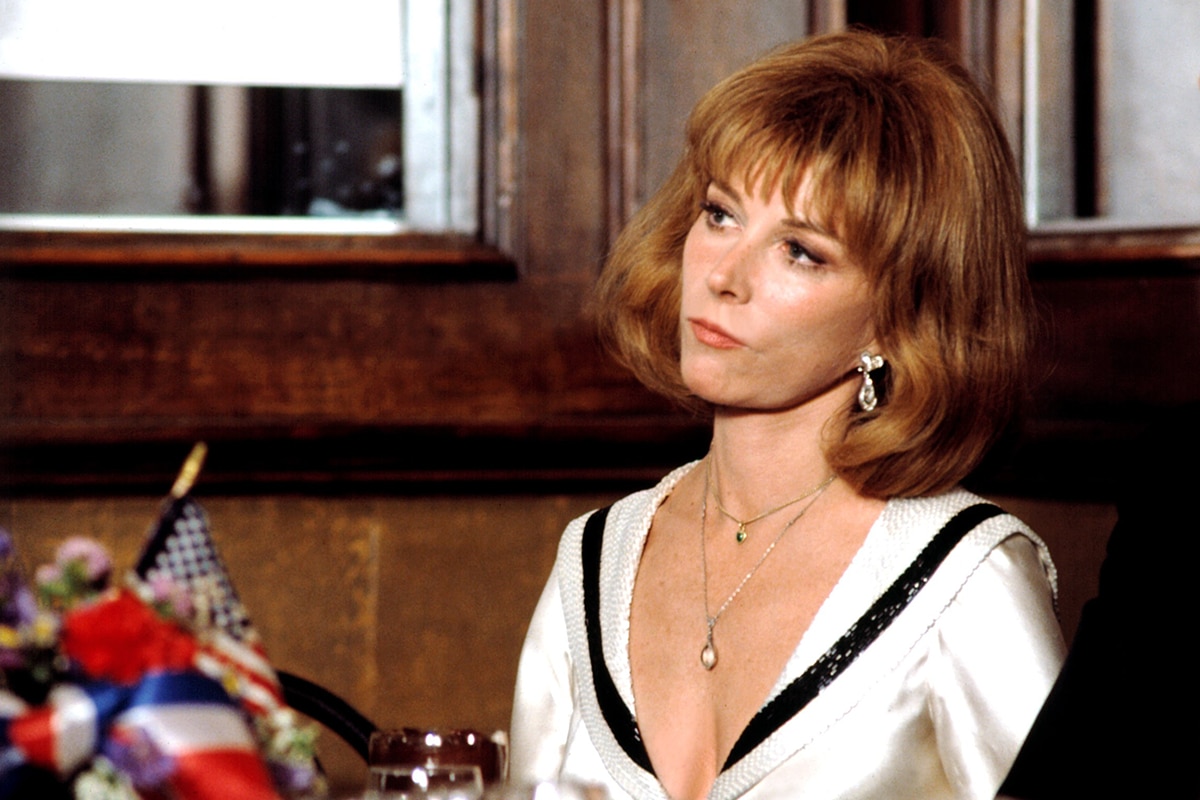
This article was originally written about programming for the TCM Now Playing newsletter in October 2025.
Over her nine-decade career, Oscar-winning actress and director Lee Grant has achieved enormous success in nearly every aspect of the entertainment industry, earning multiple acting awards for her work on stage, screen and television. Such an achievement is impressive enough, but Grant’s career is unique in that her accomplishments occurred despite enormous setbacks, particularly her involvement in the notorious Hollywood Blacklist. This Halloween marks the centennial of this Hollywood survivor, and on the 29th, TCM is celebrating with an evening of Lee Grant's most famous and acclaimed films.
Grant was born Lyova Haskell Rosenthal, the only child of a middle-class Jewish couple in New York City. Her father was an educator, and her mother was a childcare worker who encouraged her daughter to pursue the arts from a very early age. She made her stage debut at the age of six, playing a Chinese boy in a production of Leoni’s “L’Oracolo” at the Metropolitan Opera in 1931. Grant went on to study with multiple prestigious performing companies, including the American Ballet, Juilliard and ultimately the Actors Studio (for which she remains a lifelong member and sometime teacher). With such an extensive arts education and early-stage work, it was no surprise that Grant found success quickly.
In only her second Broadway show, playing a young shoplifter in Sidney Kingsley's 1949 play “Detective Story,” Grant received rave reviews and was one of a group of original cast members hired to film. Grant has said that her transition from stage to screen was seamless, mostly due to the support of her director, the great William Wyler. It was Wyler who championed for Grant and her fellow actors, Michael Strong and Joseph Wiseman, to be cast in the movie despite never having worked in film. For her debut performance, Grant received the Best Actress Award from the Cannes Film Festival and was nominated for an Academy Award for Best Supporting Actress. While she should have been reaching the pinnacle of success, Grant’s career came to a screeching halt.
Grant’s first play after “Detective Story” had been the short-lived 1950 play “All You Need is One Good Break,” written by Arnold Manoff (who would soon become Grant’s first husband), directed by John Berry and co-starring J. Edward Bromberg. Manoff, Berry and Bromberg were all recent refugees of the Hollywood Blacklist. The House Un-American Activities Committee (HUAC) had gone after Hollywood writers and actors whom they suspected of subversive or communist sympathizing beliefs, and Hollywood studios responded by blacklisting them from working.
Bromberg died of a heart attack in December 1951. At his memorial, Grant said publicly that she felt the HUAC’s hounding of Bromberg to testify before Congress had helped drive him to his death. Shortly after this, Grant’s comments were found in “Counterattack,” an anti-communist newsletter from the same group who’d released the notorious “Red Channels,” a book of names of writers and actors and the communist front organizations they allegedly supported. For the next 12 years, Grant was unable to find work in Hollywood. She was given a chance to clear her name from the blacklist in 1957, when the HUAC asked her to name her husband as a member of the Communist Party. Staying true to her principles, she refused.
After a decade of stage work and bit roles on New York television, Grant officially returned to Hollywood for a starring role on the television series “Peyton Place.” It was her success on this popular series that brought Grant back into Hollywood’s good graces and allowed her to work in A-list films, including the Best Picture winner In the Heat of the Night (1967). Grant earned her second Best Supporting Actress nomination for playing the mother of Beau Bridges in The Landlord (1970). This was her first film with director Hal Ashby (making his directorial debut) and was the first in a series of roles in which Grant played a wealthy, but unhappy matron who meddles in the lives of younger central characters.
Another of these roles came the following year with her appearance in Arthur Hiller’s film version of the hit Neil Simon play Plaza Suite (1971). The film tells three separate stories about three different sets of occupants in room 719 of New York’s Plaza Hotel. Grant plays Norma Hubley, the wife of Roy Hubley (played by Walter Matthau in one of the three roles he plays in the film) and mother of Mimsey Hubley (Jenny Sullivan). It is Mimsey’s wedding day, and the Hubleys must coax their daughter out of the bathroom where she has locked herself in, claiming cold feet. At the same time, they must stall a massive wedding party anxiously waiting in the Baroque Room.
Grant had previously played this role (and two others) in the original touring production of the play in 1968, directed by Mike Nichols. Nichols next asked Lee to appear in the Broadway production of another Neil Simon play, “The Prisoner of Second Avenue” in 1971. It was during her run in this play that Warren Beatty presented Grant with his script for a story about a playboy hairdresser in Beverly Hills and the many, many women in his life. When Beatty first showed Grant the script for Shampoo (1975), it was still called Hair. Beatty and his co-writer Robert Towne changed the title to avoid confusion with the Broadway musical of the same name.
Beatty thought Grant would be perfect for the role of Felicia, a wealthy but unhappily married woman who is one of the several women having an affair with her hairdresser, George (Beatty). Felicia could’ve been just another wealthy married matron role, the kind that Grant had already tread in her previous films, but the character has other dimensions. Felicia’s dependence on George’s affections makes her increasingly unstable, and her indirect connections to the other women in George’s life make the story very unpredictable. Among the other girls is Jackie (Julie Christie), who is the mistress of Felicia’s husband, Lester. Meanwhile, Felicia has persuaded Lester to invest in George’s own hair salon he hopes to open. The film received mixed reviews upon release, but Grant’s comedic and touching performance was unanimously praised.
Twenty-four years after her first nomination and after 12 years on the Hollywood Blacklist, Lee Grant won the Academy Award for Best Supporting Actress for Shampoo. Grant later recalled that winning her Oscar was the first time she realized that she “didn’t have enemies anymore and was safe.” At the same time, she also said that she felt at age 50 that her career might be over. Far from it!
Grant’s next role was in the all-star period drama Voyage of the Damned (1976). The film tells the true story of the passengers aboard the German MS St. Louis, an ocean liner that departed from Hamburg, Germany in 1939, carrying 937 Jews. The passengers hope to escape the rising antisemitism in Germany but are distressed to find that the Cuban, American and Canadian ports they visit will not accept the refugees’ exit visas and instead redirect the ship back to Europe. Grant plays one of the Jewish refugees, terrified about the prospect of returning to Nazi-Germany. She earned her fourth Oscar nomination for her harrowing performance. Also in the cast are Faye Dunaway, Orson Welles, James Mason and Wendy Hiller.
This film was another of the sub-genre of popular movies from the 1970s that featured giant all-star casts caught in disastrous survival situations like the megahits The Poseidon Adventure (1972) and The Towering Inferno (1974). Grant had hoped that The Swarm (1978) would be another of those megahits, but instead it ended up being a critical and commercial disaster. The film tells the story of the outbreak of deadly African bees that spreads across Texas and kills thousands of people. Also starring in the film are Michael Caine, Katharine Ross, Olivia de Havilland and Patty Duke. Despite its less-than-stellar release, the film is now viewed as a fun guilty pleasure.
Though she never stopped acting in films and on television, Grant has proven herself to be a great talent behind the camera. Shortly after winning her Oscar for Shampoo, she was invited by the American Film Institute to join their first Directing Workshop for Women, a program established to help women become directors when there were only a precious few. As a director, Grant has mostly focused on nonfiction filmmaking, bringing attention to underrepresented social issues of the times and giving voice to the voiceless. “Getting to do documentaries was a door [swinging] open for me. I could ask anything, I could say anything, and I could address some of the things I felt deeply about in a real way.”
Our program on the 29th will include the TCM premiere of her most acclaimed documentary, Down and Out in America (1985). The film explores the stories of several different groups trying to cope with the recession of the mid-1980s. Among them are a young couple and their children, unable to escape the welfare state, the inhabitants of several homeless encampments across major cities and a group of farmers whose property is being foreclosed upon by corporate banks. The film is fearless in its criticism of the deregulated capitalist policies of then-president Ronald Reagan (who had previously been one of the loudest informants for the House Un-American Activities Committee in the late 1940s).
The film won the Academy Award for Best Documentary. While the Oscar itself went to the film’s producers, Milton Justice and Grant’s husband Joseph Feury, Grant was on stage and received the award alongside them and stated, “This is for all the people who are still down and out in America.” The documentary is still a highly regarded piece of nonfiction filmmaking and has been praised by other filmmakers whose work focuses on social injustice, including Michael Moore and Chloé Zhao.
Grant’s other documentaries include When Women Kill (1983), which tells the backstories of women inmates behind bars and the circumstances that put them there, and Battered (1989), an investigation into the lives of battered and abused women, their abusers and their children. As she approaches her centennial, Grant still shows no signs of stopping. “I would rather be in the worst circumstances than be bored. To have nothing. Nothing to say. Nothing to work for. Nothing to reach for. No passion for something. That would be death.”
