This article was originally written about programming for the TCM Now Playing newsletter in October 2025.
Movies about fictional bands proliferated in the 1980s and 1990s, and for two evenings this October, six of them will battle it out on TCM. The earliest film in the spotlight is the least-known, and for years was quite difficult to find: Ladies and Gentlemen, the Fabulous Stains (1982). It’s about a high school dropout, Corinne, who forms a female punk band—the Stains—with her sister and their cousin. Entering into a rivalry with a male punk band called the Looters, the Stains endure mockery and derision in what has been a genre dominated by men and which sexualizes young women, but they still attain a fervent female fanbase and achieve media-fueled stardom. “We’re the Stains and we don’t put out!” is their catchphrase. The top-flight cast features 17-year-old Diane Lane as Corinne, with her bandmates played by Marin Kanter and Laura Dern (who, in punk-like fashion, disobeyed her parents to act in the film). Ray Winstone portrays the frontman for the Looters, whose members also include real-life Sex Pistols Paul Cook and Steve Jones, and Paul Simonon from the Clash.
The movie’s troubled production was marked by plenty of clashes itself. Screenwriter Nancy Dowd, with an Oscar freshly in hand for Coming Home (1978), said that her script was inspired by her first Ramones concert. She approached Caroline Coon, who had chronicled the punk scene as a journalist and had briefly managed the Clash, to consult on the script. Future studio head Joe Roth produced the film for Paramount and brought on Lou Adler to direct. Adler, a record producer, only directed two films in his career but produced or executive-produced several others, including The Rocky Horror Picture Show (1975). He and Dowd had very different visions for the movie, especially regarding the ending. Dowd wanted an empowering finale showing girls around the country emulating the Stains; Adler had a different idea and filmed a coda of his own. It all finally prompted Dowd to depart the production and have her name removed from the credits and replaced by a pseudonym, Rob Morton. Paramount buried the film after a poor test screening, never giving it a proper release, but within a few years, it found audiences on late-night television and is now seen as a major influence on the 1990s “riot-grrrl” feminist punk movement and subculture. It’s also simply an enjoyable time capsule of the punk-era’s hair, clothes and rebellious attitude.
The following year’s Eddie and the Cruisers (1983) is another ‘80s time capsule that became a cult film years after its release. Ellen Barkin plays a reporter, Maggie Foley, who is trying to uncover the truth behind the disappearance of Eddie Wilson (Michael Paré, in his feature debut), a rock star who may or may not have perished in a car crash in 1964; perhaps the tapes of his last recording session, which were never released and have gone missing, will provide some clues. As Maggie interviews Eddie’s surviving band members, including a keyboard player played by Tom Berenger, flashbacks bring to life the Cruisers’ glory days. With songs by John Cafferty—performed by Cafferty himself (dubbing Paré) and rock singer Helen Schneider—the film especially comes alive in those flashbacks.
This is Spinal Tap (1984) represents not just the peak of fake-band films, but is a groundbreaking movie in Hollywood history. It launched the mockumentary genre and is widely regarded as one of the best comedies of the era. (TCM host Robert Osborne often cited it as one of his own favorites.) Taking the form of a documentary whose director accompanies a British rock band on an ill-fated American tour, the movie’s blurring of rock fiction and reality was so strong that many viewers thought the film was a real documentary about a real band they’d never heard of, albeit one pitifully down on its luck. Rob Reiner directed the film and appears onscreen as the documentarian, Marty DiBergi, a nod to the real music documentary The Last Waltz (1978) and its onscreen director, Martin Scorsese.
Reiner is credited as screenwriter along with Christopher Guest, Michael McKean and Harry Shearer, who make up the Spinal Tap band, but in reality there never was a full screenplay. They devised a skeleton of a plot and a brief outline from which they improvised, giving the movie a remarkable freshness and believability. Despite its plentiful deadpan humor, the film also offers sharp insights into the real rock-and-roll scene, poking fun at performers’ pretensions and at the almost worshipful tone of many genuine concert films and music documentaries. Countless real rock stars have said the film hits close to home and that they have occasionally found themselves in real versions of some sequences, like the classic bit where the band gets lost in the backstage underground tunnels while trying to find their way to the stage. Though it barely made a dent at the 1984 box office (despite strong reviews), the movie became a cult classic in the years that followed. In 2003, Rolling Stone named This is Spinal Tap “the best rock movie ever,” and in September 2025, Reiner and the cast reunited for Spinal Tap II: The End Continues (2025).
Roger Ebert wrote of The Commitments (1991), “It is one of the few movies about a fictional band that’s able to convince us the band is real and actually plays together.” A significant hit upon release, praised for its freshness and originality, it spins the tale of a young Irish entrepreneur (Robert Arkins) who dreams of putting together a band from local, working-class North Dublin to play American 1960s soul music. The ragtag group of musicians he finds are a bit dubious at first about playing soul, but Arkins charmingly convinces them that it makes sense because “the Irish are the Blacks of Europe, Dubliners are the Blacks of Ireland, and North Dubliners are the Blacks of Dublin.”
The Commitments was adapted from the first novel by Roddy Doyle, who had worked as a North Dublin high school teacher and collaborated on the script with screenwriters Dick Clement and Ian Le Frenais. They in turn brought the project to Alan Parker, who had directed serious dramas like Mississippi Burning (1988) and Come See the Paradise (1990) as well as the rock music films Fame (1980) and Pink Floyd: The Wall (1982). Parker injected not just an exuberance into the storytelling but also a vivid naturalism. As he later said, “I think there’s a huge difference between American kids who see success as their right, whereas the kids who grow up in working-class situations in Britain or Ireland don’t. They’re more likely to see failure than success on the horizon.” Parker expressed this by incorporating visuals of working-class Dublin life—alleys, backyards and crowded interiors with crying children, for instance. He also achieved it by casting mostly untrained actors. “I didn’t want to cheat the music, so obviously I had to look for musicians,” Parker said. “Ultimately, they were cast to be pretty close to the kinds of personalities they already had, so they’re not playing roles outside of themselves.”
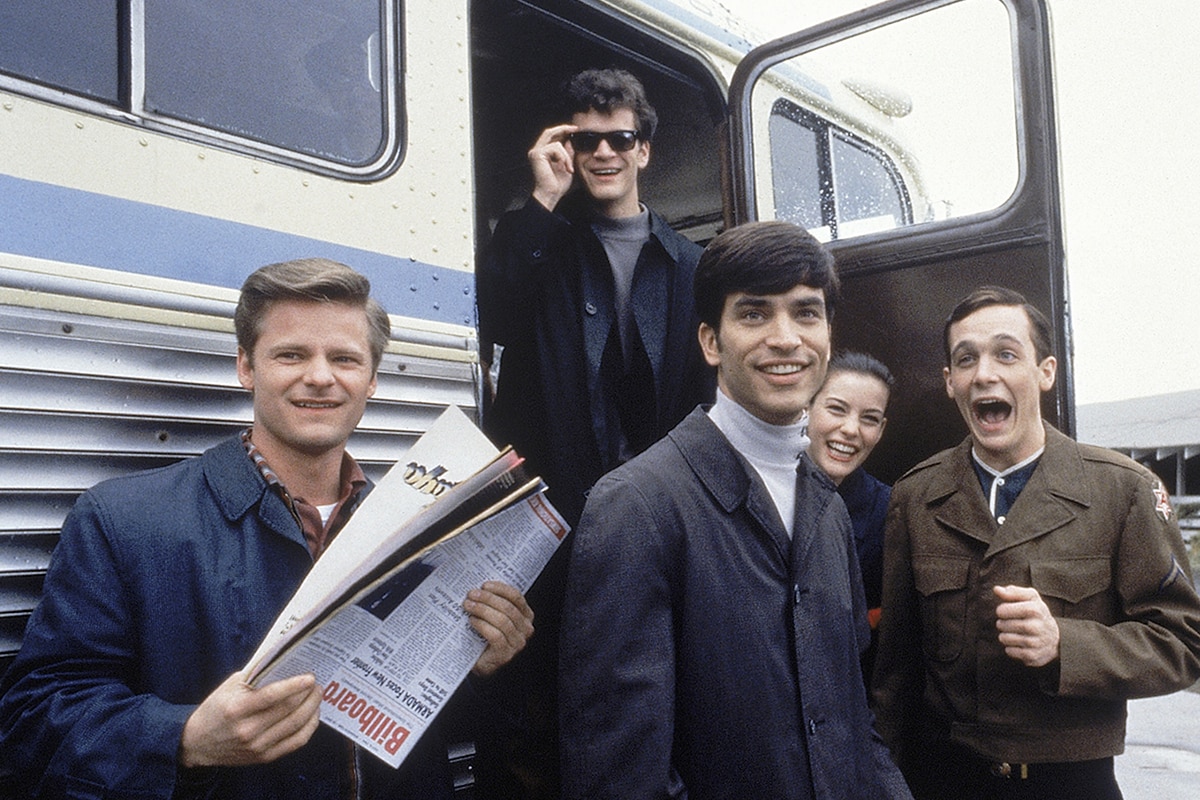
In 1996, Tom Hanks made his writing and directing debut with another fake-band film, That Thing You Do! Set in February 1964, the month of the Beatles’ appearance on “The Ed Sullivan Show,” the story charts the rapid rise and fall of a small-town Pennsylvania pop band called The Wonders (formerly spelled Oneders), who indeed have one hit, a song called “That Thing You Do!” Rather than serving up a cautionary story about show business, however, Hanks delivers an upbeat look at the irresistibility of pop music. He plays the record executive who signs the band and steers them toward Hollywood, and he also wrote some of the film’s original songs—though the title song, heard many times, was written by Adam Schlesinger, the bassist for the rock group Fountains of Wayne. According to Variety, the plot point of a record owner’s son, an amateur drummer, joining the band at the last minute when the previous drummer breaks an arm, was inspired by a true incident when the Beatles toured Japan and Australia, and a sick Ringo Starr was replaced by a fellow named Jimmie Nichol.
That Thing You Do! also stands out for its technical sheen, with cheerful production design by Victor Kempster, top-notch costumes from Colleen Atwood and radiant, colorful cinematography from Tak Fujimoto, who shot many of director Jonathan Demme’s films. Demme, in fact, is a producer of this film and makes a cameo as the director of a cheapo beach movie featuring The Wonders. Hanks’s film was roundly praised. “Rock-and-roll nostalgia presented as pure fizz,” declared The New York Times. “The best thing to be said about Hanks’ feature debut,” said Variety, “is that it bears all the elements that have made him a movie star: boyish charm, natural ease, comic precision and, above all, generosity of spirit.
Just as Tom Hanks’s love of rock and roll permeates and lifts That Thing You Do!, so does Cameron Crowe’s with Almost Famous (2000). The writer-director based his film on his own time as a teenager covering rock bands like The Allman Brothers and Led Zeppelin for Rolling Stone magazine. In the film, a 15-year-old budding journalist, William Miller (Patrick Fugit), lands a dream assignment when Rolling Stone sends him from his San Diego home to shadow Stillwater, an up-and-coming fictional rock band. On the road, William forms close bonds with the band’s guitarist, Russell Hammond (Billy Crudup, replacing the originally cast Brad Pitt), and Penny Lane (Kate Hudson, replacing the originally cast Sarah Polley), a charismatic “Band Aid” who travels with the group. Crowe freely mixes real and fictional characters and music. With a massive music budget, he assembled an outstanding soundtrack of real ‘60s hits to infuse the movie, from such artists as Cat Stevens, The Who, The Beach Boys, Simon & Garfunkel, Elton John, The Velvet Underground and even Led Zeppelin, who famously almost never granted such permissions. The final effect of all this was sweet and nostalgic. As The New York Times’ A. O. Scott summed it up, “What Mr. Crowe has done is nonetheless remarkable. He has made a movie about sex, drugs and rock 'n' roll that you would be happy to take your mother to see.”
