This article was originally written for the TCM Spotlight programming in the TCM Now Playing newsletter in October 2025.
Spooky season is here, and that means it’s time for TCM to once again deliver a killer lineup of movies. For five Fridays across October, we’ve found different ways to unnerve you with our annual TCM Terror-Thon. Every Friday night starting at 8pm, you’ll be treated to a double feature of films rife with murder, deception and your favorite actors going a little mad. Actor and comedian Mario Cantone will co-host each night with Ben Mankiewicz, and following each double feature will be a slew of more terrifying, bone-chilling tales. What connects all these movies is that although there are elements of the supernatural in some, the real monsters are all-too-human.
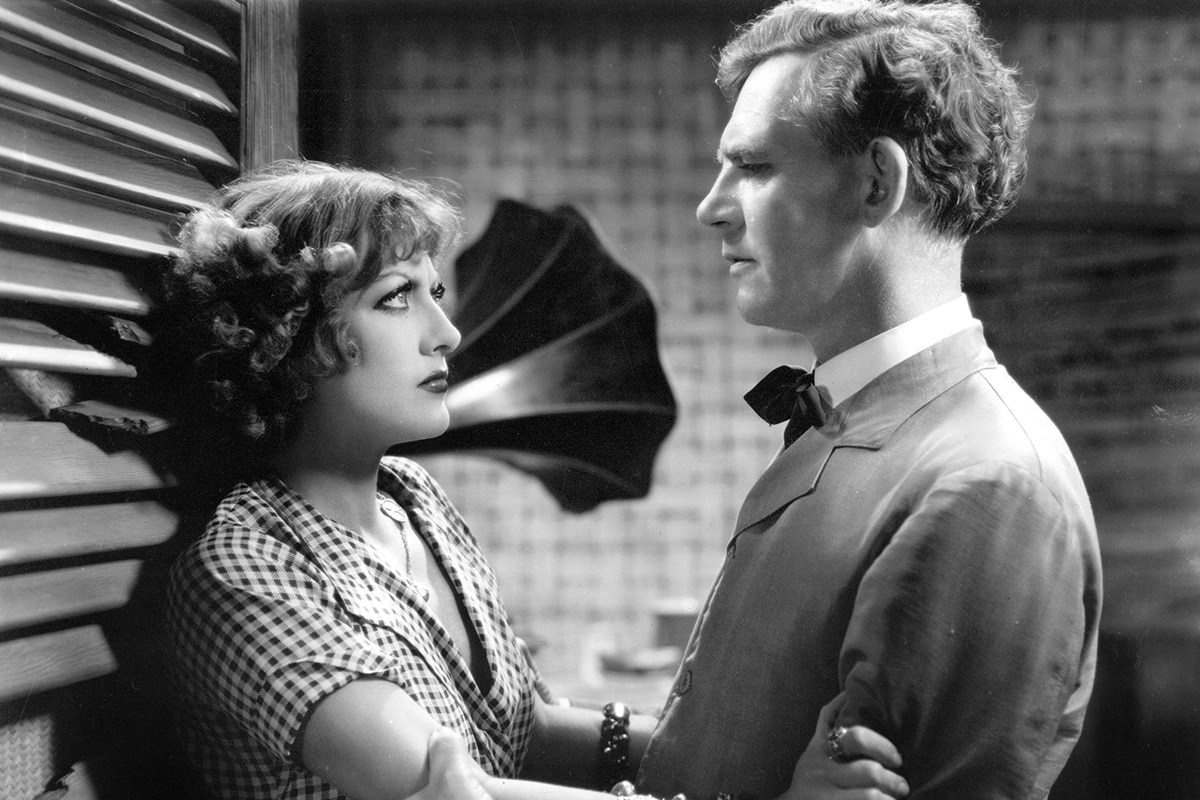
Kicking things off on October 3rd, we have a night dedicated to Bette & Joan, although you must give us a bit of credit for not just throwing What Ever Happened to Baby Jane? (1962) at you. Instead, we have a couple of deeper cuts from these luminary rivals. First up is one of Joan Crawford’s earliest sound features, Rain (1932). This scintillating pre-Code drama is set in a rain-soaked port in the Pacific Ocean, where passengers must stay after a possible cholera outbreak aboard their ship. This introduces self-righteous missionary Alfred Davidson (Walter Huston) and his wife (Beulah Bondi) to local Sadie Thompson (Joan Crawford), a prostitute living it up with American Marines stationed on the island. Although Davidson professes that he just wants to save Sadie’s soul, the film makes it clear that his protestations are a thin veneer for his lust and desire. Rather than preaching, Rain is a sharp jab at religious hypocrisy, with Crawford being able to play both the sultry aspects of Sadie and her real terror at a stranger coming to take ownership of her destiny.
We then move to Another Man’s Poison (1951), Bette Davis’s first film with husband Gary Merrill after the classic All About Eve (1950). In this twisted tale, Davis plays Janet Frobisher, a mystery novelist happily wiling away her days as she carries on an affair with her secretary’s young fiancé. But this pseudo-bliss comes crashing to a halt when she crosses paths with her deceased husband’s former accomplice (Merrill), who blackmails her into pretending that he’s Mr. Frobisher. Another Man’s Poison dances on the edge of farce (take away the murders and you basically have an episode of “Frasier”), but Davis and Merrill are so deliciously mean to each other that you have to relish this battle of wills until its glorious conclusion that feels like it’s pulled from the pages of “Tales from the Crypt.”
The following week, we’re “Trapped and in Trouble” with two claustrophobic thrillers. First up is the always-reliable John Garfield in He Ran All the Way (1951). Garfield plays Nick Robey, a petty thief on the run who picks up a young woman (Shelley Winters) at a community pool, takes her back to her place and proceeds to hold her family hostage until he can manage an escape. Aided by James Wong Howe’s incredible cinematography, the sense of fear and despair permeates the entire picture as Garfield finds pitiable shades to the desperate Nick. The film doesn’t ask us to sympathize with him, but neither is he a one-dimensional villain enacting cruelty on his victims. It’s one of Garfield’s best performances, and sadly, his last one before dying at the age of 39.
We then fast-forward a couple of decades to Die! Die! My Darling! (1965), a.k.a. Fanatic, which was the final feature for star Tallulah Bankhead. The story revolves around an American woman, Patricia Carroll (Stefanie Powers), who arrives in London with her fiancé Alan (Maurice Kaufmann), but first wants to pay her respects to Mrs. Trefoile (Bankhead), the religious mother of Patricia’s deceased fiancé, Stephen. However, when Patricia arrives, she soon finds herself a prisoner of Mrs. Trefoile’s fanaticism. It’s a delectably nasty performance from Bankhead as, like Alfred Davidson, her persecution is a form of projection.
Our next double feature is all about Gene Tierney, leading off with one of her best performances in Leave Her to Heaven (1945). In John M. Stahl’s dark drama, Tierney plays Ellen, a vindictive, jealous socialite who will go to any lengths to maintain the full attention of her novelist husband Richard (Cornel Wilde). A gorgeous example of the era’s Technicolor noir, Stahl and Tierney harness the vibrant visuals to further underscore Ellen’s psychosis. Two scenes in particular—one in a boat and the other on a staircase—further highlight just how dark you can get in a movie this visually sumptuous.
We then follow it up with Black Widow (1954), a mystery revolving around the death of an aspiring writer (Peggy Ann Garner) who sought to ingratiate herself with successful Broadway producer Peter Denver (Van Helflin). Tierney plays Peter’s wife, Iris, a successful actress, who gets swept up into the intrigue as Peter becomes the prime suspect in the case. Although Tierney doesn’t get as much to chew on here as she does in Leave Her to Heaven, writer-director Nunnally Johnson works to keep the audience guessing with the ensemble cast. Through its use of flashbacks and jumbled chronology, Black Widow continually throws a series of curveballs at the audience, although perhaps none so major as casting George Raft against type as a homicide detective rather than a criminal.
On October 24th, we have a classic pairing between the Master of Suspense, Alfred Hitchcock, and one of his most successful devotees, Brian De Palma. First up is Suspicion (1941), in which Hitchcock skillfully uses all of Cary Grant’s overwhelming charm and turns it to malevolent ends. We follow wealthy heiress Lina McLaidlaw (Joan Foantain in an Oscar-winning performance) who falls for Johnnie (Grant), a walking collection of red flags. The dark playfulness that Hitchcock brings to his movies is in full effect here, as we know Lina should run as fast as she can from Johnnie, but it’s Cary Grant. His level of charm makes for a taut thriller as we, like Lina, want to believe he’s not the monster he appears to be.
While De Palma would sometimes make his Hitchcock references overt (e.g., the Psycho [1960] references in Dressed to Kill [1980]), The Fury (1978) is a bit more of a departure. Based on the novel by John Farris, the film is more in line with De Palma’s Carrie (1976), with a focus on the tortured relationships between psychically powerful teens and nefarious adults. The story begins when former government agent Peter Sandza (Kirk Douglas) sees his psychic son get abducted by his old colleague (John Cassavetes) to be used as a weapon. We then skip over to high-school student Gillian (Amy Irving), who has similar powers and volunteers to join an institute where she can better learn about her abilities. These two storylines connect in one of De Palma’s finest scenes as he uses only visuals and John Williams’ incredible score to show the dire circumstances that force Peter and Gillian together.
TCM Terror-Thon wraps on Halloween night with two disturbing tales. The first is Richard Brooks’ grim, bleak adaptation of Truman Capote’s novel, In Cold Blood (1967). While the past decade has experienced a boom in true crime stories, both Capote’s novel and Brooks’ movie remain giants of the genre that force the audience to see the humanity in the monstrous Perry Smith (Robert Blake) and Richard “Dick” Hickock (Scott Wilson). Rather than dance around the truth or leave the audience guessing, Brooks plunges the audience into the dark psyche of two murderous drifters, seeing them not as aberrations of America, but able to walk easily among its towns and cities, representing the darker truths of life we don’t wish to acknowledge.
The TCM premiere of Who Killed Teddy Bear? (1965), an underseen gem with a major impact on highlighting psychotic behavior in cinema, closes out our TCM Spotlight. The cult favorite stars Juliet Prowse as Norah Dain, who works the counter at a dance club. When Norah starts getting disturbing calls from an unknown pervert, she goes to Detective Lt. Dave Madden (Jan Murray) for help, only to have her sense of paranoia grow as the calls continue and her peers pique her suspicions. While the subject matter may seem tame in an age of Law and Order: SVU, Who Killed Teddy Bear?, with its exploration of sex, voyeurism and more, was groundbreaking for its time and, through the lens of director Joseph Cates, has lost little of its power.
These 10 tales of the macabre are sure to send shivers down your spine and get you in the mood for thrills, chills and kills. It’s always nice to enjoy giant ants or space invaders, but what makes these movies “creepy” is how they force us to see ourselves in these flawed characters, whether we’re running from our mistakes, hiding our vulnerabilities or trapped in dire circumstances. In these tales of terror, the real horror isn’t an outsized beast. It’s us.
Happy Halloween, everyone!
