This article was originally written for the TCM Spotlight programming in the TCM Now Playing newsletter in August 2025.
Costume designer Edith Head had an illustrious career in Hollywood. She worked on over 1,000 films and was nominated for 35 Academy Awards, eight of which she won. Ambitious from the start, she navigated a male-dominated industry to become one of the most sought-after designers. Her contributions elevated the art of costume design by helping actresses transform into their characters while inspiring fashion trends. In September, TCM celebrates her contributions to the history of costume design on film with a 22-film tribute.
Edith Head was born October 28th, 1897, in San Bernardino, California. After studying languages, writing and art in college, she became a teacher. One year while searching for a job during her summer break, she responded to a classified ad for a sketch artist. This ad was posted by Howard Greer, costume designer at Famous Players-Lasky. Head was eager for the opportunity but lacked confidence in her drawing skills. She brought a portfolio of work to the interview, which consisted of drawings made by other people and very little of her own. Greer hired her and kept her on despite Head eventually confessing to her ruse. Head studied under the tutelage of Greer and Travis Banton at Paramount, the studio that would become her home for the next four decades.
She climbed the ranks at Paramount, making herself available for any project that needed her attention. Some of her earliest assignments included designing Clara Bow’s Army uniform in Wings (1927) and Mae West’s gowns in She Done Him Wrong (1933). West would prove to be a loyal client, contracting Head for design work throughout her career even up to her final film, Sextette (1977). Cultivating working relationships with the actresses was crucial to Head’s long-term success as a designer. According to Jay Jorgensen, author of “Edith Head: The Fifty-Year Career of Hollywood's Greatest Costume Designer,” “Edith developed a stable of young female stars who trusted her… Even when the studio insisted that an actress have no say in her wardrobe, Edith would still try to find out what the actresses liked and incorporate those details into her sketches.”
Head took Barbara Stanwyck under her wing as a protégé, guiding the star on what to wear in order to boost her movie star status. She knew best how to enhance Stanwyck’s narrow silhouette by dressing her in a way that accentuated her waist and showed off her legs. They worked together on various films, including The Lady Eve (1941), Ball of Fire (1941) and Double Indemnity (1944), all of which helped advance Stanwyck’s public persona.
Knowing how to work with even the most temperamental of clients, Head earned the trust of Bette Davis. In an interview, Davis said, “We may rehearse our lines, our movements, and our expressions, but not until we finally slip into the costumes does everything come together so that we actually become the character. If we are not comfortable in those clothes, if they do not project the character, the costume designer has failed us. Edith Head never failed.” These collaborations even continued post-production. For example, Head designed wedding dresses for Dorothy Lamour and Natalie Wood, curated Elizabeth Taylor’s wedding trousseau and dressed Grace Kelly in her going-away suit for her honeymoon.
While at Paramount, Head worked on an average of 40 to 50 films a year. She modeled her studio salon after ones she visited in Paris and worked with a loyal team of sketch artists, fitters, cutters and finishers. Actresses under contract had a dummy figure made to their specifications and would receive a minimum of three fittings. Head’s designs were influenced by historical research, modern trends, lighting, color, the actress’s unique body shape and the intended portrayal of the character. Movement was key because restrictive clothing could impede an actress’s performance.
Head and her team worked months, sometimes years, in advance of a film’s release. This required forward thinking. She said, “...What is shown in Paris today is a dead duck tomorrow. I cannot do what’s contemporary. If they were doing a certain type of thing in Paris, and then I came back and did it in pictures, within eight to 12 months when the picture came out, it would be a passé look.”
When categories for Best Costume Design: Black-and-White and Color were first introduced at the Academy Awards in 1949, Head received her first nomination for her work on the musical The Emperor Waltz (1948). Her first win came the following year for The Heiress (1949). She dressed star Olivia de Havilland in a wardrobe that helped portray three distinct stages of her character’s emotional development.
For Samson and Delilah (1949), Head reunited with director Cecil B. DeMille whom she worked for at the start of her career. She was tasked with creating costumes that were revealing enough to please DeMille, modest enough to appease the censors and authentic enough to represent the era—all while working with star Hedy Lamarr’s demands. DeMille even offered up his own peacocks for the feathers adorning one of Lamarr’s elaborate costumes, which was inspired by Theda Bara’s feathered dress in Cleopatra (1917). Head won her second Oscar for her work on the film.
The 1950s was the most productive period in Edith Head’s career. She received an Oscar for All About Eve (1950), a Twentieth Century-Fox production that she was loaned out to upon Bette Davis’ request. The famous brown silk dress Davis wears in the film—which eventually became one of her most iconic looks—was a happy accident. In an early fitting, the shoulder and sleeves of the dress were too loose, creating an off-the-shoulder style. Davis thought it looked better that way and the dress was fitted to match the new style.
Head designed costumes for Elizabeth Taylor in A Place in the Sun (1951), Audrey Hepburn in both Roman Holiday (1953) and Sabrina (1954) and won Oscars for all three. She was immensely proud of her Oscars and prominently displayed them in her office. The statuettes were not only a sign of her continued success but also a power move for future negotiations. Of her growing collection, actress Tippi Hedren said, “Her Academy Awards were her children.”
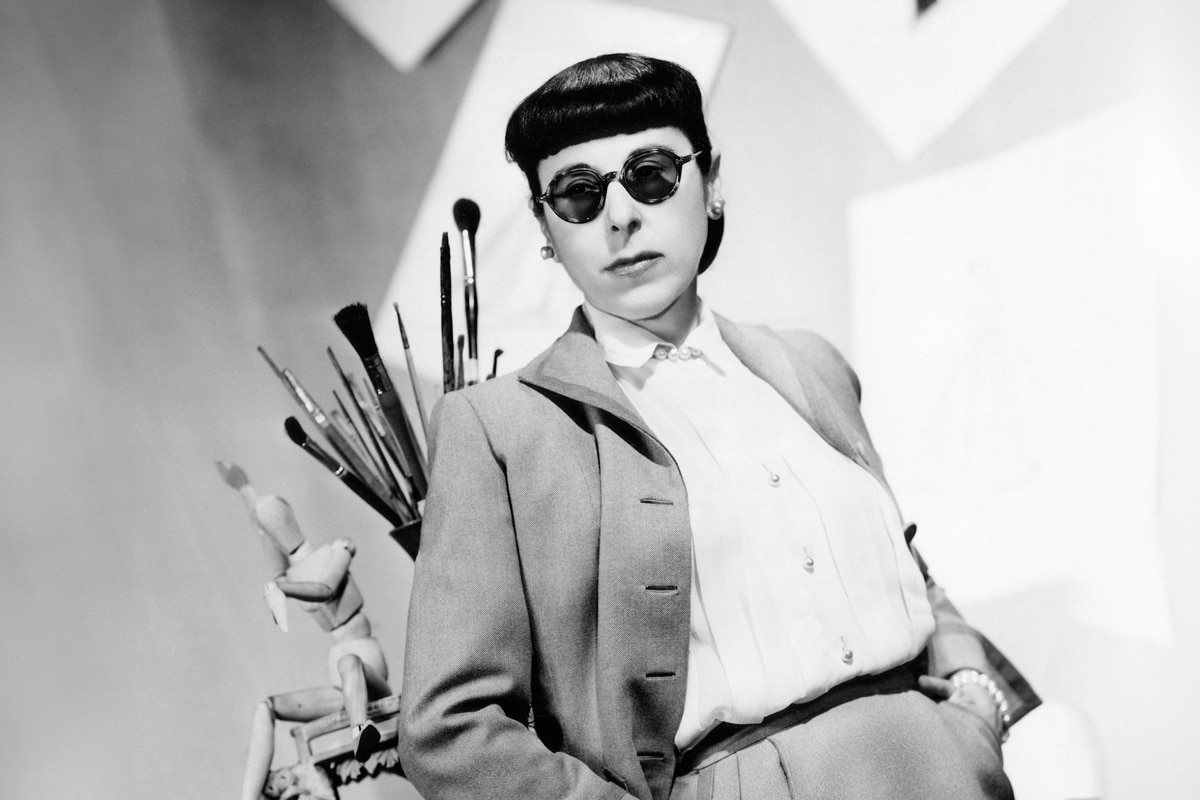
As the public’s awareness of Edith Head grew, she embraced her status as a celebrity. In her desire to maintain control of her public persona, she established her own signature look. Her jet-black hair was always styled with a straight-cut set of bangs and a bun pinned low at the nape of her neck. This look was inspired by Anna May Wong’s hairstyle in the film Dangerous to Know (1938). While working on set with Wong, Head switched from her Colleen Moore-style bob over to this new style. Self-conscious of her genetic tooth deformity, she never smiled which ultimately gave the illusion that she was all business.
Every element of Edith Head’s uniform was intentional. She wore dark, blue-tinted glasses, which helped her visualize how costumes would look in black-and-white. She dressed in monochrome skirt suits and wore simple shoes. Working with actresses on multiple costume fittings meant spending a lot of time with them in front of mirrors. Head was aware that an actress might try to compare herself to the designer. By making herself look nondescript, she eliminated those distractions.
The consistency of her look made her a recognizable figure in an industry where recognition was everything. She understood the power of publicity and made herself available for television appearances—including an early guest spot on the show “Mary McAdoo at Home” in 1953, where she offered fashion advice to a female viewership. She was a regular guest on radio, wrote a best-selling memoir titled “The Dress Doctor”, had a successful line of sewing patterns and hosted a traveling fashion show with fellow designer June Van Dyke. Head insisted upon on screen credits even when her contributions were minimal. She won the Best Costume Design Oscar for The Sting (1973) despite doing no real design work and simply approving final looks.
When Paramount was acquired by Gulf & Western in 1966, Head’s contract was not renewed. She moved to Universal to work under designer Vincent Dee and would be loaned out to other studios on special request. These requests came from actresses like Natalie Wood who worked with Edith Head on a total of 11 films, including Love with the Proper Stranger (1963), Sex and the Single Girl (1964) and Wood’s last completed film The Last Married Couple in America (1980). When Merle Oberon wanted a wardrobe designed around her collection of expensive jewels for Hotel (1967), she requested Edith Head despite there being another costume designer assigned to the production.
Edith Head was a bona fide workaholic and kept busy up until the very end of her life. Her biggest project volume-wise came towards the later part of her career when she was hired for John Huston’s The Man Who Would Be King (1975). She worked with John Wilson-Apperson and Paul Vachon to create costumes for a cast of over 15,000. At 83 years old, her final project was Carl Reiner’s Dead Men Don’t Wear Plaid (1982), where she recreated costumes from old Hollywood, including ones that she had originally designed herself. The film was released after her passing in 1981 and was dedicated in her honor.
