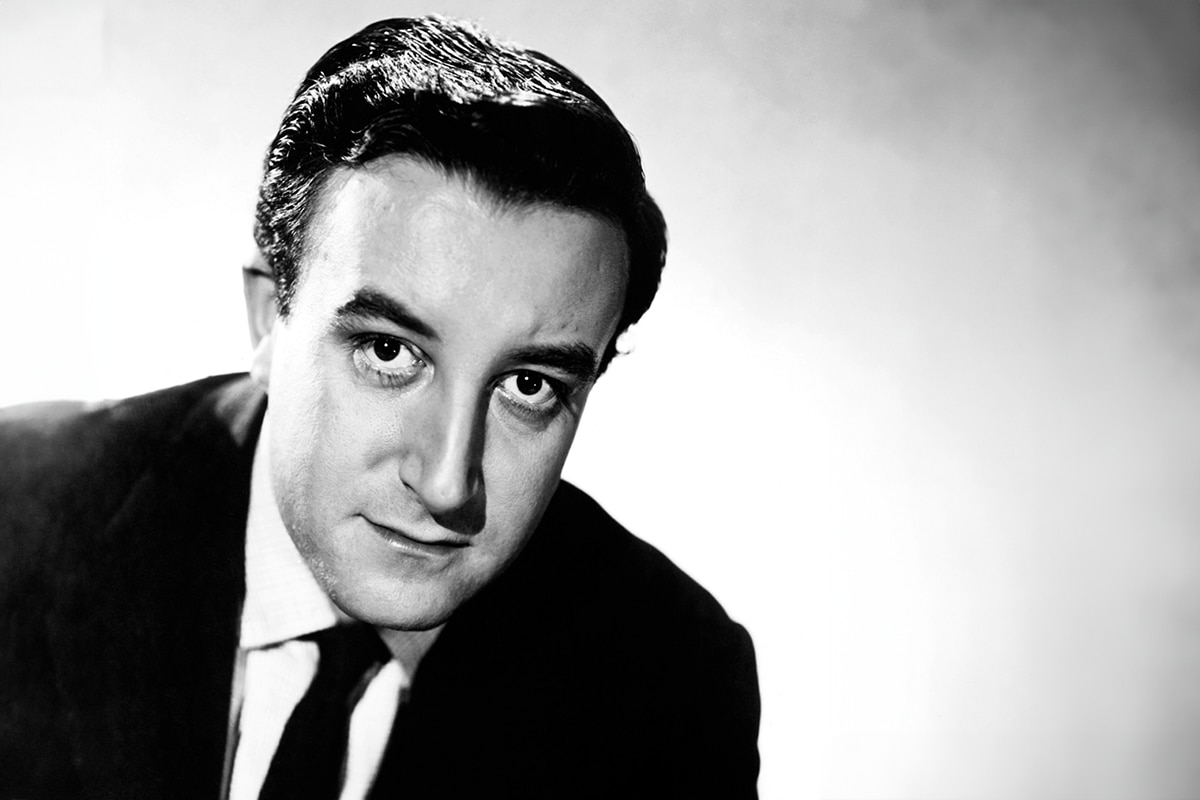
This article was originally written for the Star of the Month programming in the TCM Now Playing newsletter in August 2025.
"I could never be myself," confided Peter Sellers to Kermit the Frog during his appearance on “The Muppet Show” in 1978. "You see, there is no me. I do not exist. There used to be a me, but I had it surgically removed." It's an absurdist joke with a streak of truth to it.
Peter Sellers had a gift for disappearing into his characters. Whether playing a middle-aged union shop steward, a German psychiatrist in love with a patient, a bumbling French police detective who leaves chaos in his wake or a blank slate of a man who steps out of a mansion garden and into a world that mistakes his horticultural aphorisms for political genius, Sellers transformed himself completely. More than just a matter of make-up and accents, he became someone else entirely on the screen. As early as 1960, in an interview for "The New York Times Magazine," Sellers insisted, "As far as I'm aware, I have no personality of my own whatsoever." He came alive, slipping into other skins and personalities. It was being himself that proved difficult.
Born in 1925, the son of variety hall performers, young Sellers was a shy, sheltered boy whose talent for mimicry brought laughs and attention. He stood out only while becoming someone else. In World War II, his impersonations landed him a spot entertaining the troops, and his repertoire of regional accents and character types (many of them inspired by people from his past) landed him work on the radio after the War. He found fame through the characters he brought to life on the hit radio comedy "The Goon Show," a surreal, wildly anarchic series that inspired a new breed of British comedy that included “Monty Python's Flying Circus,” and was soon guest-starring on TV. The big screen was the next world to conquer.
The first night of TCM's centenary celebration of Peter Sellers spotlights his early character roles in British comedies, beginning with his first major big-screen appearance. After a handful of low-budget productions, he was cast alongside Alec Guinness in Alexander Mackendrick's The Ladykillers (1955). It was, in Sellers' own words, "The first real film I made," and Guinness, famed for his total immersion into character, was his idol. Sellers plays a small-time hood involved in a big-time heist, an adult in arrested adolescence bouncing off classic character types that fill out the gang, and he reportedly voiced the parrots that belonged to the landlady of their hideout. He reunited with another costar, Herbert Lom, in the slapstick Pink Panther films of the 1970s.
Sellers plays to his strengths as a TV host famed as "the jack of all faces" in Your Past is Showing (1957), where he disguises himself to plot the murder of a blackmailer, and he became a leading man in The Mouse That Roared (1959) playing the hapless, good-hearted gamekeeper of a small European kingdom who leads an invasion of the U.S. designed to fail. An American comedy shot in England, the film marked another first for Sellers: playing multiple characters in the same movie. As the scheming Prime Minister and the regal Grand Duchess, he even played scenes opposite himself. Sellers later confessed that playing a light romantic lead proved a bigger challenge than disappearing into one of his elaborate creations.
That same year, Sellers delivered one of his most memorable characters in John Boulting's satire I'm All Right Jack (1959). He originally turned down the role of shop steward Fred Kite because he didn't think it was funny, but when members of the local filmmaking trade union visited the set, his incarnation of the militant union man spouting socialist slogans with a Cockney accent had them in stitches. It ruined the take but sold Sellers on the character.
For Tom Thumb (1958), a big-screen fairy tale with a tiny hero that Hollywood filmmaker and visual effects specialist George Pal shot in London, Sellers (under a costume of black fur) took on the role of villain with frequent costar Terry-Thomas. It became his American film debut.
Could Stanley Kubrick have created Dr. Strangelove or: How I Learned to Stop Worrying and Love the Bomb (1964) without Peter Sellers? It certainly wouldn't have been the same film. Sellers takes on three central roles: an unflappable British officer, the milquetoast American President Merkin Muffley and the title character, a nuclear scientist played like a demented combination of Werner von Braun and Henry Kissinger with a perverse German accent. Sellers was also originally cast as Texan bomber pilot Major "King" Kong, but between difficulties mastering the Texas drawl and a sprained ankle, he begged off and Slim Pickens was cast at the last minute. Kubrick gave Sellers free rein to improvise and utilized a number of his inspirations in the finished film, perhaps most memorably Strangelove's involuntary "Sieg Heil" salute as Armageddon approaches. Sellers steals the show in the funniest film ever made about mutually assured destruction.
In The World of Henry Orient (1964), he essentially plays second fiddle to a pair of lovestruck schoolgirls obsessed with his character, a pompous pianist and would-be lothario whose activities are constantly thwarted by his teenage fan club. Sellers brought vanity to the part, making his musician a second-rate talent who played the sophisticate with a phony accent. For Lolita (1962), Sellers' first collaboration with Kubrick, he brings a wry, blackly comic edge to Clare Quilty, improvising lines during takes that made the character, in the words of biographer Ed Sikov, "unpredictable and terrifying." The same could be said of his part in Carol for Another Christmas (1964), a reimagining of the Charles Dickens classic as a modern plea for international diplomacy and world unity. Scripted by Rod Serling and shot on a low budget by Joseph Mankiewicz for TV, Sellers plays a self-appointed prophet of self-destruction and me-first egoism with a malevolence hidden under a huckster's grin.
The role of Inspector Clouseau has become so synonymous with Sellers that it's easy to forget the character was merely a supporting role in the original The Pink Panther (1963). In fact, Peter Ustinov was originally cast as the bumbling detective on the trail of a sophisticated jewel thief but dropped out days before shooting began. Sellers was immediately offered the part and, working with director Blake Edwards, developed the physical comedy of the accident-prone investigator. According to Edwards, the French accent was Sellers' own idea, and it was Sellers who gave the comic figure a sense of dignity in the face of his buffoonish incompetence. An iconic screen character was born.
A Shot in the Dark (1964) wasn't originally intended as a sequel. The original script, based on a stage play, had Sellers playing a French magistrate preparing for a murder trial, but when he clashed with the director, the producers reunited Sellers with Edwards. Working with writer William Peter Blatty, the farce was reimagined as a vehicle for Clouseau, and they added Clouseau's absurd disguises and two new characters to the mix: Inspector Dreyfus (played by Herbert Lom), Clouseau's exasperated boss driven to madness by the detective's incompetence, and Kato (Burt Kwouk), the valet whose job includes launching surprise attacks on his boss. They remained defining elements of what became a hit series of slapstick comedies, but that was still in the future. By the end of the production, Sellers and Edwards were no longer speaking to one another.
Sellers is but one of the James Bonds in the big-budget spoof Casino Royale (1967), along with David Niven, Ursula Andress and a handful of others, but he could well have been the villain, considering the chaos he caused the production. Thanks to constant rewrites, capricious demands and sudden absences, the film went through six directors, almost a dozen screenwriters (most uncredited) and a revolving door of costars and went weeks over schedule. Despite the chaos, it was a hit.
Sellers was cast in a relatively minor role in the sex farce What's New Pussycat? (1965), the first screenplay by rising stand-up comedian Woody Allen, who wrote a supporting role for himself. Sellers, cast as a sexually frustrated German psychiatrist to Peter O'Toole's sex addict patient, kept expanding his role with constant improvisations and, later, uncredited rewrites. As his role grew, Allen's got smaller, which may have convinced the author to become his own director for subsequent features.
The Bobo (1967), starring Sellers as a singing matador and his real-life wife, Britt Ekland, as the beauty he attempts to woo, had its own troubles. Their marriage was on the rocks, which led to tensions and outright fights on the set, and then his mother Peg passed away, sending the actor into a deep depression. Despite the conflicts, the film opened to good reviews and inspired film critic Richard Schickel to proclaim, "Peter Sellers may be the finest comic actor of his time…"
Four years after falling out, Sellers reunited with director Blake Edwards for The Party (1968), playing a sweet but bumbling East Indian actor accidentally invited to a Hollywood soiree that he sends into chaos. While the brownface make-up is a reminder of a less sensitive culture, Sellers invests the guileless character with generosity, making him an outsider in a culture of greed and power. By the end of the film, Sellers and Edwards were once again communicating through intermediaries, yet together they create a beautifully choreographed physical comedy, like a modern take on silent slapstick.
It was another seven years before the two collaborated again and desperation may have been the catalyst. Both star and director were in need of a success and reviving Inspector Clouseau for The Return of the Pink Panther (1975) proved to be their ticket. Sellers pushed his accent to absurd extremes and threw himself into increasingly outlandish physical gags. Co-star Christopher Plummer recalled that Sellers' improvisations, encouraged by Edwards, frequently sent cast and crew into hysterics. The film was a hit, reviving not just the series but the careers of both Sellers and Edwards, who went on to make two more Clouseau films before Sellers' death at the age of 54.
Being There (1979) wasn't Sellers' final film, but spiritually it feels like his final word. Sellers spent years trying to acquire the rights to Jerzy Kosinski's novel, about a childlike gardener who is less an innocent than a blank slate of a man onto which people project what they want to see. It's the perfect part for an actor who insisted that he had no personality of his own. As biographer Roger Lewis put it, Sellers "put all the nothingness he had" into the role. It earned Sellers his second Oscar nomination.
TCM's series concludes with Sellers taking on the sexual revolution. Set in London, There's a Girl in My Soup (1970) pits Sellers' womanizing TV host against a free-spirited but savvy American girl played by Goldie Hawn. In I Love You, Alice B. Toklas! (1968), he's an American lawyer who rebels against conformity by leaving his fiancée for his hippie brother's sexually liberated girlfriend (Leigh Taylor-Young). In both films he's a middle-aged man seeking escape with a younger woman but is too self-absorbed to let go of himself. It could be Sellers' own life story. His ego drove away friends and family. When he died from a heart attack in 1980, he was on his fourth marriage (to a woman 30 years his junior) and had cut his children out of his will and his life. For a man with so many lives within, he had a hard time living his own.
