This article was originally written about programming for the TCM Now Playing newsletter in August 2025.
TCM is honored to recognize the contributions of Latin Americans to U.S. life with two nights devoted to the celebration of Hispanic Heritage Month. In 1968, President Lyndon B. Johnson signed legislation declaring the week including September 15 and 16 Hispanic Heritage Week, the government’s first official recognition of Latinx culture. That was expanded to a month, from September 15 to October 15, under Ronald Reagan 20 years later. The period was chosen because of its importance to Latin History. September 15 is the anniversary of the Cry of Dolores, the tolling of a church bell that started the Mexican War of Independence in 1810. The monthlong period also coincides with the anniversaries of independence in Costa Rica, El Salvador, Honduras, Nicaragua and Chile.
Hispanics have played an important part in the development of film in the U.S.: Myrtle Gonzalez, Hollywood’s first Hispanic film star, made almost 100 silent films between 1913 and 1917; Emile Kuri was the first Mexican-American to win an Oscar for set decoration on The Heiress (1949) and 20,000 Leagues Under the Sea (1954); José Ferrer and Rita Moreno became the first Hispanics to win acting Oscars; and Efrain Gutiérrez’s Please, Don’t Bury Me Alive! (1976) is considered the first Chicano film.
TCM commemorates these and many more great achievements with salutes to two Hispanic filmmakers, actor Fernando Lamas and cinematographer Gabriel Figueroa.
Fernando Lamas, Tuesday, September 16
Fernando Lamas followed a long string of Latin lovers on screen, a type created when Italian American Rudolph Valentino played the Argentine playboy in Rex Ingram’s The Four Horsemen of the Apocalypse in 1921. He would be followed by such noted stars as Ramon Novarro, Gilbert Roland and Ricardo Montalbán, among many others. Like Valentino, Roland and Montalbán, Lamas had a fine athletic physique, honed through award-winning competitions in fencing, boxing and swimming in his native Argentina. He also had a strong singing voice and a natural sophistication. For a brief period, the fans ate him up and doted on fan magazine accounts of his amorous exploits on- and off-screen.
He was born in Buenos Aires on January 9, 1915, and after distinguishing himself in athletics, moved into acting, making his film debut in his native land’s En el ultimo piso (1942). Six years later, he became a Latin American star appearing opposite Dolores Del Río in Historia de una mala mujer (1948), an adaptation of Oscar Wilde’s “Lady Windermere’s Fan.” His first U.S. film was The Avengers (1950), shot on location in Buenos Aires and starring John Carroll, whose wife, MGM talent scout Lucille Ryman, got the studio to give him a screen test.
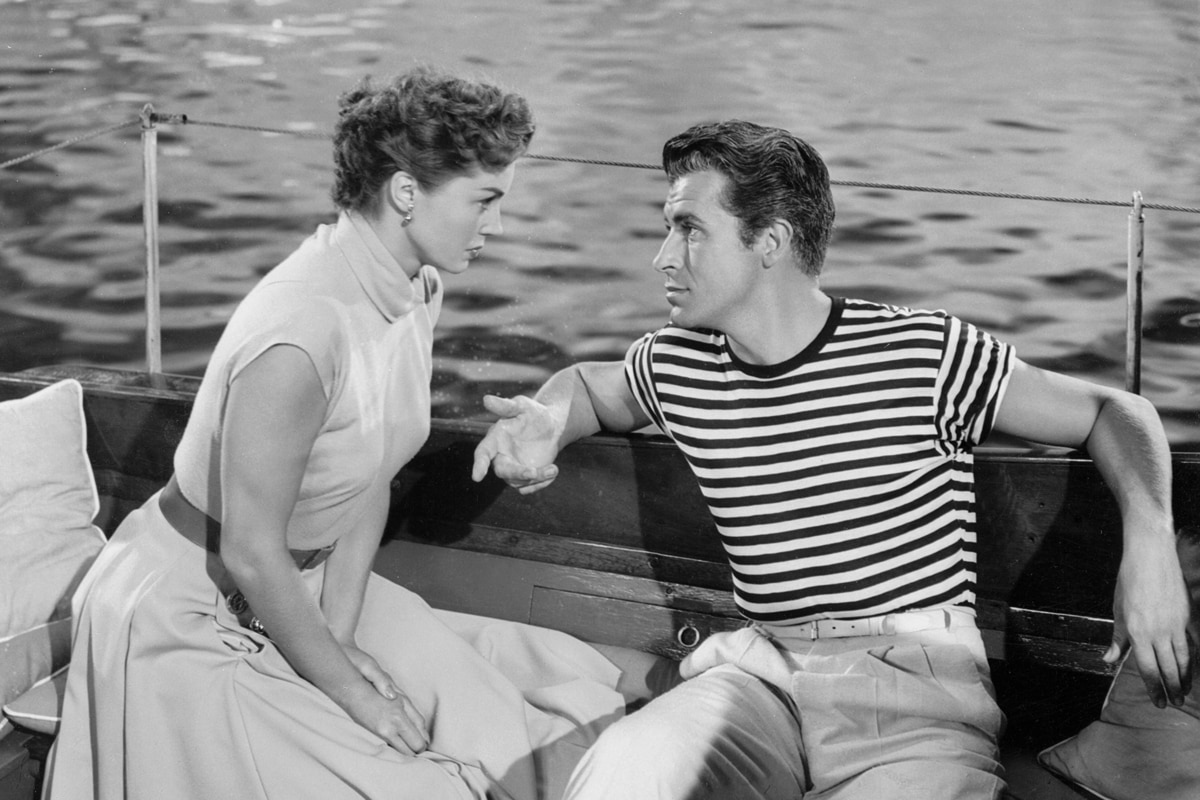
At first, all Lamas did was take English lessons. Then pianist and sometime MGM star Jose Iturbi pointed him out to producer Joe Pasternak, with the line “Here’s a prize: a gaucho for the girls!” Pasternak cast him in the Jane Powell musical Rich, Young and Pretty (1951), though his role as Danielle Darrieux’s romantic partner didn’t give him a chance to sing. After romancing lady jewel thief Greer Garson in The Law and the Lady (1951), he finally made it to stardom and got the chance to sing on-screen in The Merry Widow (1952). The film was a big hit thanks to star power, a lavish production and gossip about his and Lana Turner’s affair. Lamas was already married — for the second time — and refused to divorce his wife for Turner, leading to a very public breakup at a party that ended with him going off with Arlene Dahl, whom he would marry in 1954. He got to show off his physique and vocal skills in the Esther Williams musical Dangerous When Wet (1953). Without Turner, however, the studio didn’t have much else to offer him. He finished his contract duetting with Ann Blyth to “Indian Love Call” in a remake of Rose Marie (1954) but took a back seat to leading man Howard Keel.
Unhappy with his typecasting as a Latin lover, Lamas gave Broadway a try, teaming with Ethel Merman for one of her least successful musicals, “Happy Hunting.” He also started doing TV guest spots. One special proved particularly fortuitous when he co-starred in Esther Williams at Cypress Gardens (1960). He was divorcing Dahl at the time, and the friendship with Williams that had developed during their first film together turned into romance. They became constant companions, and he directed and co-starred with her in the Spanish film Magic Fountain (1963). They married overseas in 1967 and remarried in the U.S. in 1969. This was the marriage that stuck. They remained together as he continued with TV guest appearances and the occasional movie, like 100 Rifles (1969) with Raquel Welch and The Cheap Detective (1978), a Neil Simon spoof of Humphrey Bogart movies starring Peter Falk, Madeline Kahn and Ann-Margret, among many others. Lamas also turned his hand to directing for TV, helming episodes of series like “Starsky and Hutch” and “House Calls.”
Lamas was only 67 when he died from pancreatic cancer in 1982, but his image has lived on in popular culture. Billy Crystal based his Hispanic talk-show host Fernando on him in a series of popular sketches on “Saturday Night Live.” He even used one of Lamas’ quotes, “It is better to look good than to feel good,” as his catch phrase. Lamas’ friend Jonathan Goldsmith later turned to him for inspiration when he was cast in a series of ads for Dos Equis beer featuring “The Most Interesting Man in the World.” Closer to home, Lamas’ son with Dahl, Lorenzo Lamas, carried on the family name as one of the stars of “Falcon Crest,” a series for which his father not only guested but occasionally directed.
Gabriel Figueroa, Tuesday, September 23
In a 50-year career, during which he worked on more than 200 films, Gabriel Figueroa gave the world a window on Mexico. His landscape photography, some of it modeled on the work of such Mexican artists as José Clement Orozco and Diego Rivera, captured vivid images of the countryside, while his urban shots, often filled with violence, evoked the volatile spirit of the nation’s mid-20th century political scene. So vivid and moving were the pictures he created that Rivera ranked him as an equal in the art of painting with light and color. Despite offers to work elsewhere, Figueroa spent most of his career in Mexico, becoming a key figure in the Golden Age of Mexican Cinema and only occasionally working with non-Mexican filmmakers.
Figueroa was born to a once prominent family in Mexico City in 1907. He was studying violin and painting when family funding dried up. After dropping out of school, he started working with portrait photographers, eventually setting up his own studio. In 1932, he moved into the film industry as a still photographer, starting with Revolución (1933). His work combined standard studio portraiture with vivid posed shots reflecting a film’s action. That caught the eye of director Howard Hawks, who hired him as a camera operator on Viva Villa! (1934). Before it came out, Figueroa was given a scholarship to study cinematography in Hollywood, where he apprenticed with Gregg Toland, who would become a major influence on his work.
In 1936, Figueroa returned to Mexico to work as cinematographer for Allá en el Ranco Grande, the film often cited as the birth of the Golden Age of Mexican Cinema. His work won him a special prize at the Venice Film Festival. Starting with Flor silvestre in 1943, he forged a 20-film collaboration with the great Emilio “El Indio” Fernández. Their next picture, Maria Candelaria (1944), won him the Best Cinematography award at the Cannes Film Festival. Toland was so impressed by it, he recommended Figueroa to John Ford, who hired him to shoot The Fugitive (1947), starring Henry Fonda. Ford wanted to sign hm to a three-picture deal, but Figueroa’s involvement in leftist Mexican politics kept him from obtaining a work visa for the U.S. during the McCarthy era.
After winning a Golden Globe and a Venice Film Festival Award for his work on Fernández’s The Pearl (1947), Figueroa forged another fruitful collaboration, this time with exiled Spanish director Luis Buñuel. Their first film together, Los Olividados (1950), won Figueroa his fifth consecutive Ariel Award (he would win nine competitive Ariels, the Mexican version of the Oscar). He and Buñuel would also work together on six more films, including the satirical allegory The Exterminating Angel (1962), in which a group of posh dinner guests find themselves unable to leave the dining room.
Although he insisted on remaining based in Mexico, Figueroa continued to attract the attention of U.S. directors. He earned his only Oscar nomination for John Huston’s Tennessee Williams adaptation, The Night of the Iguana (1964), and reteamed with Huston for Under the Volcano (1984), adapted from Malcolm Lowry’s blistering tale of an alcoholic diplomat (Albert Finney). Other Hollywood filmmakers who sought him out included Robert Florey, for whom he shot Tarzan and the Mermaids (1948)—one of the most beautiful films in the series; Don Siegel, with whom he made the Clint Eastwood-Shirley MacLaine vehicle Two Mules for Sister Sara (1970); and Brian G. Hutton, director of Kelly’s Heroes (1970), a World War II heist film also starring Eastwood.
Figueroa’s prominence in the industry meant that he had script approval, something relatively rare for cinematographers. After making El maleficion II (1986), a sequel to a popular horror telenovela, he stopped making films altogether. He never officially retired, but he just couldn’t find a script that interested him. Instead, he spent time with his family, attended film festival retrospectives and accepted lifetime achievement honors from the Ariel Awards and the American Society of Cinematographers. He died of a stroke following heart surgery in April 1997. At the inaugural Los Angeles Latino International Film Festival, he was voted a posthumous lifetime achievement award. That award, named for him, has since gone to such major Hispanic filmmakers as Pedro Almodovar, Anthony Quinn and Rita Moreno.
