This article was originally written for the Summer Under the Stars programming in the TCM Now Playing newsletter in August 2025.
Sterling Hayden never felt he was cut out for Hollywood. Though he stood a towering 6’5”, boasted rugged charisma and weathered, movie-star looks, and appeared in around 50 features, he had a disdain for celebrity and stardom, to the point that he fled Hollywood several times throughout his career. His real passions lay in writing, sailing and generally rebelling against society’s (and Hollywood’s) expectations and conventions. All the same, despite his reluctance, he left behind enough unforgettable performances to firmly secure his place in Hollywood history – including in some of the most iconic movies ever made.
He made his screen debut in 1941, in two frothy Technicolor romances at Paramount that made him feel like “a male starlet” and prompted him to quit the business for the first time. After World War II, he returned to give screen acting another go. The bulk of his roles would come throughout the 1950s, and most of the films in TCM’s Summer Under the Stars tribute hail from those years. His first film of that decade, The Asphalt Jungle (1950), stands not just as one of his finest, but as the one on which he first took the acting profession seriously. Before Asphalt, Hayden recalled, “I had no particular respect for Hollywood and no real ambitions as an actor, so I ignored it as much as I could. But I realized that Asphalt was going to be a good film, and for the first time I had the feeling that I’d better make a real effort. I was carried by a brilliant director, John Huston, a very able cast, and a good story.”
The Asphalt Jungle is famed as a film noir masterpiece that reinvented the heist genre. Earlier movies had included elaborate robberies, but here the planning, execution and aftermath of a single jewel heist comprise the entire arc of the story. It also sets the framework for the film’s real focus: the rich, vividly drawn characters. These are complex and at times paradoxical antiheroes who treat robbery as simply a line of work and have needs, hopes and dreams beyond just scoring the loot. As Huston said, “You may not admire these people, but I think they’ll fascinate you.”
To cast Hayden as Dix Handley, the “hooligan” or gunman of the group, Huston had to do battle with MGM, who didn’t want the actor because he had never demonstrated real box-office value. Finally, the studio allowed Huston to make his case with a screen test. He told Hayden, “I’ve admired you for a long time. They don’t know what to make of a guy like you in this business. Maybe we’ll change all that.” Hayden later wrote that he was very nervous on the day of the test, but when he started playing the scene with Jean Hagen, “slowly my joints unlock, I shiver a little, and for the first time I begin to act.” As Dix, Hayden projected brooding intensity and natural stoicism that were well suited to the tale’s moral ambiguity. Dix is tough enough to say, “Why don’t you quit crying and get me some bourbon!” and sensitive (and naïve) enough to pine for the horse farm of his Kentucky youth.
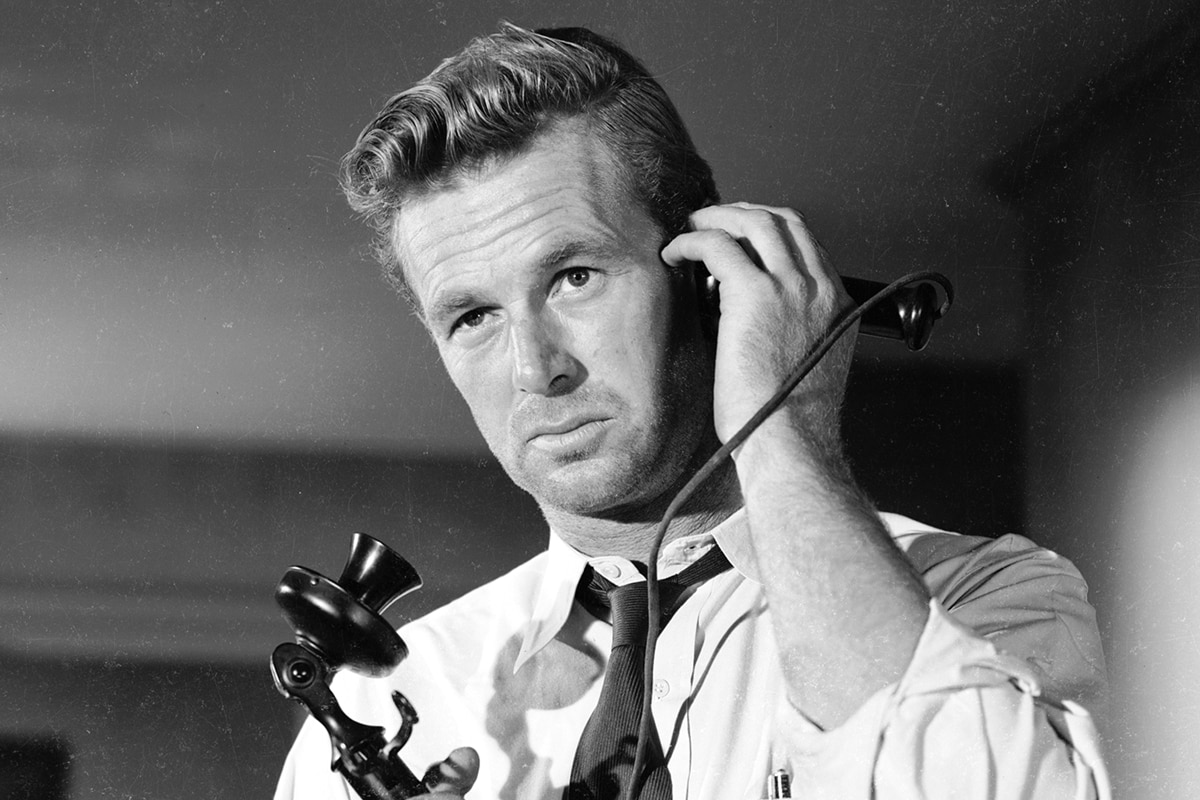
Three years later, Hayden returned to film noir in director André De Toth’s tough and gritty Crime Wave (1953), which is now a cult favorite. Here, Hayden plays a scowling, hardened police detective chasing a murderous hoodlum through vivid Los Angeles locations after an opening gas-station holdup goes superbly awry. De Toth shot the film in 13 days, all on location, using natural light and sound wherever possible. For one scene, he efficiently uses only a telephone and two hands (along with off-screen voices) to convey the action. There is not an ounce of fat in the finished picture. Among the cast is fellow Summer Under the Stars player Charles Bronson—billed as Charles Buchinsky— who steals his scenes as one of the bad guys.
The same year, Hayden appeared in Kansas Pacific (1953), one of many career Westerns. He plays a pre-Civil War Union officer assigned to aid a construction boss played by Barton MacLane, who is building a railroad that the Union will need if war comes. The trouble is that the railroad is continually being sabotaged by Southern sympathizers. As Hayden lends protection, he begins to fall for MacLane’s daughter, played by Eve Miller. While this film is in many ways merely a routine, low-budget Allied Artists oater, for which Hayden expressed little enthusiasm, he actually delivers quite an effective performance. “Variety’s” enthusiastic review called this film “one of the better pix to emerge under the Allied Artists banner...Hayden seems more at ease than usual in a tailor-made role and impresses.” “The Hollywood Reporter” deemed Hayden “excellent.”
Hayden first worked with director Stanley Kubrick on The Killing (1956), another heist picture, this time with Hayden front and center as the criminal mastermind coldly orchestrating a racetrack heist. While this was Kubrick’s third film, it was the first on which he worked with a professional cast and crew and was the one that really launched his Hollywood career. “It was the handling of time that may have made this more than just a good crime film,” Kubrick said. The story is told in a nonlinear, fragmented style (as it is in the source novel), with the actual robbery shown over and over, from the perspective of each thief. It was a bold experiment that failed to turn the film into a commercial success in 1956 but is now much admired by filmmakers and audiences alike.
In 1958, Hayden retired from the screen once again, only to be coaxed back five years later by Kubrick for what would be Hayden’s best-remembered role: Brigadier General Jack D. Ripper in Dr. Strangelove or: How I Learned to Stop Worrying and Love the Bomb (1964). As Hayden said, “My resolve to abstain from acting went out the window because I believed this was a picture that should be made.” A pitch-black satirical comedy about one of the least-funny of all topics—nuclear war—the film hasn’t dated. Kubrick actually planned to make a serious, suspenseful drama when he first plunged into adapting the novel “Red Alert.” But as he researched the world of thermonuclear war and the accidental ways in which one might start, he found that many of the possibilities were so preposterous as to be comical. They were also the most “truthful,” he later told writer Joseph Gelmis. “So it occurred to me that...the only way to tell the story was as a black comedy or, better, a nightmare comedy.”
At the heart of the picture’s brilliant humor is the tension between reality and absurdity, starting with the title sequence of two military planes engaging in midair refueling, with unmistakable and hilarious sexual overtones. (Such references are everywhere in Dr. Strangelove as the movie links sex with war through to its explosive ending.) Hayden’s portrayal of the unhinged general who initiates a nuclear strike on the Soviet Union is indelible, with his deadpan delivery of satirical lines about “precious bodily fluids” showcasing his ability to balance absurdity and menace in a single performance.
Hayden later said, “Lord knows it was a magnificent picture, but I went through the worst day of my life the first day because I began to blow my lines. I went 48 takes. I had the cigar, and all the dialogue, the military jargon, and I’m pouring sweat, they’re mopping me off. I finally couldn’t take it anymore, and walked up to Kubrick and said, ‘Stanley, I apologize.’ And he said one of the loveliest things any man has ever said to me in my life: ‘Sterling, I know you can’t help what’s going on, and you know I can’t help you. But the terror in your eyes, on your face, may just be the quality that we want in this jackass general Jack Ripper. If it isn’t, come back in another couple of months and we’ll do it all over again.”
After Dr. Strangelove, Hayden starred in a television movie, Carol for Another Christmas (1964), an unusual and until recently rarely shown adaptation of A Christmas Carol. Written by Rod Serling, directed by Joseph L. Mankiewicz, scored by Henry Mancini and boasting an impressive cast that includes Eva Marie Saint and Robert Shaw, it stars Hayden as the Scrooge character, here called Daniel Grudge, a business tycoon embittered over the death of his son, Marley, in combat in 1944. The project immediately reunited Hayden with Peter Sellers, who had played three roles in Dr. Strangelove, including the British officer who spends most of the film sparring with General Ripper. Here, Sellers wears a cowboy hat and a Santa costume as he portrays a Mad Max-like leader of a group of apocalypse survivors.
Following Carol, Hayden left the screen for another five years before coming back yet again with sporadic roles through the 1970s. One of his most unusual was Winter Kills (1979), a darkly comic conspiracy thriller based on a 1974 novel by Richard Condon, who had also written “The Manchurian Candidate.” The novel channels conspiracy theories about John F. Kennedy’s assassination into a fictional tale about the aftermath of a president’s slaying, which made it too controversial for Hollywood studios to touch. It was finally made by independent producers and a relatively inexperienced writer-director, William Richert, though he assembled a very impressive roster of talent, including Jeff Bridges, Eli Wallach, Anthony Perkins, Dorothy Malone, Richard Boone, Ralph Meeker and John Huston, who enjoyed reuniting with his Asphalt Jungle star. Hayden plays a crazed old man who stages tank battles with live rounds on his ranch. Elizabeth Taylor also appears in an unbilled cameo. Winter Kills was an extremely troubled production that went bankrupt during filming before it was eventually completed. It was pulled from distribution after just a few weeks and has since become a cult item, championed by the likes of Quentin Tarantino.
