This article was originally written for the Summer Under the Stars programming in the TCM Now Playing newsletter in August 2025.
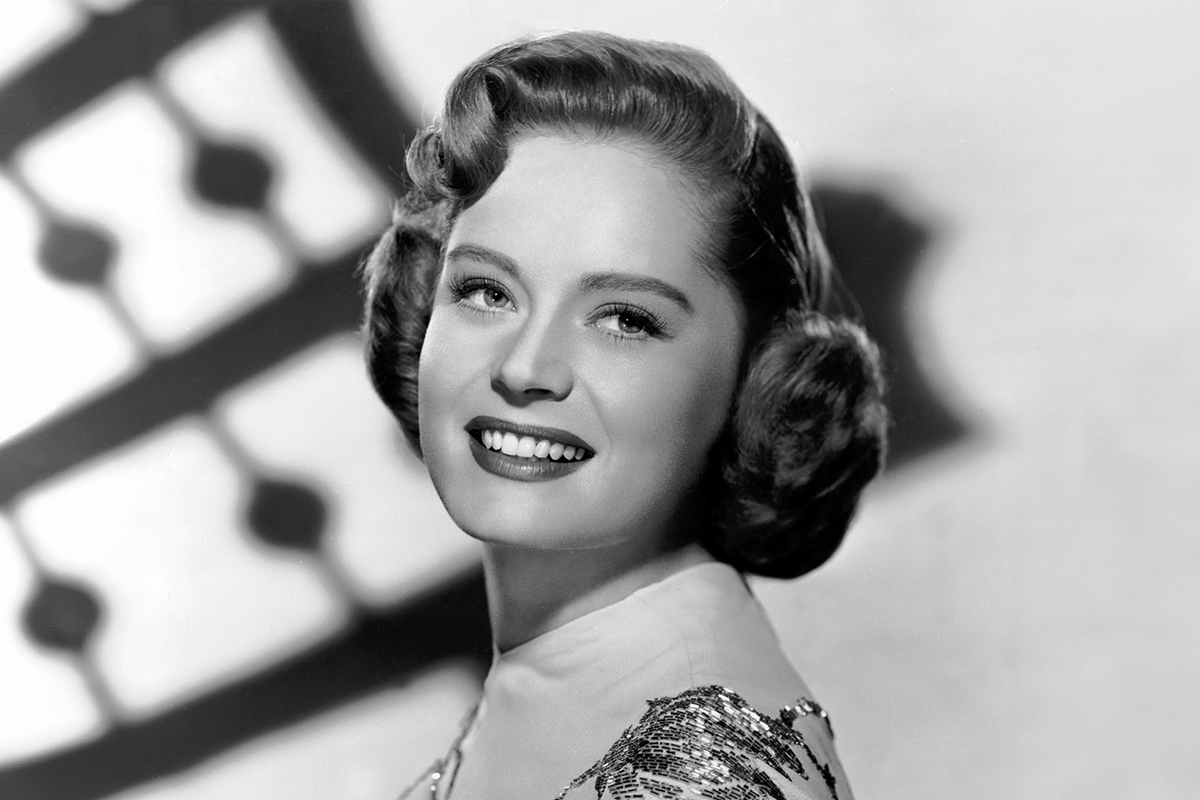
Sophisticated, stately, sultry, statuesque, snooty: That’s how Alexis Smith was frequently typecast in Hollywood. The self-described “utility player” supported Hollywood’s biggest luminaries during her tenure at Warner Bros. during the 1940s, obediently taking on roles turned down by stars like Bette Davis and Olivia de Havilland. While the full range of her talent was often overlooked during the Golden Age, Smith enjoyed surprising prominence during the 1970s on Broadway and continued to appear on screen and stage to the delight of fans until the 1990s.
Alexis Smith was born on June 8, 1921, in British Columbia, Canada. The next year, her parents moved to Los Angeles, where her upbringing was strict and sheltered but rich in scope, as Smith’s mother instilled in her daughter a love of music, literature and education. She took to the arts strongly, enrolling in dance, piano, singing and acting classes and went from enjoying a season pass at the Hollywood Bowl to making her stage debut there in 1934’s “Carmen.” She continued to hone her craft in oratory contests and school productions, and a WB talent scout took notice of her in “The Night of January 16th” at Los Angeles City College. After a successful screen test, Smith signed a seven-year contract with the studio.
Following a handful of bit parts, Smith dove into her first credited role—fourth billed behind Errol Flynn, Fred MacMurray and Ralph Bellamy—in Dive Bomber (1941), a movie Flynn himself insisted she be cast in. (They’d eventually appear in four pictures together.) The film’s success prompted Warners to build up their new star, starting with a nickname: Dynamite Girl, because she was “full of tremendous energy and is likely to explode on the slightest impulse, like dynamite,” Daniel Bubbeo quoted in his book “The Women of Warner Brothers.” (Smith did not appreciate the inaccurate moniker or the publicity stunt that came with it, in which she was presented sticks of fake dynamite.) Following Smith’s co-starring role in the mystery comedy The Smiling Ghost (1941), the blue-collar drama Steel Against the Sky (1941) proved historic for the budding star for two reasons: It was her first top billing and first pairing with future husband Craig Stevens.
Smith’s only picture released in 1942, Gentleman Jim, reunited her with Flynn. In the movie, he plays prizefighter James J. Corbett and Smith portrays his love interest, Vicki Ware, a part director Raoul Walsh originally wanted for Ann Sheridan or Rita Hayworth. While the movie strays far from the facts, it proved a success and Smith received positive reviews. However, behind the scenes, filming was not easy for Flynn, who suffered a heart attack during one of the boxing scenes.
The actress relished the chance to tackle a serious role in The Constant Nymph (1943) and considered the film her favorite. Following another prime dramatic part opposite Fredric March in The Adventures of Mark Twain (1944), Smith ventured into comedic territory in The Doughgirls (1944), starring alongside Sheridan and Jane Wyman as one of three newlyweds who end up sharing a honeymoon suite during WWII’s housing shortage. Smith was again paired with beau Stevens, and in a July 1944 “Movieland” article about their romance, Smith recounted the chaos of the scene where she misplaces their marriage license. “After we shot the scene, Craig grinned at me. ‘When we do get married—actually—I have a feeling that something like that will happen,’” she reported. Luckily, he was wrong; their real-life union later that year went off without a hitch and lasted almost five decades.
Warner Bros. kept Smith busy in 1945 across different genres. In her first Western, San Antonio, she reteamed with Flynn, he as a cowboy and she a dance hall girl. Smith had long wanted to play more musical roles, though when she got the chance, like in this picture, her voice was dubbed. She traveled to the dark side in the noir Conflict (1945) as the sister of Humphrey Bogart’s icy wife Rose Hobart, whom he kills to be with Smith. In the fantasy-comedy The Horn Blows at Midnight (1945), she co-starred as Jack Benny’s angel girlfriend and in the musical biopic Rhapsody in Blue (1945), she plays a fictional love interest opposite Robert Alda’s George Gershwin.
Smith found herself cast in another biopic the following year, Night and Day (1946), with Cary Grant portraying Cole Porter. Bubbeo wrote that the composer allegedly received $300,000 for his life rights, a fee that came with substantial creative control, resulting in a sunnier view of his story; some facts, including his homosexuality and drug use, couldn’t be included anyway due to the Production Code. Smith respected Grant’s dedication and meticulous approach, which resulted in different versions of the script – daily! She also received positive notices with “The New York Times” observing, “Alexis Smith’s role as Mrs. Porter is largely fictional, but the actress performs it with great charm.” Despite some good reviews, Smith was named one of the worst actresses of 1946 by “Harvard Lampoon,” more a reflection of the parts the studio handed her rather than her talent. While she was always a team player, she lamented in a 1970 “Films in Review” interview: “I always got the roles I didn’t want, the ones everyone else turned down.” By the mid-1940s, Warners had firmly solidified her character type. “She had this quality of being dignified, formal and aloof in the parts she played. That was not the Alexis I knew,” good friend Francis Rafferty remarked in “The Women of Warner Brothers.” “She had a face for playing that role… She did those parts well and they were easy for her.”
Following a supporting role in the 1946 Of Human Bondage adaptation, Smith co-starred in Stallion Road (1947) as a horse breeder caught in a love triangle with novelist Zachary Scott and rancher Ronald Reagan. She was initially announced to team with Flynn and Bogart in the picture, then Lauren Bacall was set to take Smith’s role… and then it went back to Smith! (The actress reunited with Bogart in 1947’s The Two Mrs. Carrolls.) The following year, 1948, Smith appeared in three Warner Bros. pictures: the romantic drama The Decision of Christopher Blake with Robert Douglas; the film noir Whiplash co-starring Scott, Dane Clark and Eve Arden; and the gothic drama The Woman in White alongside Eleanor Parker, Sydney Greenstreet and Gig Young.
Despite the steady work, the writing was on the wall for Smith at WB. As revenue dropped and many of her films faltered at the box office, she told James Bawden in a 1981 interview published in his book with Ron Miller, “You Ain’t Heard Nothin’ Yet,” that Warners “was no longer the studio I’d loved going to since 1940.” They felt the same, loaning her out for the first time to MGM for Any Number Can Play (1949) as the wife of casino owner Clark Gable. “I just fell in love with MGM’s glamour factory,” she said. One other familiar aspect was portraying an older character – here, the mother of teenager Darryl Hickman, only 10 years her junior. “Playing an older woman was always part of my persona,” she concluded.
Smith returned to her home studio for One Last Fling (1949)—figuratively and almost literally. Following that romantic comedy, she made what would be her final film under contract for Warners, the Western Montana (1950) co-starring Flynn. She finally started turning down roles, which led to suspensions and the eventual release from her contract. This allowed Smith to stretch her wings, starting with three pictures at Universal. With more freedom came more diverse parts, and she expanded beyond her WB stereotyping in Paramount’s musical comedy hit Here Comes the Groom (1951), the gritty noir The Turning Point (1952), the British thriller The Sleeping Tiger (1954) and Warners’ adult drama The Young Philadelphians (1959). The offers were fewer and farther between in the 1950s, leading Smith to declare during a 1971 interview on “The Dick Cavett Show” that she didn’t quit Hollywood; rather, “Hollywood quit me.” She wouldn’t make another movie for 15 years.
“Did I feel out of it? Yup! Bitter? Nope!” she divulged to Bawden in 1981 about her slowing film career. Her husband starred in the 1950s TV show “Peter Gunn,” then they moved to New York and “there was a whole new world waiting for me there,” she remarked. That world included TV appearances, summer stock, touring in plays with her husband and—eventually—Broadway.
When composer Stephen Sondheim asked Smith to audition for “Follies,” her first test was a flop. She “worked tirelessly to get the part,” Ted Chapin commented in “Everything Was Possible: The Birth of the Musical ‘Follies,’” partnering with a coach who helped her nail the second audition. Despite the show ultimately losing its investment, “Follies” netted several Tony Awards, including Best Actress for Smith, who enjoyed widespread praise and even landed on the cover of “Time.”
Unlike many other stars of her era, Smith embraced Hollywood’s evolution. “I’m one of the few who feels that the film industry is more exciting today than it was then – I mean the few of my peers, certainly,” she revealed in a 1983 interview for “Cinema Showcase.” “Follies” led to more second-act successes during this time, allowing audiences to see a different, often lighter side of Smith. She earned a Tony nomination for “Platinum” (1978), recurred on “Dallas” in 1984 and 1990, garnered an Emmy nomination for guest starring on “Cheers” in 1990 and in the year of her passing made one final big screen appearance in Martin Scorsese’s The Age of Innocence (1993), all illustrious work to cap off a storied career.
