This article was originally written for the Star of the Month programming in the TCM Now Playing newsletter in May 2025.
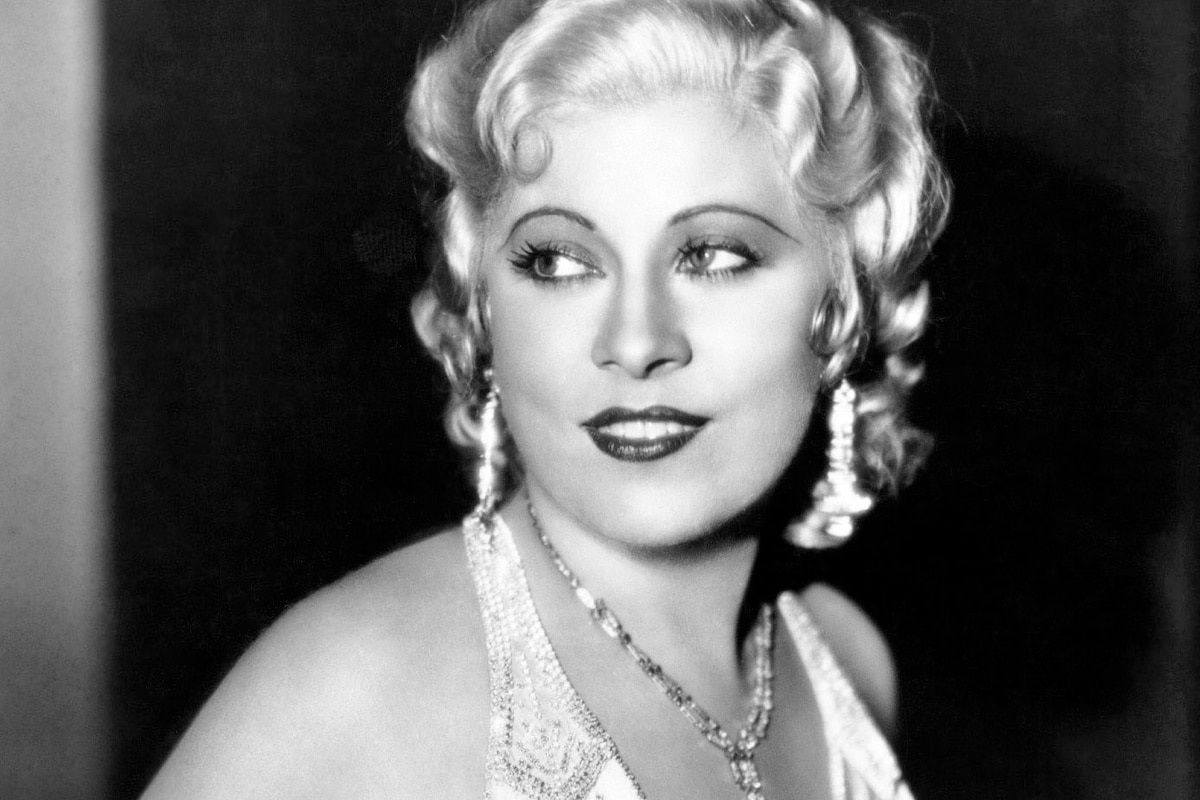
“You only live once, but if you do it right, once is enough,” Mae West, who was seemingly born to challenge convention, quipped. One can only assume West did it right. Though she appeared in only a handful of films, West’s sassy persona and liberated sexuality cemented her as one of the most provocative entertainers of all time. Her wisecracks transcended her stardom, and the level of influence she earned sometimes makes it easy to overlook the tremendous amount of controversy she elicited, especially from censors. TCM celebrates the iconic Mae in May, screening nine of her 12 features, including three TCM premieres across the first three Sundays of the month.
Born Mary Jane West on August 17, 1893, in Brooklyn, West’s earliest entertainment memory was a show she appeared in around the turn of the 20th century. Upon hearing the audience’s applause, West “knew there wasn’t any other place I ever wanted to be,” she later recalled. West eventually started working the vaudeville circuit and made the leap to Broadway while still a teen. Her performance style was inspired by a diverse array of artists, including Black vaudevillian Bert Williams, “the girl who made vaudeville famous” Eva Tanguay and female impersonator Bert Savoy.
By the mid-1920s, West began writing her own plays. Penned under the name Jane Mast, “Sex” opened on Broadway in 1926, which West also produced, directed and starred in. One “Variety” reviewer termed it “the nastiest thing ever disclosed on a New York stage.” But the rebukes only piqued interest, resulting in a hit. The show landed her in jail for eight days on an obscenity charge. Obviously, the progressive West knew how to court controversy and spin publicity in her favor. “I expect it will be the making of me,” she teased to reporters. Right, she was! West hit her stride with divisive plays, such as “The Drag” (1927), “Diamond Lil” (1928) and “The Constant Sinner” (1931), touching on provocative topics like homosexuality, gender conventions and race.
West’s reputation preceded her to Hollywood when pal George Raft recommended her for Night After Night (1932). “No one believed that the Mae West of stage could be transferred almost intact to the screen,” Paramount founder Adolph Zukor worried, as quoted in “Mae West: An Icon in Black and White” by Jill Watts. And on paper, she wouldn’t have been. Though fourth-billed, West netted the highest paycheck, her role as Maude was small—and a world apart from the meticulously fashioned persona she perfected. Refusing to play Maude as written, West got Paramount’s approval to re-write the character as an audaciously uninhibited woman. While the film received mixed reviews, everyone noticed West.
The star’s racy banter, unabashed sexuality and bold independence fit the pre-Code era well—and proved contentious points for the Studio Relations Committee (SRC), colloquially known as the Hays Office, to reckon with. West’s Gay Nineties-set play “Diamond Lil” had been banned for adaptation a few years prior, and Paramount promised to drop it when reminded of the sanction. But West’s script Ruby Red was basically “Diamond Lil” in disguise. Finally, the SRC conceded, “You can retain all of the thoughts implied, but the lines will have to be written more subtly and much more cleverly. It is the plain, rather ugly use of phrases that will get us into trouble.”
Of course, those quintessential West double entendres (“When women go wrong, men go right after them”) and the “Diamond Lil”-inspired character of Lady Lou made She Done Him Wrong (1933) a hit—and provided ample content for the censor boards to cut. West hand-picked Cary Grant as her co-star, and the movie garnered a Best Picture Oscar nomination. Based on the film’s success, which helped save Paramount from bankruptcy, the studio rushed I’m No Angel (1933) into production, in which West stars as lion tamer Tira, again alongside Grant. Her second self-authored blockbuster (without the Oscar nod) confirmed her Hollywood stardom; by the mid-1930s, she’d become one of the highest-paid people in the country.
West’s on-screen prominence intersected with the enforcement of the Production Code in July 1934. Based on her own scenario, It Ain’t No Sin was watered down to Belle of the Nineties (1934)—with West as a burlesque queen who even gets hitched at the end! In a clever move, she intentionally added blatant Code violations in the hopes that the Production Code Administration (PCA) would be drawn to the flagrant issues and unconsciously let nuanced quips slide. It worked to an extent; though tamer, West-isms still squeezed through.
Her next picture, Goin’ to Town (1935) met with mixed reviews, and the star went West, location-wise, in Klondike Annie (1936), in which she portrays a singer who experiences a spiritual awakening. Themes of religion, hypocrisy, sex and murder had PCA head Joseph Breen on high alert—as did the release of a version not approved by him. As per usual at this point in West’s films, serval lines and lyrics were chopped and altered, including changing the lyrics “Let ecstasy be fulfilled” to “Let happiness be fulfilled” in one song. Despite censor hurdles and several negative reviews, including the Atlanta Better Films Committee condemning it as “a violation of all codes of decency and a burlesque of religion,” the film performed well.
In Go West Young Man (1936), West plays a movie star dating politician Warren William but falls for mechanic Randolph Scott when she gets stuck in a rural town. She took the opportunity to make jabs at the censors’ expense, but it was clear that the pushback from the PCA and censor boards was taking a toll. “Difficulty is inherent with a Mae West picture,” Breen declared in a 1936 PCA memo regarding Klondike Annie. “Lines and pieces of business, which in the script seem to be thoroughly innocuous, turn out when shown on the screen to be questionable at best, when they are not definitely offensive.” When Paramount submitted the script for her next outing, Every Day’s A Holiday (1937), producer Emanuel Cohen wrote Breen that West “has bent over backwards to take a clean political viewpoint—in fact, so much so that it marred the entertainment value.” To audiences and critics, it sure did. Not to mention, West got in hot water during an NBC radio skit with Edgar Bergen and his puppet character Charlie McCarthy when promoting the movie. The highly publicized appearance, in which West performed a spicy Adam and Eve sketch with Don Ameche, elicited an outpouring of negative responses, resulting in her getting banned from NBC.
After years of fierce censorship battles and infamously being declared box-office poison in 1938, Universal approached the star with an idea for a Mae West-W. C. Fields team-up. The result was My Little Chickadee (1940), a period Western starring West as a gold digger and Fields as a con man. While it’s alleged the basic idea came from a Fields story and Grover Jones was brought in to write the script, Fields and West both received screenplay credit, and West penned her own dialogue. Even with many lines decimated by censors, My Little Chickadee was a hit with both Fields and West fans.
It would be another three years until her next movie, The Heat’s On (1943). The gap was partly on purpose, as the scripts presented to West centered on a man and woman. “Mae West pictures, as written by me, were built around a woman and men, the more the better,” Watts quoted West as saying in her biography of the star. Signing on to The Heat’s On more so as a favor to director Gregory Ratoff, West was disappointed with the script, a rare one not authored by her. She was eventually allowed to rewrite her role, but the end product was “not a Mae West film but a film with Mae West,” Watts observed. As a result, the movie fared poorly with critics and audiences.
West wouldn’t make another picture for almost 30 years, but she was far from idle. The actress mounted her passion project, “Catherine Was Great,” on Broadway in 1944, to weak reviews but rousing audience reception. Over the next few decades, she starred in her own Las Vegas show (complete with male bodybuilders), wrote a best-selling autobiography and other books, made several TV appearances (including on “Mister Ed”) and recorded several rock and roll albums.
“It’s a return, not a comeback. I’ve never really been away, just busy,” West contended in a 1969 “New York Times” interview when she returned to the silver screen in Myra Breckinridge (1970). Based on Gore Vidal’s book, the wild tale of a man who undergoes a sex change was replete with drama behind the scenes. While the film received negative reviews, it rekindled interest in the star, even as she started slowing down. Her next and final film, Sextette (1977), an all-star affair based on a play she wrote in the 1950s, was another production beset with chaos and panned by critics. Despite the late-stage misfires, West proudly brandished her trademark assertive, dynamic persona until the end, passing away in 1980 at the age of 87.
By constantly testing the bounds of convention, West was ahead of her time in many ways. A supporter of sexual freedom, she not only stood for liberated womanhood but also advocated for understanding of the gay community. Long influenced by Black culture, she championed Black artists and advocated for the hiring of performers like Duke Ellington and Louis Armstrong in her pictures. And not to mention, she left behind a legacy of confident, independent female characters whose iconic quips have stood the test of time.
