This article was originally written about programming in the TCM Now Playing newsletter in December 2023.
Hosted by Ben Mankiewicz
December 7 2023
One of the great things about the holiday season is how it brings families together and few familial relationships are as special as the ones people share with their grandfathers. This special bond has been a source of great storytelling in many beloved classic films. In celebration of the holiday season and Warner Bros’ release of the exciting new family film, Wonka (2023), TCM is hosting a Salute to Grandfathers.
Whether they are a cantankerous grouch, a worldly wiseman or an adorable teddy bear, the grandfather figure has proved a great acting vehicle for many Hollywood stars.
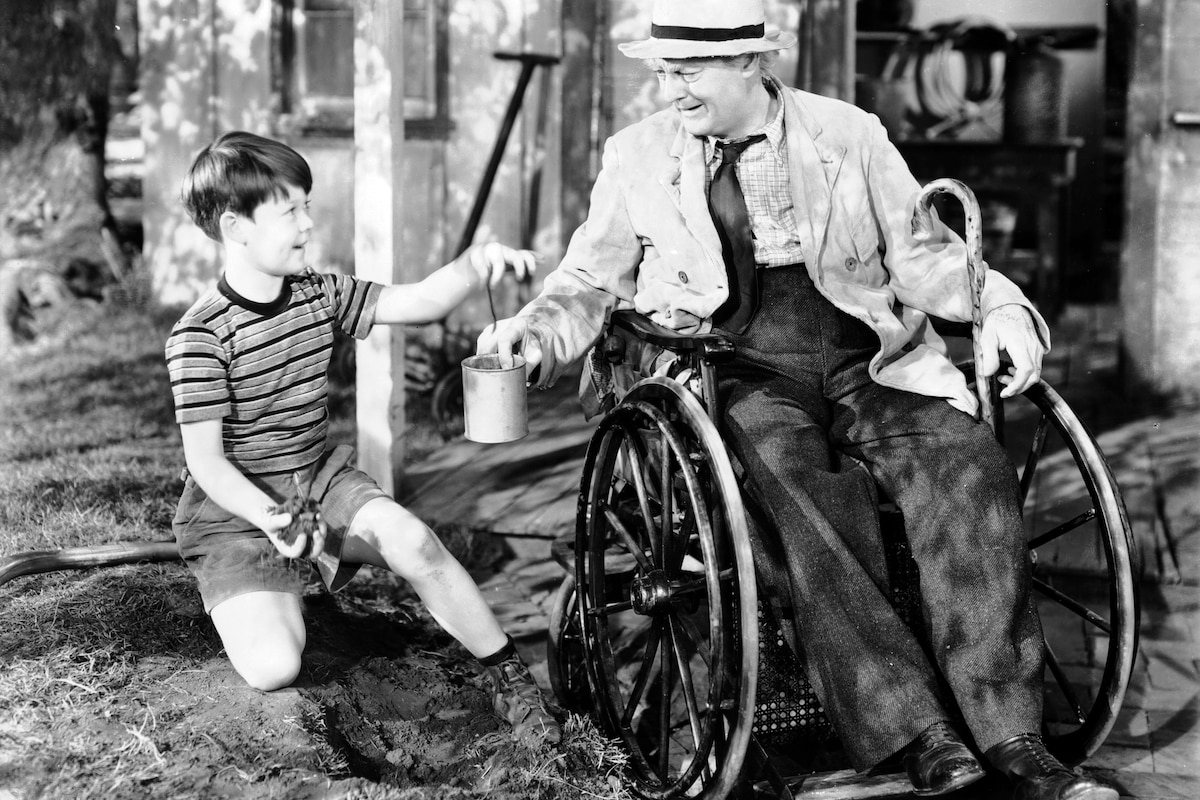
Nobody could play a grumpy, but loveable old man better than the great Lionel Barrymore. The actor managed to successfully recycle this type of role for the last two decades of his career, even after being confined to a wheelchair after breaking his hip in 1937 for the second time. One of the few times this character type was the central figure of a film was in the fantasy/drama On Borrowed Time (1939). Barrymore plays Julian “Gramps” Northrup, a crippled and bitter old man who tries to escape the spirit of death. This mysterious figure comes in the form of Mr. Brink (Sir Cedric Hardwicke). Adorable Bobs Watson is Pud, Gramps’ orphaned grandson who becomes set to be Mr. Brink’s next victim unless Gramps can save them both. MGM originally purchased the rights for the hit Broadway play by Paul Osborn (which in turn was adapted from a novel by Lawrence Edward Watkin) as a vehicle for character actor Frank Morgan. Barrymore sought the role himself and convinced the studio he could play the part, despite his disability. Accommodations had to be made using rear projection in several scenes to give the illusion that Barrymore was ably walking. Despite its modest box office, both Barrymore and Hardwicke listed this as a favorite amongst their respective filmographies.
Another great actor who used the fatherly, and grandfatherly, roles as strong acting vehicles was Spencer Tracy. After the 1950 comedy Father of the Bride became a fast box office hit and scored Oscar nominations for Best Picture and Best Actor, MGM immediately began developing the sequel, Father’s Little Dividend (1951). Spencer Tracy, Joan Bennett and Elizabeth Taylor all reprised their previous roles as Stanley and Ellie Banks and their daughter Kay. Barely recovered from their daughter’s recent nuptials, the Bankses have opposite reactions to the news that they are now going to become grandparents. The lead up to the family’s new addition is a series of comic episodes. When the baby finally arrives, it is even more laughs over how the Bankses try to compete with their in-laws for the baby’s affections. Though a feel-good family story about a new wife and mother, this film was made at a terrible time for newlywed star Elizabeth Taylor, who was suffering under the abuses of her first husband Conrad Hilton Jr. Also distracted during the film (for much better reasons) was the returning director Vincente Minnelli. Minnelli was already preoccupied with his next film, the big budget musical (and future Best Picture winner) An American in Paris (1951). He rushed the film to be shot in less than four weeks. Despite all these distractions, the film was still a critical and box office success, worthy of its predecessor.
The grandfather archetype is not only a staple of great movies, but great literature. Frances Hodgson Burnett’s 1885 children’s novel “Little Lord Fauntleroy,” about a small boy from a working-class family who suddenly finds himself heir to his estranged grandfather’s fortune, has been adapted into several film and television versions. Probably the most acclaimed of these versions came in 1936, from director John Cromwell. Freddie Bartholomew plays the title role. C. Aubrey Smith is his pompous grandfather and Dolores Costello his loving and struggling single mother. This film marked the first independent production of producer David O. Selznick after he chose to leave MGM to start his own studio. Selznick had scored a string of hits the year before with his film versions of the other 19th century novels A Tale of Two Cities (1935), Anna Karenina (1935), and David Copperfield (1935) (also starring young Freddie Bartholomew) and chose to continue with this streak of literary adaptations. Selznick had to purchase the film rights to “Little Lord Fauntleroy” from Mary Pickford who had made her own film version fifteen years earlier, in which she played both the title role and his mother. Though now widely considered the best film version of the story, Selznick’s film was only a moderate success.
Something that many are fortunate to receive from their grandfathers is important life lessons. A great example of this on film is the relationship between Charlie Bucket and his Grandpa Joe in Willy Wonka & the Chocolate Factory (1971). Charlie (Peter Ostrum) is the precocious child who helps take care of his bedridden grandparents, but who secretly wishes to be one of the lucky children allowed to visit the famous chocolate factory of the mysterious candy maker Willy Wonka (Gene Wilder in perhaps his most iconic performance). Jack Albertson (fresh off a Best Supporting Actor Oscar win for The Subject Was Roses, 1968) is Charlie’s Grandpa Joe, who is determined to help his beloved grandson’s dream come true. Though this film version of the Roald Dahl children’s novel “Charlie and the Chocolate Factory” is widely received as the definitive version, it does have some major differences from the source material. Roald Dahl was originally hired to adapt his own book for the screen but failed to deliver an approved screenplay to director Mel Stuart. Roald Dahl eventually parted ways from the project all together and was quite vocal about his disapproval of the final film. Replacement screenwriter David Seltzer chose to put greater emphasis on the character of Wonka himself, even changing the title. The movie is also a musical, with original songs by Anthony Newley and Leslie Bricusse. Though only a modest box office success upon release, the film has since become one of the most beloved family/fantasy films.
Familial relationships are filled with both hysterical humor and serious drama, and nobody could combine these two emotions quite like playwright and screenwriter Neil Simon. One of his less remembered original films was Max Dugan Returns (1983). Marsha Mason plays Nora McPhee, a schoolteacher and single mother struggling to make a living in Los Angeles. One night, Nora and her son Michael (a young Matthew Broderick) receive an unexpected visit from her father Max (Jason Robards in a wonderfully hammy performance). Max had been sent to prison when Nora was only nine and vanished for several years after. He claims to now be in possession of over half a million dollars which he managed to embezzle in Las Vegas before going to prison. This situation does not fare well with Nora’s new policeman boyfriend Brian (Donald Sutherland). This marked the fifth and final collaboration between Neil Simon and director Herbert Ross, who mutually decided to part ways after this film’s box office failure. It also marked the fifth and final film between Simon and Mason, whose 10-year marriage came to an end before the film was even released. Perhaps the most difficult situation of all was for Matthew Broderick, whose father James Broderick died of cancer when the film was still in development. This made playing the role of a fatherless teenager very hard for Broderick. All these troubles can be felt in the actors’ performances in the final film. However, it seems to make the story and its emotions felt even more profoundly.
The Grandfather figure will remain a great character in many more films for many years to come, because grandfathers open our minds and hearts like no other.
