This article was originally written about programming for the TCM Now Playing newsletter in September 2023.
September 21st | 5 movies
Though Hollywood is synonymous with filmmaking, Los Angeles’ sister city to the north, San Francisco, has been the set of countless movies. With its charming nooks by the sea, its rolling hills and steep urban streets, San Francisco has lent its unique cityscape to the screen. And as a city known for its progressive views on immigration and race relations, San Francisco also seems like a natural backdrop for films that take on heady social issues. This month, TCM screens five movies that celebrate “The Golden City.”
Two films in the lineup shine a light on the immigrant experience in San Francisco. Raoul Walsh’s Gentleman Jim (1942) is a biopic of real-life heavyweight boxing champion James J. Corbett (Errol Flynn) who grew up in San Francisco in a combative Irish immigrant family. Based on the boxer’s 1894 autobiography, the film follows Corbett as he rises to fame and navigates San Francisco society. Thought of as the finest Raoul Walsh/Errol Flynn collaboration, the film takes mobility as a subject and metaphor for this second-generation American experience. George Stevens’ I Remember Mama (1948) – the film adaptation of John Van Druten’s stage play – recounts the everyday life and economic struggles of a Norwegian family in San Francisco in the early 20th century. Scenes were filmed on San Francisco’s Potrero Hill, Nob Hill, Telegraph Hill, Russian Hill, Eureka Valley and Market Street. The film stars Irene Dunne as the mother, as well as Barbara Bel Geddes, Oscar Homolka, Ellen Corby and Philip Dorn. It was nominated for five Academy Awards, with Dunn receiving her final Best Actress nomination.
The lineup also features Alfred Hitchcock’s cult thriller, the film adaptation of Daphne du Maurier’s short story, The Birds (1963), which engages with the classic juxtaposition of city life and rural life. The film follows Melanie Daniels (Tippi Hedren in her big-screen debut for which she won a Golden Globe), a wealthy San Francisco socialite who has a knack for practical jokes. After some playful flirtation with attorney Mitch Brenner (Rod Taylor) over some lovebirds at a pet store, she decides to follow him to his family’s farm in Bodega Bay. However, their budding romance soon turns sinister as massive hordes of birds inexplicably swarm the town and terrorize the residents.
Hitchcock, who had directed the 1943 film Shadow of a Doubt in Santa Rosa a couple of decades earlier, returned to Sonoma County, this time selecting Bodega Bay for its quaint atmosphere. “It is small, intimate, isolated, colorful – the sort of place made for this picture. The people are just right for the scenes I need,” Hitchcock said. The director wanted the film’s finale to feature a murder of crows perched on the Golden Gate Bridge, but The Birds was already overbudget due to extensive special effects, so Hitchcock had to forgo the idea. The city of Bodega has become a destination for thousands of Hitchcock fans every year. Tourists traverse the area to take photos of Saint Teresa of Avila Church and the historic Potter Schoolhouse, where some of the most iconic scenes were filmed. The Birds was nominated for an Academy Award for Best Special Effects.
Stanley Kramer’s Guess Who’s Coming to Dinner (1967), one of the first films to show interracial love in a positive light, takes advantage of San Francisco’s progressive stance on racial integration. The film tells the story of world renowned African American physician Dr. John Wade Prentice (Sidney Poitier) and a young white woman Joanna “Joey” Drayton (Katharine Houghton) who met and fell in love on a Hawaiian vacation and have come to San Francisco to break the news of their imminent marriage to her liberal parents, Matt Drayton (Spencer Tracy) and Christina Drayton (Katharine Hepburn) who had always preached “racial equality.” Though the film has several cringe-worthy moments from a 21st century perspective, at the time of its filming, interracial marriage was still illegal in 17 states so the stakes were much higher for John and Joey who would have been deemed criminals at the time. Anti-miscegenation laws wouldn’t be struck down by the Supreme Court until June 12, 1967, just six months before the film was released. California was different. In 1948, the California Supreme Court ruled that the state’s anti-miscegenation statute violated the Fourteenth Amendment to the U.S. Constitution. This made California the first state to repeal its ban on interracial marriage since Ohio did so in 1887 and thus began a state-by-state campaign to repeal anti-miscegenation laws throughout the country.
Because Spencer Tracy was extremely ill at the time of filming Guess Who’s Coming to Dinner – indeed he passed away just a couple of weeks after filming his last scene – the San Francisco set film was made almost entirely in Columbia Pictures’ Sunset Gower Studios in Hollywood. Kramer played tricks to make it seem as if Tracy and Hepburn worked and lived in the city by the bay. He brought the rest of the cast and crew to San Francisco to take establishing shots of the city. The first scene, when John and Joey arrive at SFO from Hawaii, signals that this is a story that could only be told in a place like San Francisco. When John and Joey smooch in the back of a cab from SFO, it was one of the first times a black actor and a white actress had kissed in a motion picture. Guess Who’s Coming to Dinner won two Academy Awards – for Best Actress (Katharine Hepburn) and Best Story and Screenplay (William Rose).
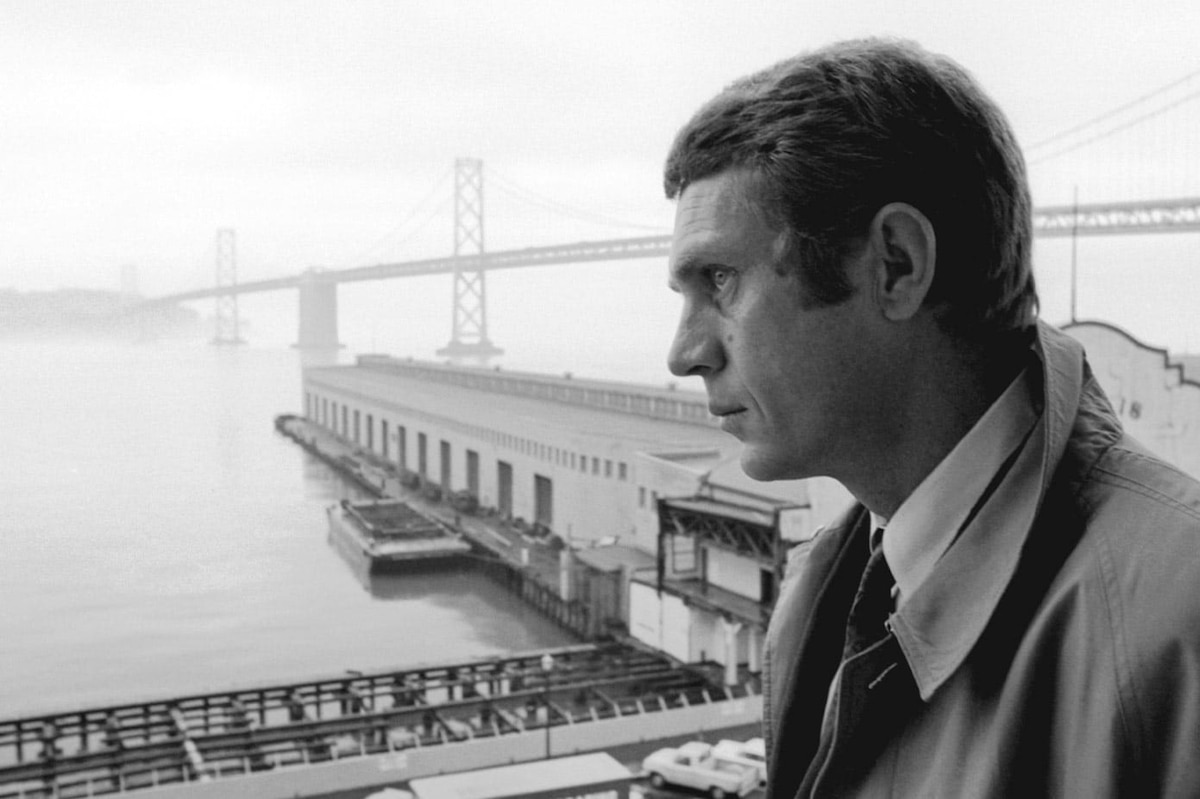
The lineup rounds out with Peter Yates’ neo-noir thriller Bullitt (1968), the first modern car chase movie. Set in San Francisco, Senator Walter Chalmers (Robert Vaughn) aims to take down mob boss Pete Ross (Vic Tayback) with the help of testimony from the criminal’s hothead brother Johnny (Pat Renella), who is in protective custody under the watch of Frank Bullitt (Steve McQueen). When a pair of mob hitmen enter the scene, Bullitt follows their trail through a maze of complications, complete with a high-speed chase. The famous car chase starts a little over an hour into the film. Bullitt is in a cool green Mustang, trying to outdrive a black Dodge Charger, helmed by the two hitmen. The 10 minute and 53 second chase begins at the Fisherman Wharf area and ends outside the city at the Guadalupe Canyon Parkway in San Bruno Mountain near Brisbane. Bullitt won the Academy Award for Best Editing (Frank P. Keller).
