This article was originally written about programming for the TCM Now Playing newsletter in July 2023.
Tuesday, July 18th | 5 Movies
They prowl the streets, the pool halls, the smoky card rooms for prey. They can smell money in the air and overconfidence in their marks. Like the predators of the deep for which they are named, they home in on their quarry and go in for the kill, but instead of leaving blood in the water, they leave their targets poorer, sometimes broken, and in the most extreme cases, dead. So as cable TV returns to the depths for another round of "Shark Week," TCM leans into a different kind of predator found lurking the dark alleys and back rooms of the urban ocean we call the American city.
The Pool Shark
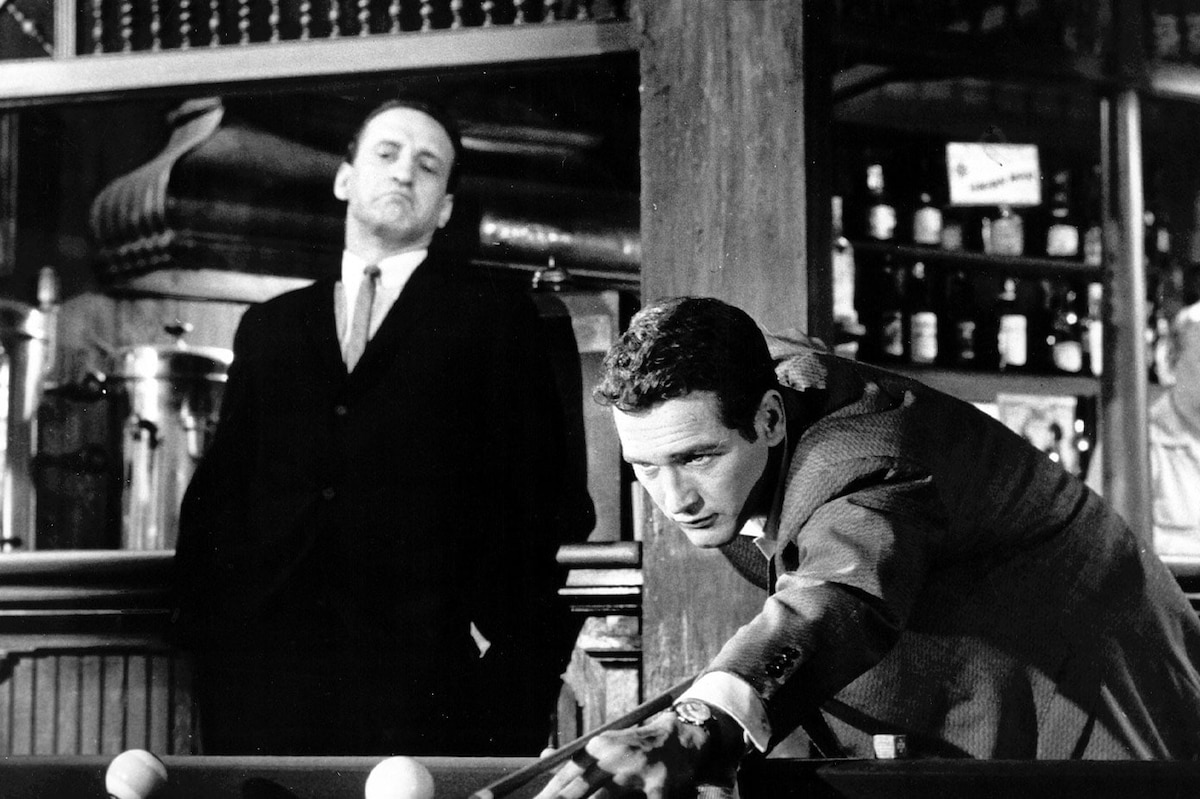
Paul Newman is "Fast" Eddie Felson, a cocky, swaggering punk of a pool hustler in The Hustler (1961), a film that plays out in the smoky, seedy pool rooms of anonymous Mid-West cities and towns. Newman was already a star with one Oscar nomination to his credit but The Hustler, adapted from the novel by Walter Tevis, gave him the most challenging role of his career to date. He trained with pool champion Willie Mosconi, who was hired as the film's technical advisor, and became good enough to perform many of his own shots in the film. Cast in support were Piper Laurie, who plays the delicate, alcoholic socialite he falls in love with; George C. Scott as the ruthless promotor who brings Eddie into the big money; and Jackie Gleason in a rare dramatic role as king of the poolroom Minnesota Fats, the man Eddie is driven to challenge. Gleason was a seasoned pool player and, according to Newman, something of a hustler in his own right. In between takes, he suckered Newman into a big wager. Newman paid off in pennies.
The project was a labor of love for filmmaker Robert Rossen, who according to his daughter had hustled pool himself as a young man. He knew the world well and produced the film independently, giving him the freedom to shoot the film entirely on location in New York City and give it a gritty quality. "It was one of those movies when you woke every day and could hardly wait to get to work," recalled Newman, "because you knew it was so good that nobody was going to be able to louse it up." Eugen Schufftan earned an Academy Award for his shadowy B&W cinematography, as did art directors Harry Horner and Gene Callahan for their deceivingly simple set designs. Rossen directed Newman and his three costars to Oscar nominations. And the film itself became so iconic that pool player Rudolph Wanderone adopted the name Minnesota Fats after the film was released and claimed to be the inspiration for the character, a claim that frustrated author Tevis, who always insisted that his characters were entirely fictional.
Newman reprised the role of "Fast" Eddie Felson in The Color of Money (1986), which picks up twenty-five years later after Eddie walked away from the game. Now a liquor salesman, he spots a hotshot cleaning up at the pool table in a local bar and decides to get back into the game, this time as a promoter teaching the green kid the ropes. Newman was a big fan of Raging Bull (1980) and Newman reached out to Martin Scorsese to direct the project. Scorsese liked the idea of working with Newman but was uninterested in initial scripts so with Newman's blessing he brought in novelist Richard Price to rework the story. Price attended what he described as "so-called tournaments, which are really just excuses to get together and let heavy gambling happen after it's over," and began from there. They spent a year developing the new screenplay, with both Newman and Scorsese contributing ideas to each draft, while the project changed studios twice. When Walt Disney took on the production and Tom Cruise, at the time a fast-rising young star, signed on to costar as Eddie's protégé Vincent, the production was a go.
Like The Hustler, the film was shot largely on location, this time in Chicago. Newman and Cruise were coached by pool champion Michael Sigel and continued to hone their skills throughout the shoot. Scorsese planned each shot and meticulously choreographed all the pool sequences with Sigel, and the actors performed almost all of their own pool shots. For all the efforts to craft the world of pool hustling, however, the focus remained on the journey of Eddie. In Newman's words, "The Color of Money is really about recapturing excellence, having been absent from it, and then witnessing it in somebody else."
The Card Shark
Steve McQueen plays another cocky young hotshot who takes on a veteran champion in The Cincinnati Kid (1965), a gambling drama set in the card rooms of Depression-era New Orleans. Producer Martin Ransohoff imagined the film as a western with card games in place of gunfights and hired Sam Peckinpah to direct. But the key to the production was McQueen, who was in search of a project to mark his return after a year off from acting. While he had starred in a couple of major hits, notably The Magnificent Seven (1960) and The Great Escape (1963), he had yet to carry a major film on his own.
It was a troubled production. The script went through numerous revisions and a revolving door of screenwriters. McQueen insisted on adding action scenes and on doing his own stunts. Spencer Tracy was originally signed to play Lancey Howard, the reigning poker champ, but left over a script dispute. Peckinpah fought with producer Ransohoff over casting and he insisted on shooting in black and white. Ransohoff fired Peckinpah a few days into production over "creative differences" and the production went on hiatus for a month as Norman Jewison, a TV veteran whose sole movies credits were a couple of frothy romantic comedies, took over the director's chair and reworked the script with Terry Southern.
Comparisons to The Hustler were inevitable, not always to the film's benefit, but The Cincinnati Kid was a big hit. It opened up new opportunities for director Jewison and reinvigorated Edward G. Robinson's career, which was in its fourth decade. "It was one of the best performances I ever gave on stage or screen or radio or TV, and the reason for it is that it wasn't a performance at all," wrote Robinson in his autobiography, "it was symbolically the playing out of my whole gamble with life." And it confirmed McQueen's status as a movie star who could carry a major studio film.
The Loan Shark
Martin Scorsese drew upon his experiences and stories of his friends growing up in New York's Little Italy around small time mobsters and young toughs and would-be operators for Mean Streets (1973). Harvey Keitel stars as Charlie, a debt collector for his mobster uncle, and Robert De Niro plays his unpredictable, self-destructive childhood buddy, Johnny Boy. In Scorsese's own words, "Mean Streets was an attempt to put myself and my old friends on the screen, to show how we lived, what life was like in Little Italy. It was really an anthropological or a sociological tract." Mardik Martin, who cowrote the script with Scorsese, described it as their attempt "to tell the story about the real gangsters… the petty ones you see around." The film was made independently on a tight budget pulled together by Jonathan Taplin, a former road manager for Bob Dylan who became a film producer on this film.
Scorsese originally cast Jon Voight in the lead as Charlie with Keitel, the star of his debut feature Who's That Knocking at My Door? (1967), as the volatile Johnny Boy. Then Voight dropped just before Scorsese was to shoot a scene of Charlie walking through The Feast of San Gennaro, a festival in Little Italy that took place months before the production was ready to officially begin. "I went right back to Harvey Keitel and Harvey did it that day," explained Scorsese, and he turned to De Niro, a neighborhood acquaintance from his childhood, for Johnny Boy. "I couldn't see myself as Johnny Boy at first, but in a way it was a good thing," recalled De Niro. "When you play a role you don't see yourself doing at first, you can get things from yourself that you ordinarily wouldn't get." Scorsese set aside time to rehearse with the actors and encouraged improvisation, taping the rehearsals and incorporating elements into the final script. Scorsese reunited much of the crew from his previous film Boxcar Bertha (1972), who were veterans of budget-minded filmmaking, and though it was shot largely in Los Angeles, he squeezed the budget to get six days on location in New York. "I kept pushing the limits of the budget and drove everybody crazy," he recalled, but he completed the film in 27 days on a budget of $300,000. "We had to finish and that was that."
Mean Streets opened at the New York Film Festival to excellent reviews and was released a week later for a successful run in New York City. That box-office unfortunately didn't translate to other cities but critics and filmmakers alike took notice of the talent on screen. It was a breakout film for De Niro, who was cast by Francis Ford Coppola in The Godfather II (1974) on the strength of his performance, and Hollywood came knocking on Scorsese's door. While it isn't Scorsese’s first film, you could call Mean Streets the first mature, full blooded "Martin Scorsese Film."
I Promise to Pay (1937), one of the "ripped from the headlines" crime dramas that thrived in the 1930s, stars Chester Morris as an earnest family man in New York City straining to stretch his salary during a summer heatwave. He innocently signs a vague note with a faceless organization to borrow the money to take his family out of town, little realizing that it's a scam designed to keep him perpetually in debt.
Loan sharks proliferated in New York City during the Depression, preying on high-risk customers who couldn't get loans from legitimate lenders. Government task forces went after this form of predatory lending and major busts made the papers; "27 Arrested as Usurers in Sudden Move by Dewey to Break Up Vast Racket," reads one 1935 headline in The New York Times. Columbia Pictures turned the real-life events into fodder for a low budget crime drama. The original title of the film, Loan Shark, was replaced after complaints from loan companies and dialogue was added to emphasize the difference between the shady loan sharks of the film and legitimate, licensed banks and loan companies.
Morris thrived as a leading man in such films as the iconic prison drama The Big House (1930) and the racy Red-Headed Woman (1932) opposite Jean Harlow but by the mid-1930s was slipping into B-movie roles. I Promise to Pay comes in at a brisk 68 minutes but boasts some A-list costars. Leo Carrillo, a prolific character actor best known for his comic roles, brings a flamboyance to the high-living mobster behind the loan racket and Thomas Mitchell dominates the screen as the idealistic District Attorney determined to take down the operation. Though he wasn't yet a major star when he made the film, by the end of 1937 Mitchell had costarred in Frank Capra's Lost Horizon and earned his first Oscar nomination for John Ford's The Hurricane. And while Morris never quite regained his earlier stature, in 1941 he landed the role for which he would be best known: Boston Blackie, the witty detective of 14 entertaining B-movie mysteries.
