This article was originally written about programming for the TCM Now Playing newsletter in May 2023.
Monday, June 19th | 5 Movies
Do the Right Thing (1989)
Turner Classic Movies Juneteenth tribute begins with Academy Award-winning director Spike Lee’s seminal film, Do the Right Thing (1989). Inspired by racially motivated violence, Lee dedicated the film to the families of six Black individuals, of which, five were killed by police officers.
On a sweltering summer day, as temperatures soar, so do the racial tensions of a Brooklyn New York neighborhood, leading to a tragic culmination.
According to Lee, fearing societal fallout due to the film's controversial graphic climax, Paramount, the original distributor, dropped the picture. “The same weekend Paramount said no, Universal said yes," Lee stated in a documentary about the consequential film.
Turner Classic Movies own Robert Osborne, a columnist for The Hollywood Reporter at the time, wrote of the film: “On one hand, Do the Right Thing will grab a lot of positive reactions both as a chunk of spunky entertainment and as a piece of spirited moviemaking by Lee...But it’s also going to get its share of slams, triggered by arguments as to whether or not it’s a dangerous flick, possibly advocating violence by Blacks against non-Blacks. Any way you judge it, Thing reaffirms Lee’s position as a filmmaker with audacity, courage, and ideas.”
As writer, producer and director of the film, Lee stars as Mookie, a delivery man for the local pizzeria. Do the Right Thing featured the debut of Academy Award-nominated actress, choreographer, dancer and activist Rosie Perez as Mookie’s girlfriend Tina, along with seasoned multi-award-winning acting veterans and activists, husband and wife, Ossie Davis and Ruby Dee.
The jazz-infused score was composed by Bill Lee, Spike Lee’s father, but it was the film's anthem, “Fight the Power,” by 80s Grammy Award-nominated hip-hop phenoms, Public Enemy, with its militant lyrics against a rugged instrumental sampling of James Brown’s “Hot Pants,” that the film demanded and remains indelible.
For all of the film's trepidatious gravity, Lee expertly performs a precarious balance of racially unfiltered conversations interwoven with sharp humor.
Cinematographer Ernest Dickerson whose collaboration with Lee began while both were attending NYU, attributed the films cinematic style to the award-winning classic film noir, The Third Man (1949) directed by multi-award-winning Carol Reed. “When Spike and I were preparing Do the Right Thing, we looked at The Third Man because we really wanted to get that feeling of the world out of balance,” Dickerson stated in an interview with Turner Classic Movies Eddie Muller, further explaining that canted angles were used to intensify the films tension.
In an interview with The Hollywood Reporter, Dickerson pointed to the work of cinematographer Jack Cardiff as additional inspiration for the vibrancy of the film in its use of color. “One of my influences in cinematography is Jack Cardiff. His work on Black Narcissus (1947), The Red Shoes (1948), A Matter of Life and Death (1947)-his use of color in those influenced me.”
A message which remains as potent and as relevant today as it was in 1989, Do the Right Thing opened the door for a series of Black Realism films such as Boyz n the Hood (1991), Menace II Society (1993), and Set It Off (1996).
“You always hope that they will help resolve the issue,” Lee stated at a 25th anniversary event of the film, “or at least bring attention to the issue. The tragedy, of course, is that here we are 25 years later, and these same social and political issues are still in the headlines. Still need to be addressed.”
Alma’s Rainbow (1994)
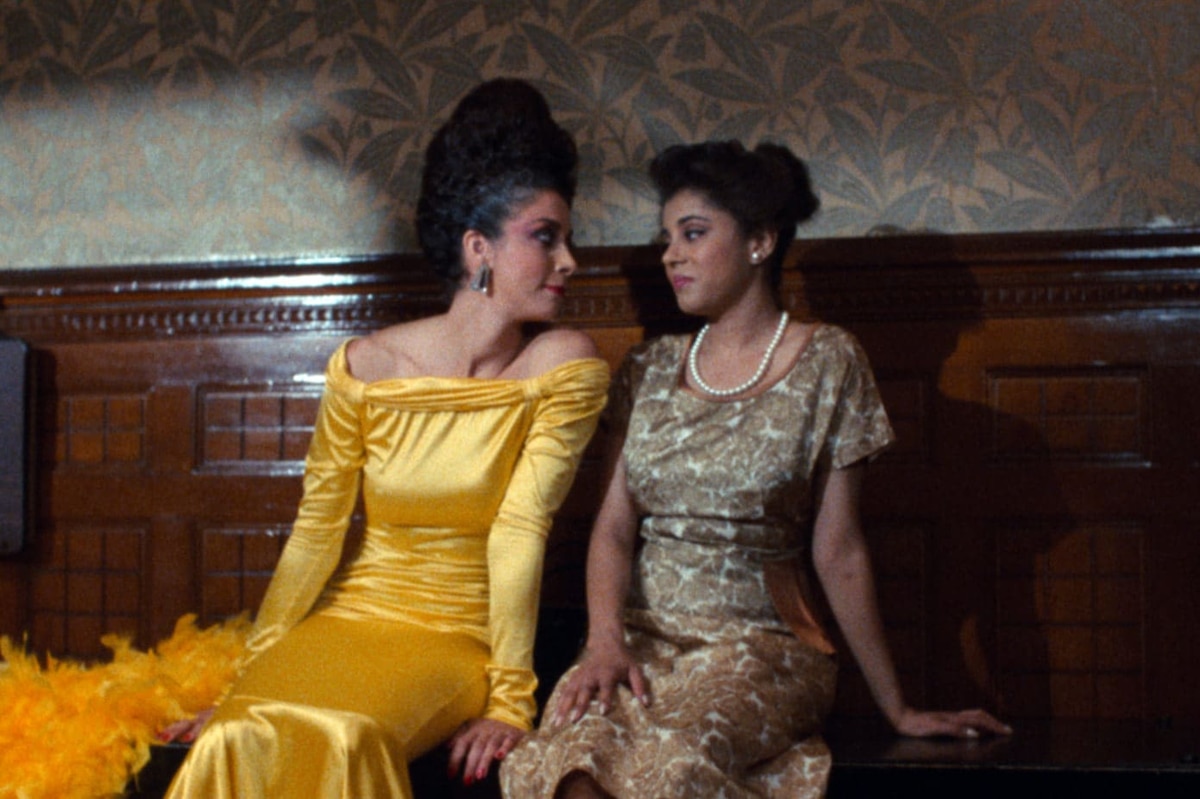
Written, directed, and produced by Ayoka Chenzira, Alma’s Rainbow (1994) is the coming-of-age story of Rainbow Gold, (Victoria Gabrielle Platt) a Black teenage girl navigating the precarious tightrope between adolescence and womanhood.
After a 10-year absence, the cultured and free-spirited Aunt Ruby (Mizan Nunes) whose career has seen its best days, saunters into Rainbow’s life precisely on schedule for her eminent blossoming, enrapturing the impressionable teenager.
Rainbow's proper, and comparatively grounded single mother, Alma (Kim Weston-Moran) is seemingly in stark contrast to the eccentric Aunt Ruby as reflected in the styling of their coifs. Aunt Ruby sports free-flowing curls as opposed to Alma’s Gibson Girl hairstyle made popular during the late 1800s.
With her bohemian-like ideals and lithe personality, Aunt Ruby quakes the environment, leaving an enduring impression on Rainbow's evolution and Alma’s re-discovery of herself.
Art imitates life in Alma’s Rainbow. During her childhood, director Ayoka Chenzira’s mother owned and operated a hair salon, where, as in the film, Chenzira absorbed the feminine perspective. “I’d like to state that I got my formal education and my degrees at NYU, Columbia University, Teachers College and I have a PHD from Georgia Tech but my real degree is from my mom’s beauty parlor.” Chenzira stated in an interview with Reelblack Podcast.
Alma’s Rainbow, a comedy, was one of a very few films that centered around the coming-of-age story of a Black teenage girl. Its uniqueness in exhibiting Black joy and affluence, was an unfamiliar narrative for potential distributors.
Chenzira explained, the home where the movie was filmed was real and this baffled film distributors, "...because they kept wondering how a single mother could own such a beautiful home. It seemed to be an unusual thing to them and they were confused. They were more comfortable with stories where there was more urban blight than there was beauty on the screen."
Alma’s Rainbow enjoyed a theatrical re-release in July of 2022
Just Another Girl on the I.R.T. (1992)
Directed by Leslie Harris, the first Black woman to win the Special Jury Prize at the Sundance Film Festival in 1993, who served as writer, director and producer of Just Another Girl on the I.R.T. (1992), one of the first 35mm American features to be directed, written and produced by a Black woman, spotlights the unexpected pregnancy of an inner city Black teenage girl. In her first acting role as Chantel Mitchell, activist, actress, dancer and choreographer, Ariyan A. Johnson’s depiction is performed with convincing candor. A combination of street savvy and outspoken brilliance, Chantel cleverly conceals her pregnancy from the people around her, and in a somewhat delusional state, from herself.
Breaking the fourth wall, Chantel’s character directly addresses the camera, allowing further insight to her innermost thoughts, including her plans of becoming a doctor, which based on her intellect is more than conceivable.
Similar to Alma’s Rainbow, Just Another Girl on the I.R.T. highlights the journey of a Black teenage girl, a subject that rarely received attention.
As a child, Harris watched classic films with her mother. She found inspiration for Just Another Girl on the I.R.T. through the film Vagabond (1985), directed by multi-award-winning director Agnès Varda, stating “It actually inspired me to do my movie…because it showed a woman who was a complex character. She wasn't just a good girl or a bad girl. She was really complex in this movie, and it was a realistic portrait of a woman going through homelessness, and despair, but still having a sense of who she is as herself and that was kind of a great inspiration for my film Just Another Girl on the I.R.T”
Perhaps Harris did not expect the words of her 1992 script to be saturated in the relevance of today's world, yet, shockingly they are. When the lead character, Chantel delivers the lines, “Abortion it's my right not the federal government's,” and, “In order for us to live together, we have to have a fair account of our history,” they echo the same conversations particularly relevant to the present day.
Harris became the first Black woman to negotiate the theatrical release with the motion picture company Miramax Films of Just Another Girl on the I.R.T. through her own production company Truth 24 FPS Productions.
Blackboard Jungle (1955)
Directed by Academy Award-winning producer novelist and screenwriter Richard Brooks, starring the multi-award-winning Sidney Poitier and multi-award-winning Glenn Ford, Blackboard Jungle (1955) brought the violence and social commentary of juvenile delinquency to the forefront. Filmed in 1954, the same year the Supreme Court outlawed segregation of public schools, the film sent shockwaves through American society and abroad. It was banned in Georgia and Tennessee due to its reflection of an integrated inner city vocational high school, along with its provoking anthem, by Bill Haley & His Comets, “Rock Around the Clock.” Though the song seems innocuous by today's standards, during the mid-50s, rock ‘n’ roll in its infancy, was deemed rebellious. “Rock Around the Clock” was banned by the American government and blamed for causing riots in schools and cinemas.
No stranger to hot-button subjects, Richard Brooks, who was encouraged by multi-award-winning director, screenwriter and actor John Huston to become a director, had a rugged reputation, considering himself an outsider in traditional Hollywood. His films include, Cat on a Hot Tin Roof (1958), Elmer Gantry (1960) (for which he won an Oscar) and In Cold Blood (1967).
An extreme departure for the glittering MGM studios, known for its family friendly material and sparkling musicals, Blackboard Jungle tackled rape, race and violence, subject matters that seemed better suited for the gritty Warner Bros.
Brooks spoke of MGM’s dissonance with the feature, specifically from a repulsed Louis B. Mayer, recalling that daily, the film crew would clean fingerprint smudges on the set, purposefully placed for effect.
Blackboard Jungle was Poitier’s fifth film and played a pivotal role in his ascent to coveted leading man stature.
According to Poitier’s memoir, The Measure of a Man: A Spiritual Biography, the film was offered to him when he was 27, after he was requested to petition younger actors for the role. While preparing for the film, Poitier was asked to sign a loyalty oath by MGM studio lawyers regarding his association with civil rights figures. During the McCarthy era, it was not the only time his, and others’ loyalty would be questioned by the industry.
“It drove me wild that these men could see red but couldn't see Black.” Poitier penned. “That was galling enough, but what also appalled me was that I was being accused of being sympathetic towards, respectful of, even admiring of Paul Robeson and Canada Lee. Men I did respect tremendously. How could I not admire men of such character and integrity? I would far rather wash dishes and work over a grill any day than sign a loyalty oath I considered repugnant.”
Edge of the City (1957)
In his debut as a director, the multi-award-winning Martin Ritt’s film noir Edge of the City (1957) tells the story of two men, one Black, the other white, who become close friends, and the deadly consequences of their camaraderie. Starring actor and filmmaker John Cassavetes and Sidney Poitier, the film is based on the televised play, A Man is Ten Feet Tall. Considered ground-breaking for its time, the film is significant for its integrated cast as well as Poitier’s reprisal of Tommy Tyler, which he depicted in the televised version, portraying a dock manager whose appointment as a Black man supersedes that of the recently hired Axel Nordmann, (John Cassavetes) his White co-worker. Consequently, the film did not show in southern states.
Unexpectedly, Edge of the City’s most profound performances are by its secondary characters, Lucy Tyler, Tommy’s wife, portrayed by Ruby Dee who performs an excruciating scene with such complexity of emotion, once she realizes Axel has pertinent information of her husband's murder, as well as an explosive performance by Kathleen Maguire, who portrays Ellen Wilson.
