This article was originally written about programming for the TCM Now Playing newsletter in April 2023.
Monday, April 10 | 4 Films
Commemorating Warner Brothers’ 100th anniversary in 2023, join TCM on April 10th for an afternoon and evening of films where famed British production company Hammer Films banded together with the studio to bring the former’s brand stateside.
Ask any fan of scary movies and they will undoubtedly sing the praises of Hammer Films’ oeuvre of gothic horror films, which were stylistically chic and quite graphic for their time. However, according to Hammer’s official website, the production company put out television and film projects in an assortment of genres, including “psychological thrillers, sci-fi, noir and historical epic.” Often set hundreds of years in the past and in quaint country settings, many of these films cast the same actors multiple times, including two men long thought to epitomize “Hammer Horror”: Peter Cushing and Christopher Lee. As you will see, through their years-long involvement with these projects, it is impossible not to include all three names in one sentence.
The classic monsters we know and adore show up in a myriad of cinematic adaptations. Hammer Films tackled Mary Wollstonecraft Shelley’s seminal 1818 novel, “Frankenstein,” in 1957’s The Curse of Frankenstein. Directed by Terence Fisher and starring Cushing, Lee, Robert Urquhart and Hazel Court, it depicts the story of the scientist whose ambition to create a creature and bring it to life becomes a dangerous obsession.
After the death of his mother, Victor Frankenstein not only inherits a barony, but becomes massively wealthy. Toting her young daughter, Elizabeth, his impoverished aunt comes calling after the funeral to ask her nephew to continue financially supporting herself and his cousin. Following his agreement to do so, Victor next seeks out a tutor to help him further his education. Enter Paul Krempe (Urquhart), also a scientist. Initially eager to mold the mind of his young charge, he joins the now-adult Victor (Cushing) in his experiments. After resurrecting a deceased dog, the Baron comes up with the idea to make an entity out of corpses and do the same.
As Shelley’s novel is subtitled as “The Modern Prometheus” (which, according to Encyclopedia Britannica references the Greek god of fire, who also fashioned humans), Frankenstein’s motive for creating a being may seem to be simply for the benefit of scientific discovery, however it is his own rampant egomania that propels Victor to take the course of action that he does. For the most part, Frankenstein is so self-involved and fixated on his work, he treats others rather poorly. To get the body parts that he needs from people who he feels possess the proper qualities that he wants, Frankenstein not only resorts to graverobbing, but outright commits murder; not showing one iota of remorse for any of it. As you could imagine Paul’s disgust with what his charge has become, Victor is also set to marry the now-grown Elizabeth (Court), therefore Paul feels quite protective towards her. The Baron’s ego continues to swell when he treats the maid he is having a dalliance with (Valerie Gaunt) with disdain, especially once she threatens to expose him if he doesn’t marry her. As for the Creature (Lee), he is treated as sub-human, merely as prop and a means to an end. Lee doesn’t have any lines, but his portrayal of the creature is both frightening and saddening, and you do empathize with this being who just exists and has no autonomy whatsoever. Only when everything unravels does Frankenstein suffer the consequences of his actions.
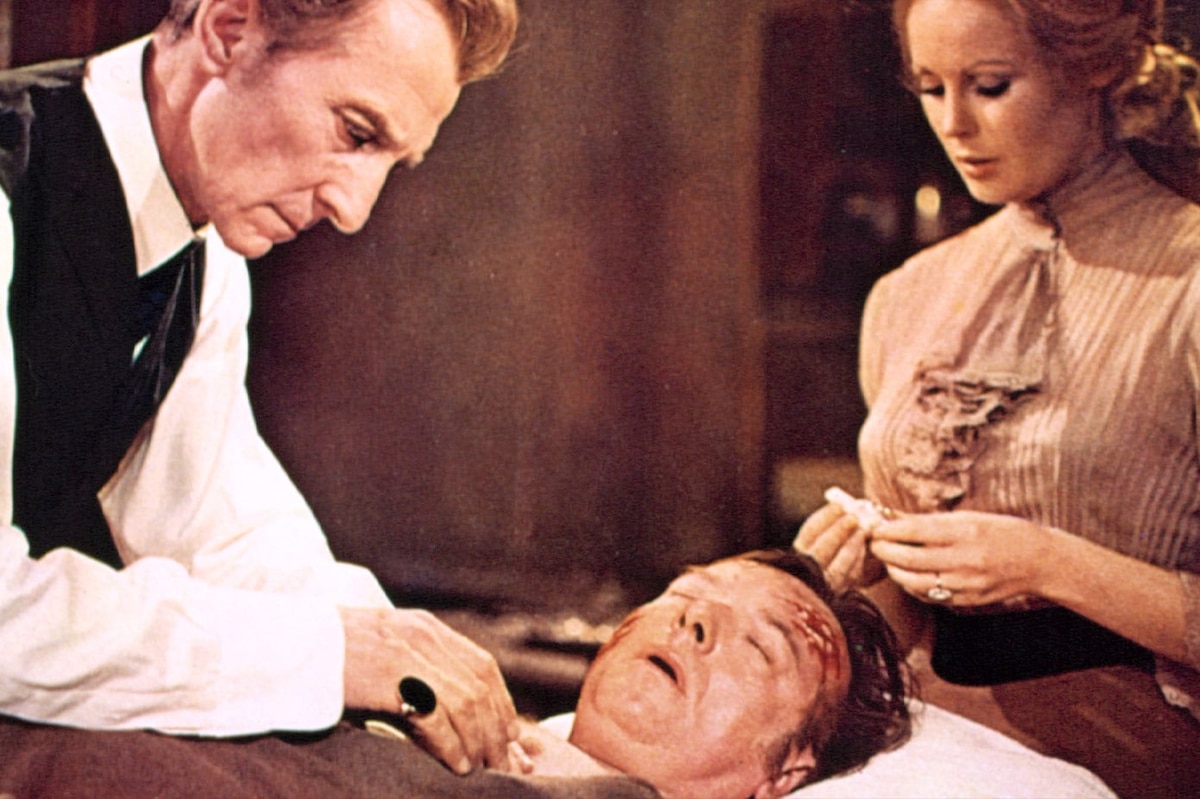
This would be the first of Hammer’s seven films tackling “Frankenstein” thematically, and Cushing would return as the Baron in 1969’s Frankenstein Must be Destroyed. Ignoring most of the canon from The Curse of Frankenstein, Cushing’s reprisal of Victor once again presents that egomania, but ramps up his narcissistic and sociopathic tendencies. After severing the head of a doctor and thwarting a thief in a laboratory, under an assumed name, he checks into a boarding house run by Anna Spengler (Veronica Carlson). Frankenstein’s one-time assistant Frederick Brandt (George Pravda) has been committed to a mental health facility nearby, where coincidentally Anna’s fiancé Karl Holst (Simon Ward) works as a physician. Karl’s hands aren’t exactly clean, as he has been stealing drugs to help another patient, Anna’s mother.
Victor has been run out of his home country of Bohemia (now the modern-day Czech Republic), but is up to the same tricks, this time adding kidnapping and blackmail to the mix (especially when he learns what Karl has been doing). Forcing the young doctor to help him abduct the now-insane Brandt to continue with his endeavors, once Karl commits murder himself, Victor has even more leverage. Karl tells Anna what he has done, and she ends up being dragged into the whole scheme, which gets even more dicey once Brandt dies. As Brandt apparently had a brilliant mind that shouldn’t be wasted, Frankenstein comes up with a new plan to hijack the asylum’s head, Professor Richter (Freddie Jones) and transplant Brandt’s brain into him. By late 1960s standards, there are some pretty risqué scenes and pieces of business in this film, however it is Frankenstein’s sexual assault of Anna that is truly quite shocking, particularly within this genre and time of release.
As in The Curse of Frankenstein, in Frankenstein Must Be Destroyed, it is the Baron’s hubris and utter contempt for anyone questioning his self-aggrandizing behavior that will bring about his ruin. While many often erroneously refer to the creature as Frankenstein rather than the man that made him, in this case the title fits quite nicely. Driven by another’s unrelenting anger and deep need to stop the madness, Frankenstein is, in fact, destroyed by his very own handiwork.
Standing at a towering 6’5” and sporting a booming bass-baritone voice, no actor is more synonymous with the role of Dracula than Christopher Lee. According to Screen Rant and Wikipedia, Lee played Dracula a whopping 10 times throughout his career, in both Hammer productions and others. Lee’s imposing countenance and costuming certainly scared this writer as a child, but I can’t think of any other actor that matches his allure and command in this part.
In Dracula Has Risen from the Grave (1968), a woman is found dead by a boy in a church’s bell with tell-tale bite marks on her neck. Ostensibly, the townspeople know she is yet another victim of the infamous (and since destroyed) vampire. When Monsignor Ernst Mueller (Rupert Davies) comes back to visit, to appease the townspeople who are so frightened by the bloodsucker’s castle that they refuse to attend religious services, he performs an exorcism on the structure. The town’s priest (Ewan Hooper) accompanies Mueller on his mission, but once a minor accident with a bit of bloodshed reaches and revives Count Dracula, no one is safe. Now that the priest is under his thumb, it’s time for Dracula (Lee) to exact his revenge against Mueller and his family, with the intention of luring his young niece Maria (Veronica Carlson) into his evil web. Co-starring Barry Andrews, Barbara Ewing and Marion Mathie and directed by Freddie Francis, this would be Hammer’s fourth Dracula film.
Incorporating the fate that the Count succumbs to at the finale of Dracula Has Risen from the Grave, in Taste the Blood of Dracula (1970), Lee once again returns to wreak havoc on an Eastern Europe town. We begin when a man named Weller (Roy Kinnear) is tossed out of his carriage while on his journey and ends up unconscious. Once he becomes lucid, he notices an impaled figure yelling before dying. Weller then grabs the items Dracula (Lee) left behind after his destruction, including a good amount of his blood (which has been reduced to a powder), a cloak and a brooch inscribed with his name. Later, under the guise of traveling for charity work, three men end up at a house of ill repute. As they are enjoying themselves, a fourth man, Lord Courtley (Ralph Bates) enters and the other men are quite charmed by him. Once Courtley entices them into helping him procure Dracula’s relics from Weller, we then learn they are all to be involved in a black magic ritual at a deserted church, with Courtley at the helm. After the men refuse to drink the concoction comprised of Courtley’s and Dracula’s blood as part of the ceremony, Courtley swallows it and promptly collapses. The men beat Courtley to death and flee the house of worship, however Courtley’s body has now transformed into none other than Dracula’s. As always, the Count is bent on getting back at those who did away with the one he calls his “servant” and begins his work taking them all down. Also starring were Anthony Corlan (who would be credited later in his career as Anthony Higgins), Linda Hayden, Isla Blair, John Carson and Geoffrey Keen.
As with contemporary horror and slasher films with multiple sequels such as Friday the 13th and Halloween, not only does Dracula keep getting decimated time and time again, but returns with just as much power as before. Each movie’s plot was quite similar: revenge, a quest to defeat evil and the seduction of a young girl. These films incorporate a great deal of pop culture’s vampire lore, including the usage of Christian imagery and invocations to terminate them.
If you are a fan of Hammer’s trademark gothic horror films or just beginning your journey into their offerings, you’ll not only be at the edge of your seat, but absolutely mesmerized by each nail-biting, eye-widening, heart-quickening moment.
