This article was originally written about programming for the TCM Now Playing newsletter in April 2023.
Saturday, April 1 | 8 Films
Warner Brothers was founded on April 4, 1923 by siblings Harry, Albert, Samuel and Jack with help from funds loaned to Harry by his banker. And a century later, the studio is still going strong. TCM is celebrating all things Warner Bros in April with an epic retrospective shining the spotlight on its stars, filmmakers and innovations such as the introduction of sound that changed the cinematic landscape.
The festivities begin April 1 with “The Early Years,” which features eight films spanning 1924 to 1933 highlighting some of the studio’s top talent of the era in front of and behind the camera as well as showcasing such genres as period dramas, war flicks, gangster films and controversial pre-Code productions.
While the German shepherd Rin Tin Tin may have been the studio’s biggest star and good boy at the box office for Warner Brothers, one of the studio’s biggest two-legged stars was John Barrymore, aka “The Great Profile.” He gave a heartbreaking performance as Beau Brummel in the 1924 four-hankie weepie period romance. Barrymore, the baby brother of Ethel and Lionel, had been a staple on Broadway for over 20 years and a veteran of films such as Paramount’s 1920, Dr. Jekyll and Mr. Hyde. But he became a Broadway sensation as the Melancholy Dane in “Hamlet” in 1922-23.
It was prestigious for the young studio to acquire Barrymore for Beau Brummel in which he played the famed English dandy who, in the late 18th and 19th century, was a royal favorite of the corpulent Prince of Wales. But when he makes a commentary about the Prince’s weight, Brummel quickly loses favor with royalty and the upper class. He ended up penniless.
Barrymore starred opposite Mary Astor in her breakout role. The 41-year-old Barrymore and the 17-year-old newcomer fell in love, which she recounted fondly in her autobiography, My Story. “The world was a lovey place that seventeenth summer of my life. It never again would be so romantic, so storybook beautiful, or quite so romantically tragic.”
Barrymore was married at the time to his second wife Michael Strange (the pen name of Blanche Oelrichs).
The film was a big hit with Photoplay noting the actor gave “one of the finest performances of his screen career.” The studio was so impressed they signed Barrymore a three-picture contract worth $76,250 per film.
Barrymore wasn’t the only Broadway name Warner Bros. signed to a major contract. British actor George Arliss, a longtime veteran of the British theatre, Broadway stage and silent film, was 61 when he starred in his first talkie, 1929’s Disraeli, for which he received the Best Actor Oscar.
Arliss was no stranger to the role of the famed British prime minister Benjamin Disraeli. He had appeared on stage in the role, as well as a 1921 silent version. Disraeli suffers from what ailed so many early talkies-it’s stagey and verbose. At times, creaking as badly as an arthritic knee. Arliss’ method of acting is very declamatory. In fact, some critics found his performance akin to a three-course ham dinner, while others were impressed with this dignified performer. Little wonder he earned the nickname: “The first gentleman of the talking screen.”
It's a digital world when it comes to visual effects which makes the huge flood sequence at the end of the 1929 epic Noah’s Ark even more impressive. Alan K. Rode notes in his biography, Michael Curtiz that for years “people in the film industry who never saw ‘Noah’s Ark’ or knew little about Michael Curtiz remembered the anecdote of the crazed movie director who drowned several extras while making a biblical epic,” said Rode.
“But other than long shots of temple miniatures being flooded, Curtiz had no intention of using special effects for the majority of his shots of the Great Flood,” said Rode. So nearly 140 technicians constructed a system of three tanks holding four million gallons of water that would “pour down a myriad of spillways…and topple columns.”
When cinematographer Hal Mohr learned the extras had no idea what was going to happen, he walked off the film and was replaced by Barney McGill. And though it has long been rumored that three people died from the flood sequence according to Rode, Mohr believed one man had lost a leg and ”a couple of people were injured to the point that they never did recover.”
Though Dolores Costello, who married Barrymore in 1928 and is best known today as Drew’s grandmother, and George O’Brien of Sunrise (1927) fame are the leads of Noah’s Ark, Michael Curtiz and mogul-in-waiting Darryl F. Zanuck in his first foray as producer, are the stars.
Noah’s Ark is also an example of the part-talkie phenomena that took place after Warner Bros. changed the face of Hollywood with 1927’s The Jazz Singer, the first feature film with a synchronized recorded score as well as lip-synchronous singing and speech. Numerous films like Noah’s Ark were planned as silents but added some talkie sequences. They shouldn’t have bothered. The dialogue is clunky and painful.
The Dawn Patrol, a pre-Code World War I film from 1930 that marked director Howard Hawks’ first talkie, was sort of swept under the rug and retitled Flight Commander when the studio remade it in 1938 with Errol Flynn, Basil Rathbone and David Niven.
Thanks to TCM and Warner Archive, the original has been rediscovered. Though it’s a bit dated, the 1930 version is just as good as the 1938 remake. In fact, a lot of the flying sequences were re-edited for the Flynn production.
The Hawks’ version has an impressive pedigree. The director had been a flight instructor during the Great War -he flew in this film in the uncredited part of a German pilot- and John Monk Saunders, who won the Oscar for Best Story, also had been a fight instructor.
Richard Barthelmess, one of the top stars of the silent era, stars in the drama. Though he was often stiff as a board in a lot of his talkies, Hawks elicits a full-blooded performance from the actor. Equally impressive is 20-year-old Douglas Fairbanks, Jr.
Dawn Patrol impressed critics and audiences becoming the third biggest film that year for the studio after Gold Diggers of Broadway and Sally.
Warner Bros. didn’t shy away from controversy whether it be from its violent gangster films or the naughty and bawdy pre-Code releases. Director William A. Wellman’s gangster melodrama The Public Enemy which made James Cagney a star and his pre-Code shocker Night Nurse, both from 1931, stirred up a bruhaha because of their violence and risqué morals. These films were among several Warner Bros. films that would be referenced as the reasons why the Production Code went into full force.
The scrappy Night Nurse is best known for showing Barbara Stanwyck and Joan Blondell in various stages of undress. The subject matter is pretty depraved. Stanwyck plays a young nurse sent to take care of two very sick young girls by an unscrupulous doctor. She soon learns that the girls are being starved to death by the doctor and their boozy mom’s vicious chauffeur (Clark Gable) to get their inheritance money. Gable was making a name for himself playing villains and his Nick is one of this most brutal. His beating of Stanwyck in one scene is still shocking.
As memorable as his performance is in Night Nurse, Warner Bros. didn’t sign Gable to a contract. Wellman wrote in his autobiography Gable played one “of the most despicable heavies imaginable, and he did it with such savoir faire that he became a star. The powers-that-be-at Warner Bros liked his performance but decided he was not…star material; his ears were too big. They forgot to look at his dimples and listen to his voice and see his smile.” Gable went to MGM and the rest is history.
The delightful 1932 pre-Code comedy Jewel Robbery would never have passed the Production Code. It’s the funny cigarettes that turn everyone into giggling idiots with tremendous appetites.
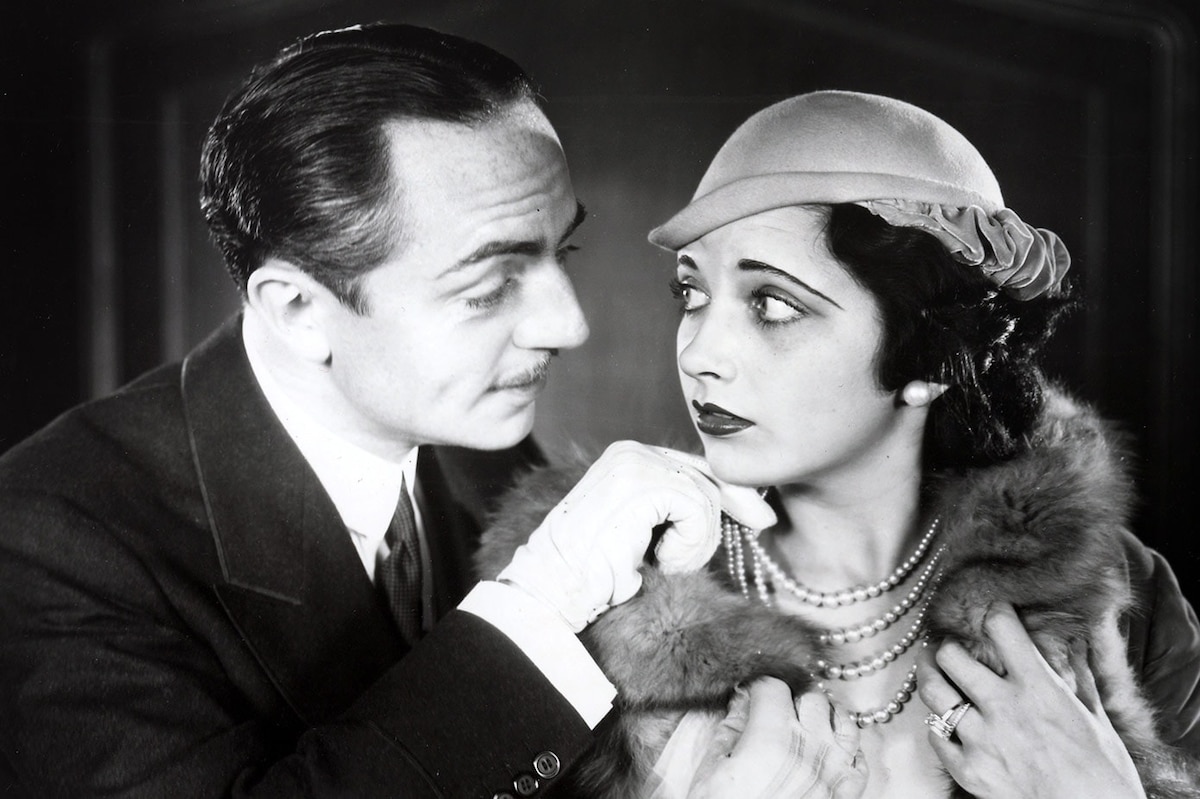
Though William Powell and Myrna Loy made 13 films together at MGM including six Thin Man mysteries, he and Kay Francis enchanted audiences in six movies at Warner Bros. including Jewel Robbery.
This time around, Powell is a debonair jewel thief working in Vienna who falls in love with his latest victim (Francis), the rather jaded and bored wife of a much older Baron. Powell carries off his robberies thanks to an endless supply of “funny cigarettes” he gives those in the jewelry shops. The dialogue is sophisticated if mildly risqué.
Though Lee Tracy continued acting until 1964’s The Best Man, for which he earned a supporting acting nomination, he was made for pre-Code comedies. He excelled at playing fast-talking protagonists whether they be reporters or publicists. He was quick with a smile and even quicker with a quip. He had honed that personality playing reporter Hildy Johnson in the original 1928 Broadway production of “The Front Page.”
He became a star with his tenth film, 1932’s Blessed Event, which was based on a play that premiered on Broadway earlier in the year. Tracy is at the peak of his pre-Code powers playing a New York gossip columnist who gets a lot of notoriety when he writes about married and unmarried women expecting a “blessed event.” One of those notices gets him into deep trouble with a gangster.
Just as Tracy, Warren William was the epitome of the pre-Code leading man. Tall, slick-haired with wolf-like features and a sonorous voice, his characters thrilled in seducing women and gaining power anyway they can. William continued in films after the pre-Code era ended, but he was playing secondary roles or starring in B pictures by the end of the decade.
If you want to wallow in William’s deliciousness then check out 1933’s Employees Entrance, in which he plays a ruthless general manager of a department store he has transformed into a financially successful business. Along the way, one of his board of directors commits suicide jumping out of a window and he seduces poor naïve Loretta Young.
