This article was originally written about programming for the TCM Now Playing newsletter in February 2023.
3 Movies | Friday, February 17th
It would be safe to say that when James Naismith invented basketball in 1891, he could not have imagined what an international, emotionally charged sport he had created. A century and some change later, NBA and NCAA finals bring in mass audiences every year. An entire month (March Madness) is named for the sport’s most intense season. From childhood, kids dream that they may one day find their fame and fortune by hitting that clutch 3-pointer in the last seconds of a championship game. What started as Naismith’s way of keeping students engaged in physical activity on a rainy day has become one of the great cultural forces of modern history.
Around the same time that basketball was finding its footing, pictures were beginning to move. As basketball teams spread across schools and universities around the country, movies became the go-to pastime of America. It is no surprise that film has gone back to the court over and over for basketball-related stories.
Dating to the silent era, film fans could watch as Marion Davies attempted to woo a basketball coach by joining the team in The Fair Co-Ed (1927). Betty Grable falls for her college’s new star player in Campus Confessions (1938). Shirley Temple’s boyfriend has a knack for the game in The Bachelor and the Bobby-Soxer (1947). A scandal involving attempts to fix games is explored in The Big Fix (1947). The history of one of the most famous teams out there is examined, supported by the likes of Dorothy Dandridge, in The Harlem Globetrotters (1951).
While American football and baseball certainly have had movies that expunge upon their reverence, some of the most inspiring films have come out of basketball, including the Gene Hackman-led Hoosiers (1986) and, of course, that incredible pup Air Bud (1997).
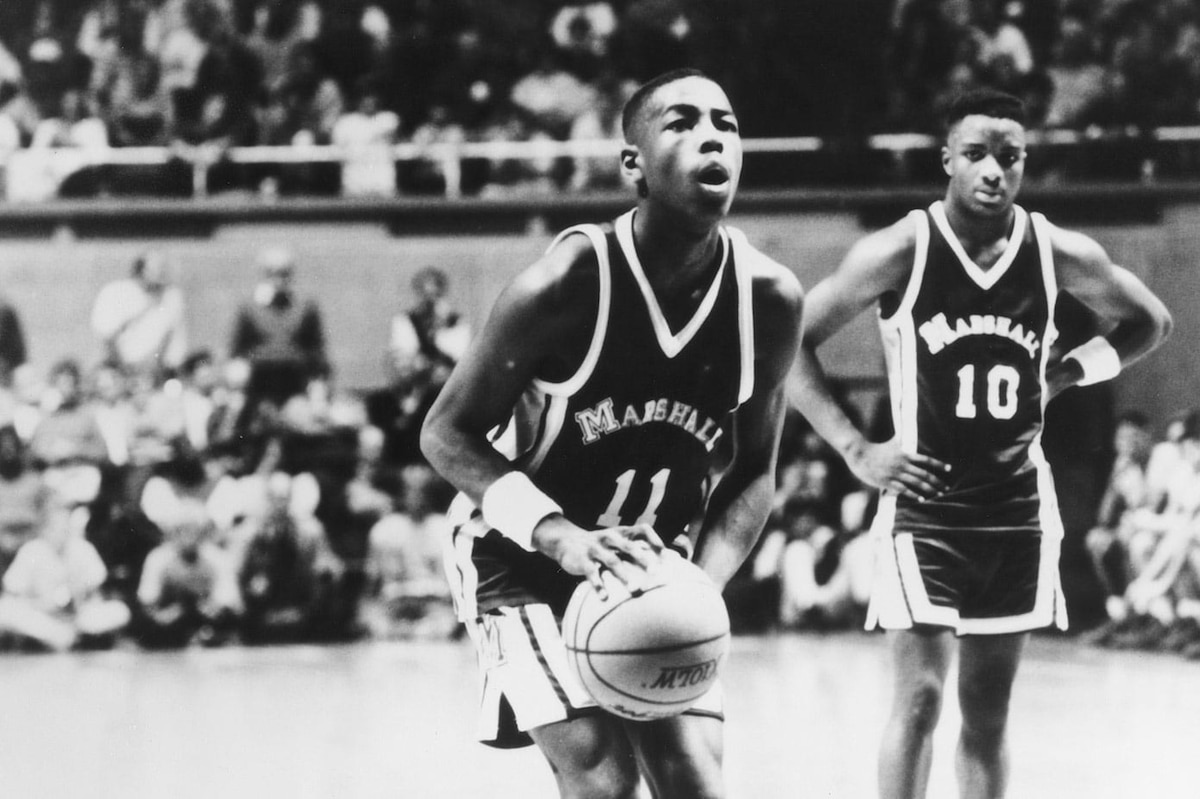
Documentary films have often explored basketball stories, with perhaps the most famous example being Hoop Dreams (1994). The film opens in 1987 and follows the high school basketball and academic careers of William Gates and Arthur Agee, two Black students from Chicago who, at the beginning of the film, are recruited to join St. Joseph High School and its renowned basketball program. Various life complications hit both students as the years go on, and Agee is unable to financially continue at St. Joseph and goes back to public schools. As the two boys go through school, the documentary tracks their dreams of collegiate and professional play. While both, in the years after those covered by the film, would go on to play basketball at universities, neither would make it to the NBA.
The documentary based on their dreams, however, would become one of the most celebrated movies of the 1990s, winning numerous industry honors including the Audience Award at the Sundance Film Festival. It was also added to the National Film Registry by the Library of Congress in 2005.
A different side of sports culture is explored in The Great Santini (1979), in which Robert Duvall plays a domineering war veteran who inflicts his rage through his high school-aged, basketball star son, played by Michael O’Keefe. Whereas Hoop Dreams shows the possibilities that basketball can provide for students, The Great Santini shows how the competitive nature of sports can be abused and mutilated into something ugly and violent. Based on the novel by Pat Conroy, both Duvall and O’Keefe’s performances were praised by critics and earned them Academy Award nominations for Best Actor and Best Supporting Actor, respectively. While the film was well-reviewed, its studio Warner Bros. had little faith in the film, giving it an abbreviated theatrical release, changing its title to The Ace, and ultimately selling the cable rights to HBO and yanking the movie from theaters.
An earlier depiction of basketball can be found in Tall Story (1960), also released by Warner Bros. and often noted for being the film debut of Jane Fonda. In it, she plays the love interest of a star college basketball player, portrayed by Anthony Perkins. She tries all manner of logic to try and get his attention, but it takes a while for the sexually naive Perkins to clue into her interest. There is also a Russian game-fixing plot thrown in, reminding viewers that the movie was made during the height of the Cold War.
Tall Story would be one of the last movies where the up-and-coming Perkins would get to play the love interest, as that same year Psycho (1960) was released and pushed his career into an entirely different direction. Fonda, meanwhile, would see her star rise with additional romantic comedies and dramatic forays throughout the 1960s, before her activist personality would take her into socially conscious fare and two Oscars in the 1970s.
The film’s director, Joshua Logan, was not exactly known for being a sports director, having been at the helm of the melodrama Picnic (1955) and the musical South Pacific (1958). While Logan was married and had two children, Fonda later said in an interview with WIRED that the Tall Story shoot was difficult, because both she and Logan were in love with Perkins.
No matter what tensions might have existed off camera, Tall Story gave viewers yet another entertaining glimpse into basketball, and unlike The Great Santini and Hoop Dreams, this outing made the sport out as something a lot more fluffy.
As the decades have worn on and basketball has gained increased national and international prominence, the sport has been treated with increased respect by the film industry. Tracking the tone of Tall Story to The Great Santini to Hoop Dreams not only shows a variety of ways to look at the sport, it also shows an evolution of that sport’s infusion into American culture.
Basketball movies continue to be popular with audiences and show no signs of slowing output anytime soon. Recent years have seen such hoop entries as The Way Back (2020) and Space Jam: A New Legacy (2021). Surely James Naismith would be proud to see that, some 132 years later, his little basket game is still making an impact.
