This article was originally written about programming for the TCM Now Playing newsletter in January 2023.
3 Movies | January 9th
Hollywood has long looked to true crime stories as fodder for the movies, with results ranging from loose inspirations to meticulous onscreen recreations. Two of the films in TCM’s True Crime tribute, made one decade apart, were grim, hard-hitting titles of their day, each boasting an excellent performance from its lead performer and each still fascinating for the story it brings to the screen—however “loosely inspired” it may be.
Even those who have never seen I Want to Live! (1958) may well be aware of its reputation as a powerful indictment—and depiction—of capital punishment. It was one of the most talked-about movies of 1958, and when Susan Hayward won her first and only Academy Award (after four previous nominations) for her performance as Barbara Graham, its place in film history was cemented.
Graham herself was much talked about in American media from her 1953 arrest to her 1955 death in the gas chamber at San Quentin. She and three male accomplices (two of whom were also executed) were accused of murdering 64-year-old Mabel Monahan during an attempted robbery of Monahan’s Burbank, Calif., home. The case was a sensation, and while legitimate questions were raised about Graham’s guilt, her sordid past strongly twisted public opinion against her. She had been in and out of reform school and prison since age 13, for prostitution, forgery, perjury and drug possession, and had long associations with crooks, con artists and lowlifes.
Graham claimed to have been home with her husband during the murder, but her husband vanished, never to be seen again, and could not confirm her alibi. In prison, Graham was entrapped by an undercover officer who got her to agree to a fabricated alibi and to say, on a recording, that she had been in the Monahan house the night of the murder. All this destroyed her credibility at trial. The press had a field day with the case, with San Francisco Chronicle reporter Ed Montgomery christening Graham “Bloody Babs.” Following her conviction, however, Montgomery found discrepancies in the testimony and case facts which changed his tune. He became convinced of Graham’s innocence, writing articles to try and change public opinion. His crusade, as well as a psychiatrist’s judgment that Graham was incapable of murder, succeeded only in the granting of three stays of execution by the state governor, including one as Graham was about to enter the gas chamber.
A year or so later, Montgomery published a book of his articles, including those about the Graham case, that caught the eye of producer Walter Wanger. Wanger had a personal interest in exposing the inadequacies of the American criminal justice system, stemming from his own four-month incarceration in 1952 for having shot his wife Joan Bennett’s lover (and agent), Jennings Lang. Upon his release, Wanger produced an acclaimed and hard-hitting prison expose, Riot in Cell Block 11 (1954), and now, with Montgomery’s book, he saw a vehicle to make a searing statement against capital punishment.
He also saw a perfect vehicle for his old friend Susan Hayward. The actress had recently moved to Georgia with her new husband and was semi-retired. It didn’t take much coaxing by Wanger, however, to get her back; in fact, she agreed to do the film before there was even a finished script or a committed director. This was highly unusual but showed how much she respected Wanger, who had had her under contract a decade earlier and produced her films Smash-Up: Story of a Woman (1947) and Tulsa (1949). Hayward felt she owed much of her career success to Wanger, once telling him, “I’ll work for you anytime, in anything.”
Like Graham and even Wanger, Hayward had personal experience dealing with unflattering press coverage of her private life, over a few messy years that had included an overdose, suicide attempt, divorce and custody battle. She later said of Graham (whom she also happened to resemble physically), “I was fascinated by the contradictory traits of personality in this strangely controversial woman who had had an extraordinary effect on everyone she met. She was first a juvenile, then an adult delinquent... But somewhere along the line she was a good wife and mother. I read her letters, sometimes literate, often profound. She loved poetry and music, both jazz and classical. None of this seemed to square with the picture drawn of her at the time of the trial. I studied the final transcript. I became so fascinated by the woman I simply had to play her.”
The film was made for Figaro, a production company that Joseph L. Mankiewicz had created under United Artists. To direct, Wanger hired Robert Wise, who was attracted to the chance to hone his documentary-like visual techniques. Shortly before production, Wanger suffered a heart attack; he survived, but Wise became the de facto producer as well.
While the movie draws audience sympathy for Barbara Graham, it does not explicitly claim she was innocent. Like Wanger, Wise was much more interested in filming a straightforward, realistic presentation of death row. He asked prison officials to show him every detail and routine leading up to and including execution. “Then,” Wise recalled, “I saw an execution. I felt like a ghoul, asking to see it, but I felt that if I was going to deal with this matter of capital punishment, I wanted to be able to say...that this is the way it is. I didn’t want the reviewers to say, ‘Well, that’s a Hollywood version of what goes in the death cell and the gas chamber.’
“The thing we were trying to say was very well expressed in the papers the day after her execution... that no matter whether a person is innocent or guilty, nobody should ever have to go through the kind of torture that Barbara Graham went through, and that we should arrange our laws to protect anybody from that.”
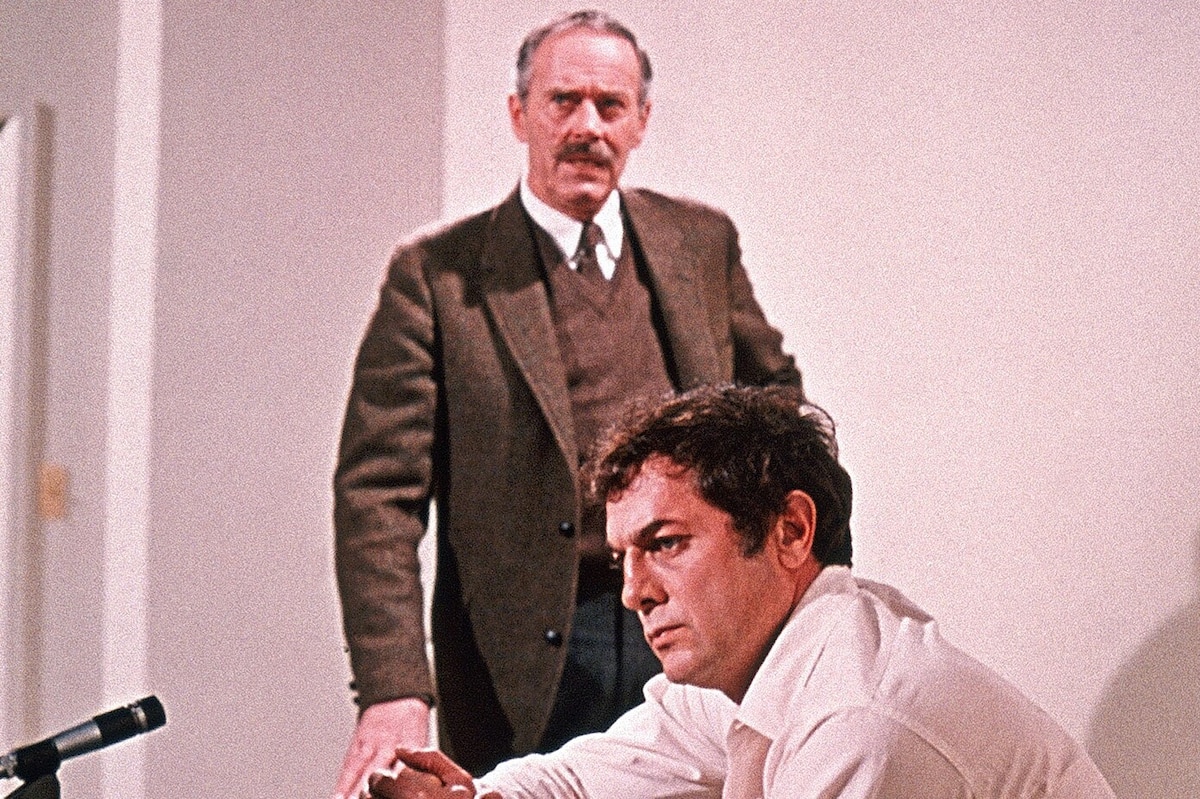
Ten years later, Fox released The Boston Strangler (1968), another film based on real events but even more fictionalized. From 1962 to 1964, 13 women in the Boston area had been strangled to death, in most cases after being sexually assaulted. The killer, Albert DeSalvo, was ultimately arrested, convicted and sent to prison for life, though he was killed by a fellow inmate in 1973. The film concentrates first on the manhunt for the killer, led by an assistant attorney general played by Henry Fonda, and then on the realization of DeSalvo’s severe mental illness (which was not necessarily the case in reality).
Director Richard Fleischer was keen to give the film a documentary-like feel, even with heavy use of a split-screen technique that had been popularized a few months earlier in The Thomas Crown Affair (1968). But Fleischer’s most notable brainstorm was to cast the unlikely Tony Curtis as DeSalvo. Curtis badly wanted the part. As he later wrote, “I wasn’t happy with my recent pictures. My career was losing momentum. I needed a new challenge. I needed a new kind of movie. The Boston Strangler was it... Up to that point I had mostly played the romantic love interest, but I knew there was no reason I couldn’t play a psychopath.”
Producer Richard Zanuck, however, did not want Curtis, arguing that the actor had such a distinctive look and voice that audiences would never believe him to disappear into such a serious role. “Everyone’s going to know he’s Tony Curtis,” Zanuck said. So Fleischer asked Curtis to create a more sinister look for himself. As Curtis recounted, “I got some putty and worked it into the bridge of my nose, so it looked broken. I mussed up my hair and put dark makeup around my eyes. Then, holding a camera at arm’s length..., I took photos of myself as though I was being booked in a police station: profile and front-facing.” When Zanuck saw the photos, he didn’t recognize them as being of Curtis, and when he realized the truth, he relented.
To prepare for his transformation, Curtis gained 15 pounds, used brown contact lenses, and wore ankle weights to change his stride as well as army boots two sizes too big. When he looked at himself in the mirror, “it was the most eerie experience I’ve ever had. I wasn’t there anymore. I was nowhere in sight. Instead that brooding, suspicious, uneasy image of a man was looking back at me.”
During production, he later wrote, his relationship with his second wife Christine was becoming strained, with “terrible fights. Some nights I stayed on location because I couldn’t bear to go home and face her... I suppose my problems with Christine helped me in one sense, because I was able to take my rage and express it through the character of Albert DeSalvo... I had to find a level of playing it that was very introverted and cerebral, inside my head. That performance is very interior.” (Soon after the film’s completion, the couple divorced.)
The result onscreen was hugely impressive. As Variety declared in its review: “A triumph of taste and restraint. The Boston Strangler stands as Tony Curtis’s finest hour as a dramatic actor.”
